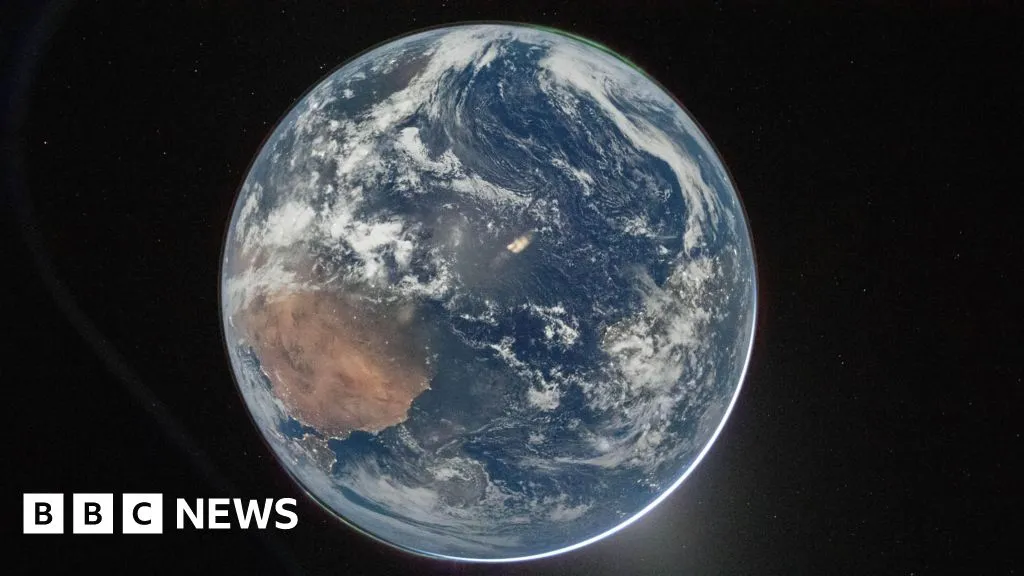
17 hours agoRebecca Morelle,Science Editor,Alison FrancisandKevin Church,Johnson Space CenterNasa/Reid WisemanEarth as seen from the Orion capsule in a new image taken last weekNo-one will have been further from home than the Artemis astronauts.But as the Earth shrinks ever smaller in their rear-view mirror, they've had a constant connection with mission control in Houston, Texas. The calm words from the Nasa team have given the crew a comforting link with home.That link is about to be lost.As the astronauts pass behind the Moon at about 23:47 BST (18:47 EDT) on Monday, the radio and laser signals that allow the back-and-forth communication between the spacecraft and Earth will be blocked by the Moon itself.For about 40 minutes, the four astronauts will be alone, each with their own thoughts and feelings, travelling through the darkness of space. A profound moment of solitude and silence.'Spectacular!' - Rebecca Morelle reacts to the launchArtemis pilot Victor Glover told us he hopes the world will use the time to come together."When we're behind the Moon, out of contact with everybody, let's take that as an opportunity," he told BBC News before the mission. "Let's pray, hope, send your good thoughts and feelings that we get back in contact with the crew."More than 50 years ago, the Apollo astronauts also experienced the isolation brought by a loss of signal during their missions to the Moon.Perhaps none more so than Apollo 11's Michael Collins.NASAAstronaut Michael Collins said he felt "truly alone" on the far side of the MoonIn 1969, while Neil Armstrong and Buzz Aldrin made history taking the first steps on the lunar surface, Collins was alone in the command module, orbiting the Moon.As his craft passed behind the far side, contact with the pair on the lunar surface, as well as with mission control, vanished for 48 minutes.He described the experience in his 1974 memoir Carrying the Fire, saying he felt "truly alone" and "isolated from any known life", but that he did not feel fear or loneliness.In later interviews, he described the peace and tranquillity brought by the radio silence, saying it offered a break from the constant requests from mission control.More on Artemis IIFirst stop, the Moon. Next stop, Mars? Why Nasa's mission mattersEverything you need to know about Nasa's Artemis II missionWho are the crew - and what are they taking to the Moon?Artemis II: Inside the Moon mission to fly humans further than everThe spectacular new image of Earth taken by the crewBack on Earth, the blackout will be a tense time for those with the job of maintaining contact with the spacecraft.At the Goonhilly Earth Station in Cornwall, in the south-west of England, a huge antenna has been collecting signals from the Orion capsule, carefully pinpointing its position throughout its journey, and feeding this information back to Nasa HQ.Matt Cosby, Goonhilly's chief technology officer, told the BBC: "This is the first time we're tracking a spacecraft with humans on it."We're going to get slightly nervous as it goes behind the Moon, and then we'll be very excited when we see it again, because we know that they're all safe."But the hope is these dropouts in communications could soon become a thing of the past. And Cosby says that will be essential as Nasa – and other space agencies around the world – begin to build a Moon base and ramp up further exploration."For a sustainable presence on the Moon, you need the full comms - you need the full 24 hours a day, even on the far side, because the far side will want to be explored as well," he said.Programmes like the European Space Agency's Moonlight are planning to launch a network of satellites around the Moon to provide continuous and reliable communication coverage in the future.For the Artemis astronauts, their time without contact with the Earth will allow them to devote all of their attention to the Moon.They'll spend the blackout dedicated to lunar observation – taking images, studying the Moon's geology and simply gazing at its splendour.When they emerge from the Moon's shadow, and that signal is re-established, the world will breathe a collective sigh of relief.And the history-making astronauts will be able to share their incredible views with everyone back home.Why isn't Artemis II landing on the Moon?
SRCBBC News - World
LANGEN
LEANCenter
WORDS710
ENT10
SUN · 2026-04-05 · 23:02 GMTBRIEF NSR-2026-0406-54950
NSR-2026-0406-54950News Report·EN·Technology
The 40 minutes when the Artemis crew loses contact with the Earth
During the Artemis II mission, the crew will experience a 40-minute period of radio silence when their spacecraft passes behind the Moon at approximately 23:47 BST on Monday. This loss of communication with mission control in Houston is due to the Moon blocking radio and laser signals.
BBC News - WorldFiled 2026-04-05 · 23:02 GMTLean · CenterRead · 3 min
BBC News - WorldFIG 01
Reading time
3min
Word count
710words
Sources cited
3cited
Entities identified
10entities
Quality score
100%
§ 01
Briefing Summary
AI-generatedNEWSAR · AI
During the Artemis II mission, the crew will experience a 40-minute period of radio silence when their spacecraft passes behind the Moon at approximately 23:47 BST on Monday. This loss of communication with mission control in Houston is due to the Moon blocking radio and laser signals. The astronauts will be completely isolated, similar to what Apollo astronauts, including Michael Collins, experienced during lunar missions. Victor Glover, the Artemis pilot, hopes people will use this time to send positive thoughts to the crew. This period of isolation offers a moment of solitude for the astronauts as they travel through space.
Confidence 0.90Sources 3Claims 4Entities 10
§ 02
Article analysis
Model · rule-basedFraming
Technology
Human Interest
Tone
Measured
AI-assessed
CalmNeutralAlarmist
Factuality
0.80 / 1.00
Factual
LowHigh
Sources cited
3
Well sourced
FewMany
§ 03
Key claims
4 extracted01
Goonhilly Earth Station is tracking the Orion capsule and feeding information back to Nasa HQ.
factualMatt Cosby, Goonhilly's chief technology officer
Confidence
1.00
02
Apollo 11's Michael Collins experienced a 48-minute loss of signal while orbiting the Moon.
factualNASAAstronaut Michael Collins
Confidence
1.00
03
Artemis pilot Victor Glover hopes the world will use the time of lost contact to send good thoughts to the crew.
quoteVictor Glover
Confidence
1.00
04
The Artemis astronauts will lose contact with Earth for about 40 minutes as they pass behind the Moon.
factualRebecca Morelle, Alison Francis, Kevin Church
Confidence
1.00
§ 04
Full report
3 min read · 710 words§ 05
Entities
10 identifiedKey playerOppositionContextPositiveNeutralNegative
People5
§ 06
Keywords & salience
9 termsmoon
0.90
artemis ii
0.90
loss of communication
0.80
space mission
0.70
astronauts
0.70
nasa
0.60
radio silence
0.60
apollo missions
0.60
michael collins
0.50
§ 07
Topic connections
Interactive graph No topic relationship data available yet. This graph will appear once topic relationships have been computed.