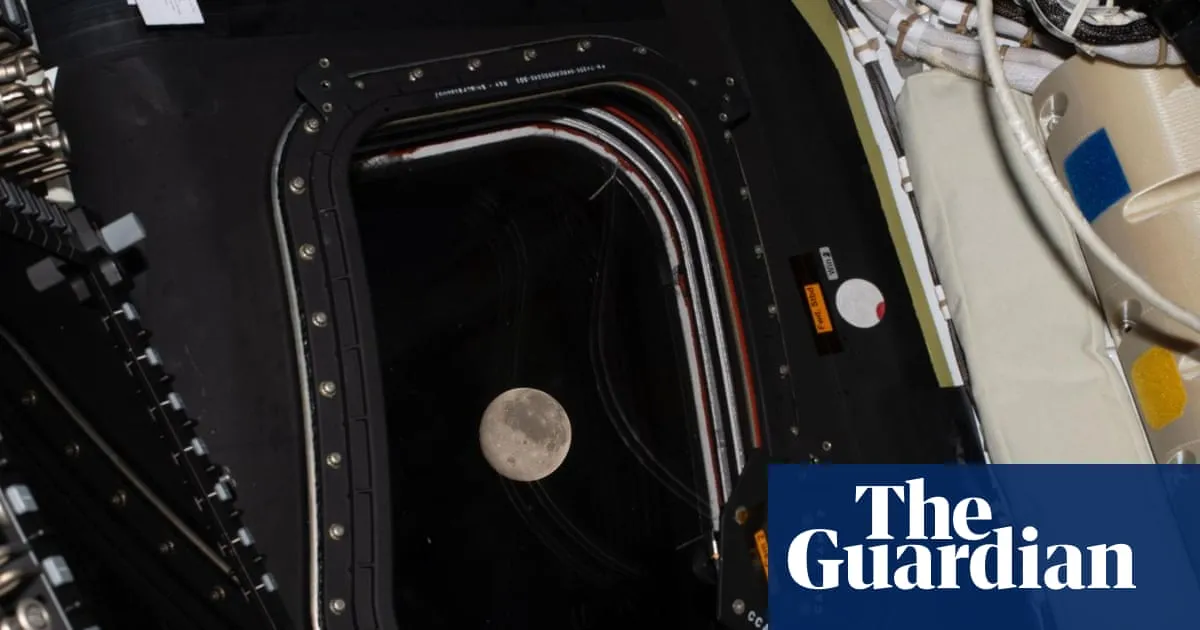
The four astronauts on Nasa’s Artemis II mission are poised to begin the first flyby of the far side of the Moon in more than half a century, bringing them to the furthest point from Earth ever reached by humans.The crew of three Americans and one Canadian earlier entered the Moon’s “sphere of influence”, where its gravity has a stronger pull on the spacecraft than Earth’s.Kelsey Young, the lead scientist for the Artemis II mission, said she expected thousands of pictures from the lunar loop, whose timing means the crew will be able to take in a total solar eclipse from their vantage point behind the Moon.“People all over the world connect with the Moon. This is something that every single person on this planet can understand and connect with,” said Young, wearing eclipse earrings.The six-hour flyby is the climax of the mission, which began last Wednesday. The team are on course to beat the record of most distant humans in history, currently held by the Apollo-13" class="entity-link entity-event" data-entity-id="34403" data-entity-type="event">Apollo 13 astronauts, who in April 1970 travelled 248,655 miles (400,171km) from Earth.Nasa’s Apollo flights of the 1960s and 70s flew about 70 miles above the lunar surface, but the Artemis crew will be just over 4,000 miles above at their closest approach, allowing them to see the complete, spherical surface of the Moon, including regions near both poles.Known as a free-return lunar trajectory, the no-stopping-to-land route takes advantage of Earth’s and the Moon’s gravity, reducing the need for fuel. It’s a figure-of-eight that will put the astronauts on course for home, once they emerge from behind the Moon late on Monday.The crew will observe the Moon with their naked eyes along with cameras they have onboard. The journey promises views of the Moon’s far side that were too dark or too difficult to see by the 24 Apollo astronauts who preceded them.When the Orion spacecraft passes behind the Moon, the mission will enter a planned communications blackout of about 40 minutes as the lunar surface blocks the radio signals needed for the Deep Space Network to connect with the spacecraft.“I think it’s important to remember that we don’t always know exactly what they’re going to see,” Young told a press conference on Sunday.'You look beautiful': Artemis II crew makes contact from space – videoThe astronauts have already taken in sights of the lunar surface never before seen by human eyes. In the early hours of Sunday, the US space agency published an image taken by the crew showing a distant Moon with the Orientale basin (sometimes known as the Moon’s “Grand Canyon”) visible.“This mission marks the first time the entire basin has been seen with human eyes,” Nasa said. The huge crater, which resembles a bullseye, has been photographed before by orbiting cameras.Charlie Duke, who walked on the Moon in 1972 as part of the Apollo 16 mission, gave the ceremonial wake-up call to the crew on day five on the Orion. “Below you on the Moon is a photo of my family. I pray it reminds you that we in America and all of the world are cheering you on,” said the 90-year-old. “Thanks to you and the whole team on the ground for building on our Apollo legacy with Artemis.”Nasa said the Artemis crew had completed a manual piloting demonstration and reviewed their lunar flyby plan, including checking the surface features they must analyse and photograph during their time circling the Moon.At the same time, Nasa’s chief, Jared Isaacman, told CNN: “We’re focusing very much on the ecosystem, the life support system of the spacecraft. This is the first time astronauts have ever flown on this spacecraft before. That’s what we’re most interested in getting data from.”On day five, the astronauts were testing their “survival” suits, according to Nasa. The bright orange suits are worn during takeoff and re-entry but also in emergency situations such as cabin depressurisation.The information will be “paramount to set up for subsequent missions like Artemis III in 2027 and, of course, the lunar landing itself on Artemis IV in 2028”, Isaacman said.The multibillion-dollar series of missions aims to return astronauts to the Moon’s surface by 2028, before China, and establish a long-term US presence there over the next decade, building a lunar base that would serve as a proving ground for potential future missions to Mars.It will take the Artemis II team four days to get back, with a splashdown in the Pacific concluding their test flight on Friday.With Associated Press, Reuters and Agence France-Presse.
SRCThe Guardian - World News
LANGEN
LEANCenter-Left
WORDS749
ENT10
MON · 2026-04-06 · 15:38 GMTBRIEF NSR-2026-0406-54963
NSR-2026-0406-54963News Report·EN·Technology
Artemis II crew enters moon’s gravitational grip ahead of historic flyby
The Artemis II mission, carrying four astronauts, is commencing a flyby of the moon's far side, setting them on course to become the furthest humans from Earth. The crew has entered the moon's sphere of influence, where its gravity supersedes Earth's.
Deborah Cole and agenciesThe Guardian - World NewsFiled 2026-04-06 · 15:38 GMTLean · Center-LeftRead · 3 min
The Guardian - World NewsFIG 01
Reading time
3min
Word count
749words
Sources cited
2cited
Entities identified
10entities
Quality score
100%
§ 01
Briefing Summary
AI-generatedNEWSAR · AI
The Artemis II mission, carrying four astronauts, is commencing a flyby of the moon's far side, setting them on course to become the furthest humans from Earth. The crew has entered the moon's sphere of influence, where its gravity supersedes Earth's. This six-hour flyby is the mission's climax, aiming to surpass the Apollo 13 record for distance from Earth. Unlike the Apollo missions, Artemis II will orbit at a higher altitude, allowing observation of the entire lunar surface, including the poles. The free-return trajectory utilizes Earth and moon gravity to conserve fuel, guiding the spacecraft back home after passing behind the moon, during which a communications blackout is expected. The astronauts will visually observe and photograph the lunar surface, capturing views previously unseen by humans.
Confidence 0.90Sources 2Claims 5Entities 10
§ 02
Article analysis
Model · rule-basedFraming
Technology
Human Interest
Tone
Measured
AI-assessed
CalmNeutralAlarmist
Factuality
0.80 / 1.00
Factual
LowHigh
Sources cited
2
Limited
FewMany
§ 03
Key claims
5 extracted01
This mission marks the first time the entire Orientale basin has been seen with human eyes.
factualNasa
Confidence
1.00
02
The Artemis crew will be just over 4,000 miles above at their closest approach.
factual
Confidence
1.00
03
The team are on course to beat the record of most distant humans in history, currently held by the Apollo 13 astronauts.
factual
Confidence
1.00
04
The crew earlier entered the moon’s “sphere of influence”, where its gravity has a stronger pull on the spacecraft than Earth’s.
factual
Confidence
1.00
05
The Artemis II mission is poised to begin the first flyby of the far side of the moon in more than half a century.
factual
Confidence
1.00
§ 04
Full report
3 min read · 749 words§ 05
Entities
10 identifiedKey playerOppositionContextPositiveNeutralNegative
Organizations2
Locations4
§ 06
Keywords & salience
10 termsartemis ii
1.00
moon flyby
0.90
far side of the moon
0.80
lunar surface
0.70
astronauts
0.70
nasa
0.60
gravity
0.60
spacecraft
0.60
total solar eclipse
0.50
apollo 13
0.50
§ 07
Topic connections
Interactive graph Network visualization showing 26 related topics
View Full Graph Person Organization Location Event|Click node to navigate|Edge numbers = shared articles