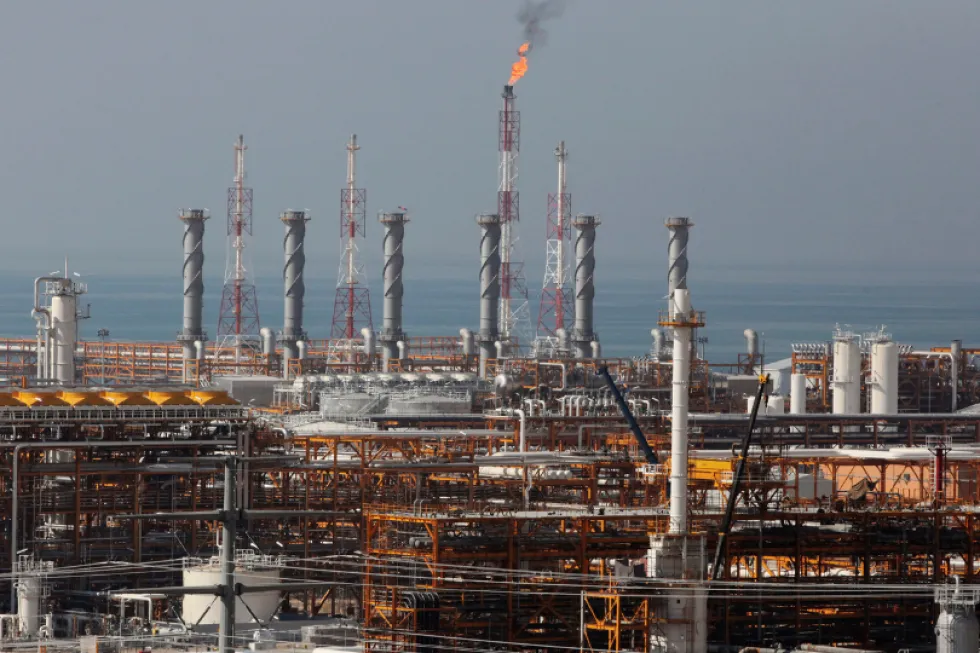
Katz says Israel has attacked Iran’s South Pars gas field Updated [hour]:[minute] [AMPM] [timezone], [monthFull] [day], [year] FRANKFURT, Germany (AP) — For the second time, Israel has attacked Iran’s South Pars natural gas and its associated petrochemical complex - an energy lifeline for Iran that both helps keep the lights on for civilians and provides a key source of export earnings.Israel’s Defense Minister Israel-katz" class="entity-link entity-person" data-entity-id="4249" data-entity-type="person">Israel Katz said Monday that Israel attacked a key petrochemical plant at Asaluyeh, the onshore industrial aspect of the gas field, which lies under the Persian Gulf. Katz said the “powerful strike” hit what he called “the largest petrochemical facility in Iran ... responsible for about 50% of the country’s petrochemical production.” Combined with an earlier attack, two facilities responsible for 85% of Iran’s petrochemical exports have been taken out of service, he said. Attacks on South Pars are sufficiently provocative to Iran that an earlier Israeli attack on March 18 prompted Iran to target energy infrastructure in other Middle East countries in response, an escalation of the war that sent new shockwaves across the region and beyond. After the March attack, U.S. President Donald Trump said that Israel would not attack South Pars again, but warned on social media that if Iran continued attacking key energy infrastructure in Qatar, the United States would retaliate and “massively blow up the entirety” of the field.Here are things to know about the South Pars natural gas field and its associated industries making chemicals using gas as a raw material: Iran’s share of the world’s largest gas field provides both domestic energy and export earnings. South Pars is Iran’s biggest source of domestic energy in a country that sometimes struggles to produce enough electricity. The gas field under the Persian Gulf — the world’s largest — is shared by Iran and Qatar. It’s called South Pars on the Iranian side and the North Field on the Qatari side. Iran relies heavily on gas to produce electricity and heat homes. It is the fourth-largest consumer of natural gas in the world, behind the U.S., China and Russia, according to the Center on Global Energy Policy at Columbia University, even though its economy is much smaller. In contrast to other Middle East countries, it uses gas for heating due to its cold climate and much of that use is subsidized, which discourages efficient use. Abundant, affordable gas from South Pars fuels industries making chemicals for exportWhile the South Pars gas is important at home, the petrochemical plant is a source of export earnings. The gas is used to make basic chemical building blocks like ethylene, propylene, methanol, ammonia and urea used to make other products such as plastic pipe, packaging, clothing, household products or fertilizer. Among the largest importers are Turkey, China, India and Southeast Asian countries, according to Iranian mining and petrochemical export company Irminex. Iran’s petrochemical industry gets a competitive advantage from low raw material costs due to its access to South Pars gas.Israeli Prime Minister Benjamin Netanyahu says those earnings benefitted Iran’s paramilitary Islamic Revolutionary Guards Corps. “Today we destroyed the largest petrochemical plant in Iran,” Netanyahu said. “In other words, we are systematically destroying the money machine of the Revolutionary Guards.” Iran has struggled with rickety energy infrastructure and shortagesIran has suffered power shortages because of interruptions to gas supplies, even though on paper it has huge energy reserves. In July, public buildings had to shut down when a heat wave strained the power grid.So an attack on South Pars could potentially target both civilian welfare and export earnings. Qatar and Iran have made starkly different uses of the same underground reservesQatar, with only 3 million people, has invested billions in developing the field as a source of liquefied natural gas, which before the war it exported from its Ras Laffan facility. It’s a lucrative business and made Qatar the supplier of about a fifth of the world’s LNG before the war forced it to shut down Ras Laffan. Iran, with 93 million people, is another story. Sanctions and lack of investment have blocked the development of LNG export terminals. Instead, Iran feeds its gas into its own pipeline system and uses it domestically for cooking, heating homes, generating electricity, and as a raw material for industry. Iran exports relatively little, about 9 billion cubic meters, compared to Qatar’s more than 120 billion cubic meters. So the South Pars petrochemical industries are one way Iran can get export earnings from its massive gas reserves. Iran once planned three LNG export projects on its Persian Gulf coastline, one with Total Energies and another with Shell. But sanctions over its nuclear program have blocked the projects by barring the import of the needed technology and investment. A third site at Asulayeh is reportedly near completion after starting construction almost 20 years ago.
SRCAssociated Press (AP)
LANGEN
LEANCenter
WORDS802
ENT10
MON · 2026-04-06 · 16:53 GMTBRIEF NSR-2026-0406-55082
NSR-2026-0406-55082News Report·EN·Conflict
The South Pars natural gas complex is an energy lifeline for Iran
Israeli Defense Minister Israel Katz announced that Israel attacked the South Pars natural gas complex in Asaluyeh, Iran, a critical energy source for the country. The complex is responsible for approximately 50% of Iran's petrochemical production.
By
DAVID MCHUGHAssociated Press (AP)Filed 2026-04-06 · 16:53 GMTLean · CenterRead · 4 min
Associated Press (AP)FIG 01
Reading time
4min
Word count
802words
Sources cited
3cited
Entities identified
10entities
Quality score
100%
§ 01
Briefing Summary
AI-generatedNEWSAR · AI
Israeli Defense Minister Israel Katz announced that Israel attacked the South Pars natural gas complex in Asaluyeh, Iran, a critical energy source for the country. The complex is responsible for approximately 50% of Iran's petrochemical production. This marks the second Israeli attack on South Pars, with Katz claiming that combined, the attacks have disabled facilities responsible for 85% of Iran's petrochemical exports. The South Pars field is Iran's largest source of domestic energy and export revenue, providing gas for electricity, heating, and chemical industries. A previous attack on South Pars in March prompted Iran to retaliate by targeting energy infrastructure in other Middle Eastern countries. The South Pars field is shared between Iran and Qatar, known as the North Field on the Qatari side.
Confidence 0.90Sources 3Claims 5Entities 10
§ 02
Article analysis
Model · rule-basedFraming
Conflict
Economic Impact
Tone
Mixed Tone
AI-assessed
CalmNeutralAlarmist
Factuality
0.80 / 1.00
Factual
LowHigh
Sources cited
3
Well sourced
FewMany
§ 03
Key claims
5 extracted01
Iran is the fourth-largest consumer of natural gas in the world.
statisticCenter on Global Energy Policy at Columbia University
Confidence
1.00
02
Israel attacked a key petrochemical plant at Asaluyeh.
factualIsrael Katz
Confidence
1.00
03
Israel attacked Iran’s South Pars natural gas and its associated petrochemical complex.
factualAP
Confidence
1.00
04
Attacks on South Pars are sufficiently provocative to Iran that an earlier Israeli attack on March 18 prompted Iran to target energy infrastructure.
factualAP
Confidence
0.90
05
The strike hit the largest petrochemical facility in Iran, responsible for about 50% of the country’s petrochemical production.
factualIsrael Katz
Confidence
0.90
§ 04
Full report
4 min read · 802 words§ 05
Entities
10 identifiedKey playerOppositionContextPositiveNeutralNegative
§ 06
Keywords & salience
10 termssouth pars
1.00
natural gas
0.90
iran
0.80
petrochemical complex
0.70
energy infrastructure
0.70
attacks
0.60
israel
0.60
energy lifeline
0.50
persian gulf
0.40
export earnings
0.40
§ 07
Topic connections
Interactive graph No topic relationship data available yet. This graph will appear once topic relationships have been computed.