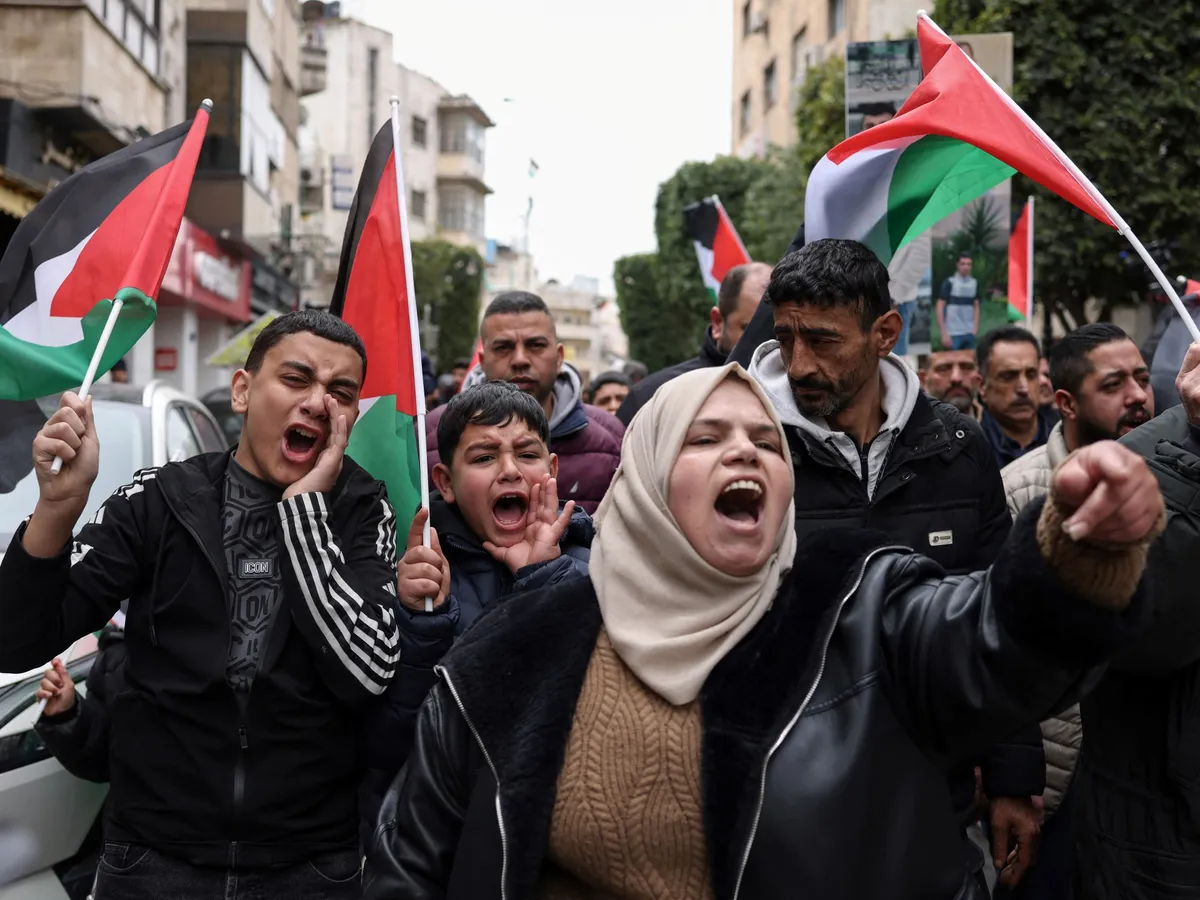
Meanwhile, Israeli strikes on Gaza escalate, with children among the injured and civilians killed in densely populated areas.Palestinian demonstrators shout slogans as they march in Ramallah in the occupied West Bank on April 1, 2026, during a protest against the Israeli parliament's approval of a new death penalty bill for Palestinians convicted of deadly attacks [File: Zain Jaafar/AFP]Published On 7 Apr 2026The Israeli Knesset’s passage last week of a law imposing the death penalty on Palestinians convicted of “terrorism” drew swift and sweeping international condemnation. It also sparked a general strike across the occupied West Bank and East Jerusalem, with Palestinians taking to the streets in Ramallah, Nablus, Hebron and elsewhere on April 1 to protest the measure.Some local shop owners in the occupied East Jerusalem area reported that Israeli forces had coerced them into reopening.Recommended Stories list of 3 itemslist 1 of 3‘Refuse to celebrate’: Christians in Gaza mark sombre Easter amid genocidelist 2 of 3Jobless young Palestinians trapped as Israel holds Gaza’s economy hostagelist 3 of 3Israeli army fire on WHO vehicle in southern Gaza kills one, medics reportend of listA coalition of eight countries, including Saudi Arabia, Egypt, Jordan and Turkiye, condemned the law as “discriminatory” and warned that it entrenches a system of apartheid. The European Union called it “a step backwards”. At the same time, United Nations Human Rights Commissioner Volker Turk went further, warning that its application to residents of the occupied Palestinian territory “would constitute a war crime”.Demonstrations broke out not only across Palestinian cities, but also in Syria, including the cities of Damascus, Hama and Deraa.The week’s political tensions unfolded against the backdrop of an ongoing siege on Jerusalem’s holy sites. Al-Aqsa Mosque has remained closed to Muslim worshippers for more than a month, with a state of emergency extended until mid-April.Palestinians in Jerusalem have been holding Friday prayers in the streets surrounding the Old City as Israeli authorities continue to ban access to Al-Aqsa, contravening the sovereignty of the Islamic Waqf over the site under the custodianship of King Abdullah II of Jordan.Israel has continued to display its de facto ultimate authority over the site. On Monday evening, Israeli National Security Minister Itamar Ben-Gvir stormed the compound under the protection of Israeli forces.Restrictions also continued at Christian sites, as Western Christian denominations commemorated Holy Week. The Church of the Holy Sepulchre, the holiest site in Christianity, remained closed to the public throughout Holy Week.Gaza peace plan reaches impasseIn Gaza, the past week brought further evidence that the Board of Peace’s framework for reconstruction and governance transition remains far from implementation. According to the Reuters news agency, a Hamas delegation informed Egyptian, Qatari, and Turkish mediators in Cairo that the movement would not discuss disarmament until Israel ceased its violations of the ceasefire agreement and committed to a full withdrawal from Gaza.“We will under no circumstances accept the surrender of weapons. We affirm that what the enemy could not seize from us through tanks and extermination, it will not take from us through politics or at the negotiation table,” the spokesperson for Hamas’s Qassam Brigades said, in a statement, released on Sunday.Meanwhile, funding pledges for Gaza’s reconstruction from Gulf Arab states have been frozen as a result of the US-Israel war on Iran.With the implementation of phase 2 of the October peace plan for Gaza appearing as remote as ever, Israeli air strikes ramped up across the Strip throughout the past week, according to documented reports published on the Telegram messaging app.On March 31, strikes killed at least six people across Gaza, including three in Jabalia, and a father and son in Khan Younis. On April 3, a drone attack injured six civilians near the Abu Shurakh roundabout in northern Gaza. On April 4, a strike hit a vehicle near the Maghazi camp, killing one person and injuring several others. Israeli forces also struck a police checkpoint in northern Gaza City and continued artillery shelling across multiple areas.And in the days since Qassam’s defiant statements, the civilian casualties in Gaza have quickly shot up. Early in the morning on April 5, three Palestinians were killed, while others were injured, in an air strike carried out by Israeli forces on al-Shawa Square, east of Gaza City.Later that day, others were injured by Israeli military gunfire in the Mawasi area of Khan Younis, including a small child, who received a bloody head injury. A Palestinian man was then reportedly shot dead by Israeli soldiers while inspecting his home east of Gaza, followed by a military strike on a group of civilians near the Al-Jazeera Club in central Gaza City, killing one person and injuring others.In all, Gaza’s Ministry of Health reported early on Monday morning that seven people had been killed and another 17 injured during the previous 24 hours.Israeli forces reportedly shot dead another man east of al-Qarara on the morning of April 6. At least two Palestinians were killed in an air strike targeting an electric bicycle in Sheikh Radwan, leaving others, including a small girl, critically wounded, later in the afternoon. And then, in the early evening, Israeli forces and affiliated armed groups unleashed heavy gunfire in central Gaza’s Maghazi camp, killing at least 10 people and leaving dozens injured, according to local reports.Not including the many casualties on April 6, since the October 11 “ceasefire”, at least 723 Palestinians in Gaza have been killed and 1,990 injured, according to Gaza’s Health Ministry. Approximately 100 Palestinians in Gaza have been killed since the US and Israel launched their war on Iran. In addition, a citizen died as a result of a building collapse, bringing the number of people in Gaza killed by building collapses to 29, according to the ministry.Meanwhile, the humanitarian situation continued to deteriorate sharply as the entry of aid into the devastated Strip remains severely restricted by Israel. The Gaza Ministry of Health issued an urgent warning on April 2 that the complete unavailability of fuel in the local market poses “a genuine threat of death to hundreds of patients” in intensive care and those relying on neonatal incubators and dialysis units, while risking the spoilage of childhood vaccines and blood bank supplies. Long queues were photographed outside a single bread distribution point on al-Wehda Street in Gaza City.The Gaza Center for Human Rights warned this week that approximately 71,000 tonnes of unexploded ordnance remain buried across the Strip, with seven people, including five children, already killed by unexploded munitions. More than 1 million people remain living in tents or in the open, with the Health Ministry warning of rising rodent populations and the risk of disease outbreaks, including plague and hantavirus.Settler attacks and military raids continue across the West BankWhile this week saw a slight drop in the feverish intensity of settler attacks in the occupied West Bank that began with the launch of the US-Israel war on Iran on February 28, the daily occurrences of settler violence, military raids and movement restrictions continued nonetheless.The most serious attack took place on April 4, when more than 40 settlers – some armed, some on government-supplied Ranger ATVs – raided the villages of Jalud and Qusra, south of Nablus, attacking homes and residents. According to locals, when residents attempted to defend themselves, settlers opened fire.Locals say Israeli soldiers reinforced the settlers rather than stopping them. Settlers then burned a farm and attacked firefighters who rushed to extinguish the blaze, severely beating one worker, Zahran Shanablah, 32, until he lost consciousness. The attack originated from the Jabel Ein Eina outpost – the same outpost from which settlers descended on Qusra on March 14 to kill a resident. The day before, settlers had cut off electricity to the village’s Ras al-Ein area and arrived with clubs when residents went to repair the grid.
SRCAl Jazeera
LANGEN
LEANCenter
WORDS1 292
ENT12
TUE · 2026-04-07 · 10:54 GMTBRIEF NSR-2026-0407-56232
NSR-2026-0407-56232News Report·EN·Human Rights
Palestine weekly wrap: Protests sweep West Bank after death penalty law
Following the Israeli Knesset's passage of a law imposing the death penalty on Palestinians convicted of "terrorism," widespread protests erupted across the West Bank and East Jerusalem on April 1, 2026. The law, condemned internationally as discriminatory and a potential war crime, sparked a general strike and demonstrations in cities like Ramallah, Nablus, and Hebron.
Al Jazeera StaffAl JazeeraFiled 2026-04-07 · 10:54 GMTLean · CenterRead · 6 min
Al JazeeraFIG 01
Reading time
6min
Word count
1 292words
Sources cited
2cited
Entities identified
12entities
Quality score
100%
§ 01
Briefing Summary
AI-generatedNEWSAR · AI
Following the Israeli Knesset's passage of a law imposing the death penalty on Palestinians convicted of "terrorism," widespread protests erupted across the West Bank and East Jerusalem on April 1, 2026. The law, condemned internationally as discriminatory and a potential war crime, sparked a general strike and demonstrations in cities like Ramallah, Nablus, and Hebron. Simultaneously, Israeli strikes on Gaza escalated, resulting in civilian casualties, including children. Tensions were further heightened by the ongoing closure of Al-Aqsa Mosque to Muslim worshippers for over a month, with Israeli authorities restricting access and Israeli National Security Minister Itamar Ben-Gvir visiting the compound under protection. Demonstrations also spread to cities in Syria.
Confidence 0.90Sources 2Claims 5Entities 12
§ 02
Article analysis
Model · rule-basedFraming
Human Rights
Conflict
Tone
Mixed Tone
AI-assessed
CalmNeutralAlarmist
Factuality
0.70 / 1.00
Factual
LowHigh
Sources cited
2
Limited
FewMany
§ 03
Key claims
5 extracted01
Israeli National Security Minister Itamar Ben-Gvir stormed the compound under the protection of Israeli forces.
factual
Confidence
1.00
02
Al-Aqsa Mosque has remained closed to Muslim worshippers for more than a month.
factual
Confidence
1.00
03
United Nations Human Rights Commissioner Volker Turk warned that its application to residents of the occupied Palestinian territory “would constitute a war crime”.
quoteVolker Turk
Confidence
1.00
04
A coalition of eight countries condemned the law as “discriminatory” and warned that it entrenches a system of apartheid.
quotecoalition of eight countries, including Saudi Arabia, Egypt, Jordan and Turkiye
Confidence
1.00
05
The Israeli Knesset passed a law imposing the death penalty on Palestinians convicted of “terrorism”.
factual
Confidence
1.00
§ 04
Full report
6 min read · 1 292 words§ 05
Entities
12 identifiedKey playerOppositionContextPositiveNeutralNegative
§ 06
Keywords & salience
10 termsdeath penalty law
0.90
palestinian protests
0.80
israeli strikes
0.70
occupied west bank
0.70
east jerusalem
0.60
al-aqsa mosque
0.60
war crime
0.50
apartheid
0.50
international condemnation
0.50
israeli forces
0.40
§ 07
Topic connections
Interactive graph Network visualization showing 51 related topics
View Full Graph Person Organization Location Event|Click node to navigate|Edge numbers = shared articles