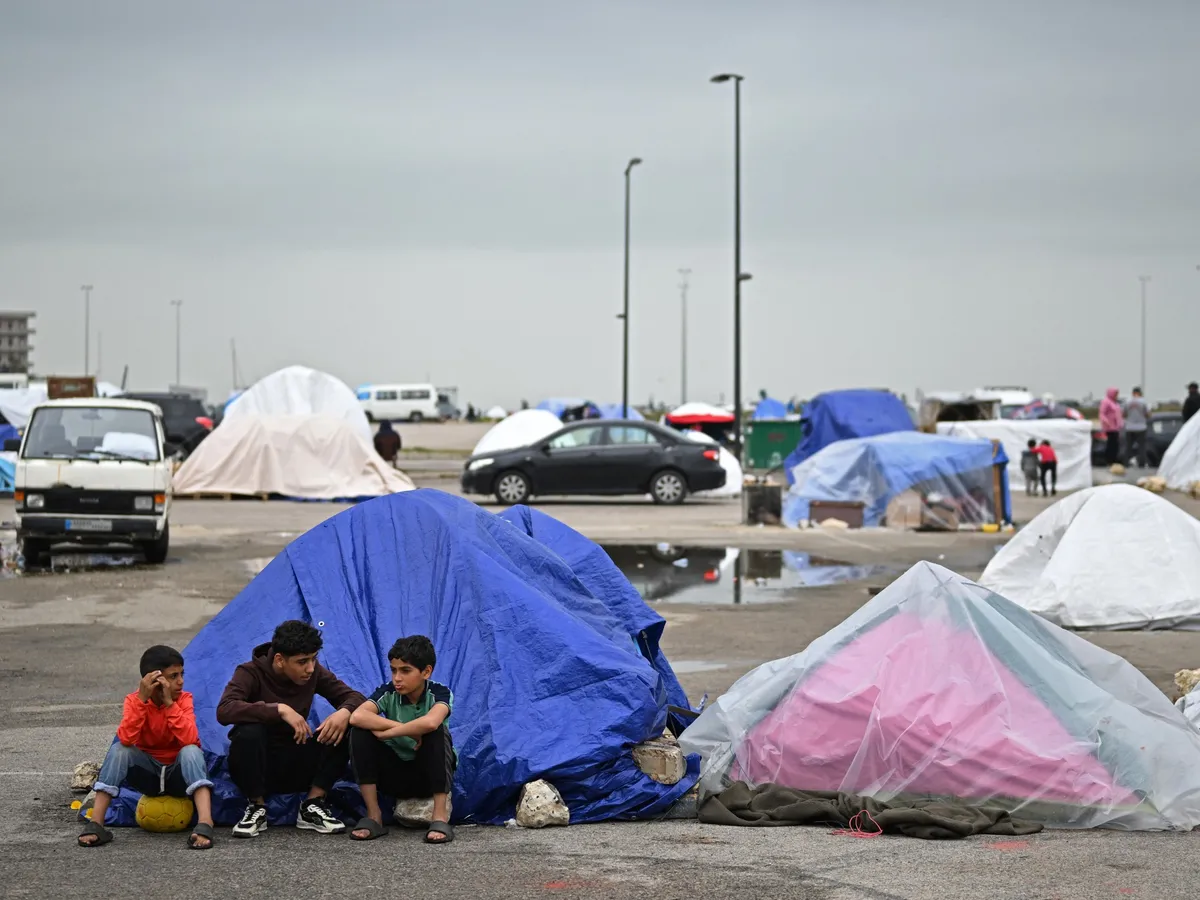
EXPLAINERIn the last month, 1.2 million people in Lebanon, or one-fifth of the population, have been forced to flee their homes.Displaced young boys sit at the entrance of a tent at an unofficial camp for displaced people on Beirut's waterfront area on April 2, 2026 [Joseph Eid/AFP]Published On 7 Apr 2026Israel’s latest invasion of Lebanon has forced more than 1.2 million people, including 350,000 children, to flee their homes, creating one of the world’s fastest-growing and most severe displacement crises.Since March 2, Israeli forces have launched more than 1,840 attacks on Lebanon, according to Armed Conflict Location and Event Data (ACLED), an independent monitor. Attacks have killed more than 1,497 people and injured more than 4,639, according to Lebanon’s Ministry of Public Health.The Israeli army claims its forces are targeting strongholds of the Iranian-backed group Hezbollah in southern Lebanon.Last week, Israel’s Defense Minister Israel-katz" class="entity-link entity-person" data-entity-id="4249" data-entity-type="person">Israel Katz said Israel plans to destroy Lebanese border towns and continue its occupation of the south of the country.An internally displaced woman hangs her laundry outside her tent at a makeshift shelter camp in the waterfront area of Beirut, Lebanon, April 4, 2026 [Wael Hamzeh/EPA]Lebanon among the world’s worst displacement crisesOne in five people in Lebanon, or 20 percent of the country’s 5.9-million population, has been displaced by Israeli attacks over the past month.Compared with other displacement crises, Lebanon’s is among the top 10 in recent years.Global displacement numbers are taken from UNHCR’s latest 2025 data, which were used to compare the rate of displacement per population. These numbers include refugees, internally displaced persons (IDPs), asylum seekers and other displaced people. Lebanon’s figures reflect the most recent available data. Numbers for all countries may shift as displacement crises continue to evolve worldwide.Where have most attacks occurred?Data from ACLED shows that between March 2 and March 27, there were more than 2,000 attacks in Lebanon. Israel carried out more than 1,840 of these – 1,486 were air or drone attacks, and 318 were shelling/artillery/missile attacks.The remainder have been carried out by Hezbollah and unidentified armed groups, mostly in the Nabatieh governorate in southern Lebanon, targeting Israeli military personnel and hardware in the region.Israel says it is targeting strongholds of the Iran-backed Hezbollah group – mostly in southern Lebanon and the southern suburbs of Beirut, the Bekaa Valley in eastern Lebanon, and Baalbek in eastern Lebanon.(Al Jazeera)The most heavily attacked administrative municipalities in Lebanon include: Bint Jbeil with 418 attacks by Israeli forces. Nabatieh (397). Tyre (394). Marjayoun (228). Sidon (113). These attacks have had huge consequences for local people.Many have targeted bridges and crossings in southern Lebanon, and are aimed at cutting off and isolating communities. Additionally, the Dalafa bridge, linking villages in southern Lebanon to western Bekaa, has been targeted by Israel.Israeli operations also aim to restrict access to the Bekaa region, according to Al Jazeera’s Obaida Hitto reporting from Tyre in southern Lebanon.“If these bridges are destroyed, it will essentially isolate the western Bekaa from the rest of Lebanon,” Hitto said. “It will make it extremely difficult for people trying to cross into the western Bekaa Valley and reach the main hub of Chtoura, to reach hospitals and other public services.”Air attacks in western Bekaa have severed key routes between villages, including the roads between Sohmor and Yohmor in the Bekaa region, according to the United Nations Office for the Coordination of Humanitarian Affairs (OCHA). Which towns and villages has Israel depopulated?In the first week of the conflict, Israel issued displacement orders for Beirut’s southern suburbs, the Bekaa region and the full area south of the Litani River.Then, on March 12, the Israeli army expanded its forced displacement orders for residents of southern Lebanon – from the Litani River to north of the Zahrani River, about 40km (25 miles) north of the Israeli border.Towns such as Jal al-Deir and Jabal Blat in the Bint Jbeil municipality in southern Lebanon are among those facing displacement of local populations, as Israel establishes new military posts in the area. In the southern Lebanon Marjayoun district, Khiam, another stronghold of Hezbollah, strategically located and seen as a gateway to southern Lebanon, has faced intense fighting in recent weeks, forcing people to leave.According to the Norwegian Refugee Council, Israel’s sweeping evacuation orders now cover more than 1,470sq km (568sq miles), or about 14 percent of the country’s territory.For context, that scale approaches the roughly 19 percent of Ukraine currently under Russian occupation.
SRCAl Jazeera
LANGEN
LEANCenter
WORDS732
ENT8
TUE · 2026-04-07 · 12:53 GMTBRIEF NSR-2026-0407-56425
NSR-2026-0407-56425News Report·EN·Human Rights
How Israel’s invasion of southern Lebanon created a humanitarian crisis
Since March 2, 2026, an Israeli invasion of southern Lebanon has displaced 1.2 million people, about one-fifth of Lebanon's population, creating a severe humanitarian crisis. According to ACLED, Israeli forces have launched over 1,840 attacks, resulting in 1,497 deaths and 4,639 injuries, according to Lebanon's Ministry of Public Health.
Hanna DuggalAl JazeeraFiled 2026-04-07 · 12:53 GMTLean · CenterRead · 3 min
Al JazeeraFIG 01
Reading time
3min
Word count
732words
Sources cited
3cited
Entities identified
8entities
Quality score
100%
§ 01
Briefing Summary
AI-generatedNEWSAR · AI
Since March 2, 2026, an Israeli invasion of southern Lebanon has displaced 1.2 million people, about one-fifth of Lebanon's population, creating a severe humanitarian crisis. According to ACLED, Israeli forces have launched over 1,840 attacks, resulting in 1,497 deaths and 4,639 injuries, according to Lebanon's Ministry of Public Health. Israel claims it is targeting Hezbollah strongholds in southern Lebanon, with the defense minister stating plans to destroy Lebanese border towns and continue occupation. The majority of Israeli attacks have been air or drone strikes and shelling, while Hezbollah and other groups have targeted Israeli military personnel and hardware, primarily in the Nabatieh governorate. The scale of displacement places Lebanon among the top 10 displacement crises globally in recent years.
Confidence 0.90Sources 3Claims 5Entities 8
§ 02
Article analysis
Model · rule-basedFraming
Human Rights
Conflict
Tone
Mixed Tone
AI-assessed
CalmNeutralAlarmist
Factuality
0.70 / 1.00
Factual
LowHigh
Sources cited
3
Well sourced
FewMany
§ 03
Key claims
5 extracted01
Between March 2 and March 27, there were more than 2,000 attacks in Lebanon.
statisticData from ACLED
Confidence
1.00
02
Israel plans to destroy Lebanese border towns and continue its occupation of the south of the country.
quoteIsrael’s Defense Minister Israel Katz
Confidence
1.00
03
Attacks have killed more than 1,497 people and injured more than 4,639.
statisticLebanon’s Ministry of Public Health
Confidence
1.00
04
Since March 2, Israeli forces have launched more than 1,840 attacks on Lebanon.
statisticArmed Conflict Location and Event Data (ACLED)
Confidence
1.00
05
1.2 million people in Lebanon have been forced to flee their homes in the last month.
statisticAl Jazeera
Confidence
1.00
§ 04
Full report
3 min read · 732 words§ 05
Entities
8 identifiedKey playerOppositionContextPositiveNeutralNegative
Organizations3
§ 06
Keywords & salience
9 termsdisplacement
1.00
humanitarian crisis
0.90
israeli attacks
0.80
invasion
0.70
southern lebanon
0.70
hezbollah
0.60
internally displaced persons
0.60
armed conflict
0.50
refugees
0.50
§ 07
Topic connections
Interactive graph Network visualization showing 51 related topics
View Full Graph Person Organization Location Event|Click node to navigate|Edge numbers = shared articles