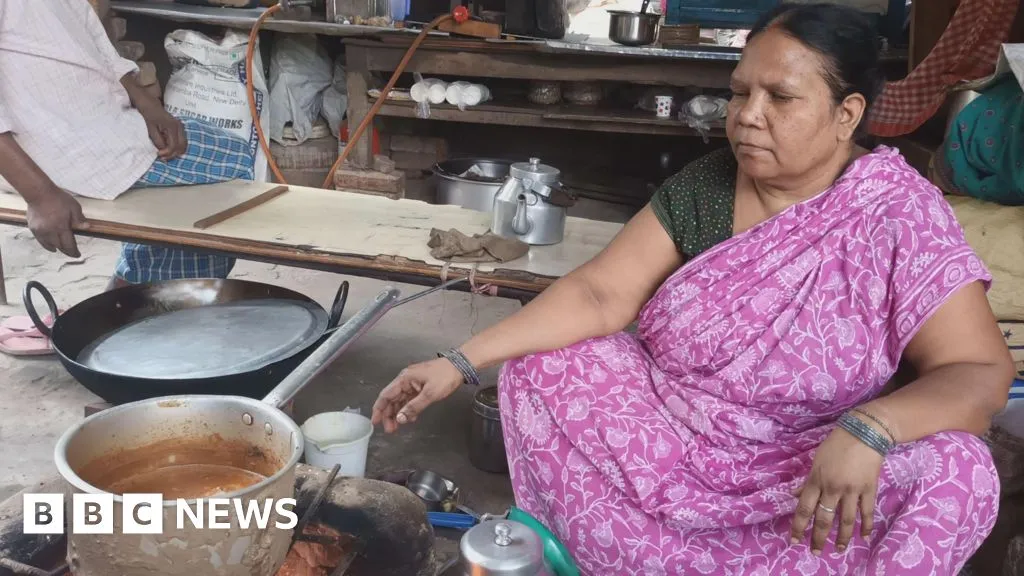
3 hours agoAbhishek DeyDelhiAbhishek Dey/BBC(From left) Shakuntala Devi, Shakiba Bibi and Vibha Yadav say they have been trying to find gas cylinders for weeksEvery morning, Shakuntala Devi and Shakiba Bibi - neighbours at a slum in India's capital Delhi - leave their homes, walking from one shop to another in search of a cooking gas cylinder.For three weeks now, they have returned empty handed."If it continues like this for a few more days, we will run out of gas in our kitchens and have to return to our villages," Shakuntala says.Shakuntala, Shakiba and many of their neighbours who join them in the cylinder hunt work as domestic helpers in middle-class neighbourhoods near the slum, earning around 15,000 rupees (£122; $161) a month. Their families migrated to Delhi from villages in neighbouring Uttar Pradesh and eastern Bihar state over the past decade.The disruption to global shipments caused by the war in the Middle East has strained cooking gas supplies in India. Many people are finding it difficult to access Liquefied Petroleum Gas (LPG) cylinders, the most widely used cooking fuel in the country. India depends heavily on LPG imports, much of which reach the country through the Strait of Hormuz, a narrow, critical shipping route affected by the conflict. While Iran is now allowing Indian vessels to pass, the situation is still uncertain and several ships are waiting near the strait to get through.The government says there is no shortage of LPG, that it is ramping up domestic production and securing more supplies from countries including the US, Russia and Australia. It has also asked people to stop "panic ordering" of gas cylinders.But migrant workers in big cities, many of whom depend on informal networks to buy cooking gas, say they are worried.The BBC spoke to nearly 30 migrant workers in Delhi who said they would have to return to their villages if the situation did not improve.News reports and visuals of crowded railway stations and bus terminals suggest the situation is similar in cities such as Mumbai, Bengaluru, Chennai and Hyderabad, where large numbers of migrant workers live and work. In some areas, shutdowns in industries such as textiles, jewellery and ceramics have also forced workers to return home.People who have left say they are watching the situation closely to decide when they can return."There was no cooking gas available. Even local restaurants were shut. I was struggling to eat two meals a day, so I had to return home," Ashok Yadav told the BBC over the phone from his village in Uttar Pradesh's Ayodhya town. He had worked in a catering firm in Delhi.Last month, the government asked refineries to prioritise gas distribution for households over businesses. This forced many small restaurants to trim their menus or temporarily shut down as they could not afford commercial gas cylinders.Abhishek Dey/BBCSushila Devi, a tea shop owner in Delhi, has been using firewood to cook for the past few daysSushila Devi, who runs a small tea shop in a bustling market in Delhi, says she has been using firewood for both her shop and home."I have not been able to get a gas cylinder for nearly four weeks," she says. "The price of firewood is rising quickly, and it is not a long-term option anyway. If the gas shortage continues, I will have to return to my village [in Uttar Pradesh]."Her neighbour Pushpa Devi says that at least they "will not starve" in their villages as they can share meals with relatives.Experts say that the situation is "manageable" right now."But if this [reverse migration] continues, it will have [a] significant impact, especially on micro, small and medium enterprises, particularly in labour-intensive sectors such as construction, textiles and manufacturing," says Arvind Goel, co-chairman of the industrial relations committee of the Confederation of Indian Industry. According to India's last census held in 2011, the country had 54 million inter-state migrants, but analysts say the actual number is much higher and would have increased manifold in the years since then. The latest census, much delayed, kicked off last week.For many of these workers, access to cooking gas was already complicated. To obtain LPG cylinders legally in India, households and businesses must register for a connection using identity and address documents, and book cylinders in advance through authorised distributors. But migrants who work in the informal sector often do not have the right documents in the cities they live in."Migrant workers relocate frequently and cannot keep updating documents. Some landlords also refuse to provide proof of address, so getting formal documents in the cities where they migrate often becomes difficult," says Rajesh Kumar, a trade unionist in Delhi.Many of these workers rely on informal, often unregulated centres that sell and refill cylinders smaller than the standard 14.2kg size.But since the war began, many of these centres have shut down, while others are charging nearly four times the usual price - around 3,500 rupees for regular household cylinders and more than 1,600 rupees for refilling the smaller ones."Most migrant workers with meagre earnings can't afford to pay so much," says Rajesh Kumar.Getty ImagesGas distribution centres across cities have seen long queues for the past few weeks, though the government says India has enough LPG in stockLimited alternatives add to the difficulties. Cooking with firewood or coal is unsafe in cramped rooms in slums. Shared electricity connections in such houses cannot support cheaper electric stoves, and safer models are too expensive.For some, the uncertainty has already forced hard decisions.Ramnaresh Yadav sold his autorickshaw two weeks ago before returning to his village near Bihar's Chhapra town. "I was already struggling to feed my family on my earnings. Then this gas shortage happened. If things don't improve, I may have to enrol my children in the village school," he told the BBC over the phone.Others are hopeful the situation will improve.Brij Kumar, a cart-puller in Delhi who recently returned to his village near Deoghar in Jharkhand state, says he expects things to get better once the conflict ends. "But until then, life will be stressful, especially for people like us."
SRCBBC News - World
LANGEN
LEANCenter
WORDS1 010
ENT12
TUE · 2026-04-07 · 21:02 GMTBRIEF NSR-2026-0407-57420
NSR-2026-0407-57420News Report·EN·Economic Impact
Indian migrant workers hit by cooking gas shortages are leaving cities
Indian migrant workers in cities like Delhi, Mumbai, and Chennai are facing cooking gas (LPG) shortages due to disruptions in global shipments caused by conflict in the Middle East. These workers, who rely on LPG for cooking and often depend on informal supply networks, are struggling to obtain cylinders.
BBC News - WorldFiled 2026-04-07 · 21:02 GMTLean · CenterRead · 5 min
BBC News - WorldFIG 01
Reading time
5min
Word count
1 010words
Sources cited
6cited
Entities identified
12entities
Quality score
100%
§ 01
Briefing Summary
AI-generatedNEWSAR · AI
Indian migrant workers in cities like Delhi, Mumbai, and Chennai are facing cooking gas (LPG) shortages due to disruptions in global shipments caused by conflict in the Middle East. These workers, who rely on LPG for cooking and often depend on informal supply networks, are struggling to obtain cylinders. The situation is forcing some to return to their villages in states like Uttar Pradesh and Bihar, as they cannot afford to live without access to cooking fuel. While the Indian government claims there is no shortage and is increasing domestic production and imports, many migrant workers are experiencing difficulties and are leaving urban areas. Shutdowns in some industries are exacerbating the problem.
Confidence 0.90Sources 6Claims 5Entities 12
§ 02
Article analysis
Model · rule-basedFraming
Economic Impact
Human Interest
Tone
Measured
AI-assessed
CalmNeutralAlarmist
Factuality
0.70 / 1.00
Factual
LowHigh
Sources cited
6
Well sourced
FewMany
§ 03
Key claims
5 extracted01
Last month, the government asked refineries to prioritise gas distribution for households over businesses.
factualBBC
Confidence
1.00
02
The government says there is no shortage of LPG.
quoteGovernment of India
Confidence
1.00
03
Nearly 30 migrant workers in Delhi said they would have to return to their villages if the situation did not improve.
factualBBC
Confidence
0.90
04
Disruption to global shipments caused by the war in the Middle East has strained cooking gas supplies in India.
factualBBC
Confidence
0.90
05
Many people are finding it difficult to access Liquefied Petroleum Gas (LPG) cylinders.
factualBBC
Confidence
0.80
§ 04
Full report
5 min read · 1 010 words§ 05
Entities
12 identifiedKey playerOppositionContextPositiveNeutralNegative
People3
§ 06
Keywords & salience
9 termsmigrant workers
1.00
cooking gas shortage
0.90
lpg
0.80
india
0.70
return to villages
0.70
cities
0.60
strait of hormuz
0.50
global shipments
0.50
domestic helpers
0.40
§ 07
Topic connections
Interactive graph Network visualization showing 51 related topics
View Full Graph Person Organization Location Event|Click node to navigate|Edge numbers = shared articles