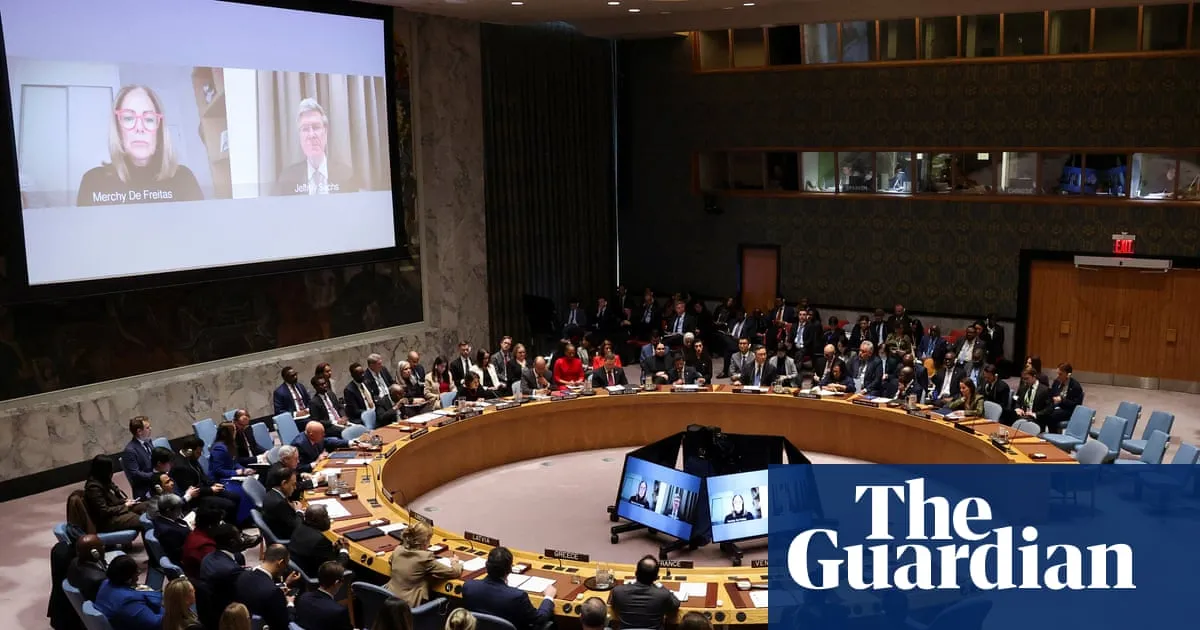
The US has faced widespread condemnation for a “crime of aggression” in Venezuela at an emergency meeting of the United Nations security council.Brazil, China, Colombia, Cuba, Eritrea, Mexico, Russia, South Africa and Spain were among countries that on Monday denounced Donald Trump’s decision to launch deadly strikes on Venezuela and snatch its leader, Nicolás Maduro and his wife, Cilia Flores, to stand trial in the US.“The bombings on Venezuelan territory and the capture of its president cross an unacceptable line,” Sérgio França Danese, the Brazilian ambassador to the UN, told the meeting. “These acts constitute a very serious affront to the sovereignty of Venezuela and set an extremely dangerous precedent for the entire international community.”Trump’s UN ambassador, Mike Waltz, defended the attack as a legitimate “law enforcement” action to execute long-standing criminal indictments against an “illegitimate” leader, not an act of war.The meeting in New York was convened just hours before Maduro was due to appear before a federal judge in Manhattan on charges including “narco-terrorism” conspiracy, cocaine importation and weapons trafficking – allegations he has long denied.António Guterres, the UN secretary general, warned that the capture of Maduro risked intensifying instability in Venezuela and across the region. He questioned whether the operation respected the rules of international law.“I am deeply concerned about the possible intensification of instability in the country, the potential impact on the region, and the precedent it may set for how relations between and among states are conducted,” Guterres said in a statement delivered to the council by UN political affairs chief Rosemary DiCarlo.He urged Venezuelan actors to engage in “inclusive and democratic dialogue” and offered UN support for a peaceful way forward.The meeting had been requested by Colombia, which delivered a carefully calibrated rebuke of Washington. The country’s ambassador, Leonor Zalabata Torres, condemned the US action as a violation of Venezuela’s sovereignty, political independence and territorial integrity.“Democracy cannot be defended or promoted through violence and coercion, and it cannot be superseded, either, by economic interests,” she said. “There is no justification whatsoever, under any circumstances, for the unilateral use of force to commit an act of aggression.” She added that the raid was reminiscent of “the worst interference in our area in the past”.Russia and China, both permanent security council members, were less restrained and called on the US to immediately release Maduro and Flores. Vasily Nebenzya, Moscow’s ambassador, described the intervention as “a turn back to the era of lawlessness” and urged the 15-member council to reject the methods of US military foreign policy.Nebenzya, whose country is currently under US sanctions following its illegal invasion of Ukraine, added: “We cannot allow the United States to proclaim itself as some kind of a supreme judge, which alone bears the right to invade any country, to label culprits, to hand down and to enforce punishments irrespective of notions of international law, sovereignty and nonintervention.”China’s representative, Fu Cong, echoed the charge, saying the US had “wantonly trampled upon Venezuela’s sovereignty” and violated the principle of sovereign equality. “No country can act as the world’s police.”China demanded that the US “change its course, cease its bullying and coercive practices”, and “return to the path of political solutions through dialogue and negotiations”.The Cuban ambassador, Ernesto Soberón Guzmán, told the meeting: “The US military attack against Venezuela has no justification whatsoever… This is an imperialist and fascist aggression with objectives of domination.”The security council meeting also heard from Venezuela’s ambassador Samuel Moncada, who described the US action as an “illegitimate armed attack lacking any legal justification” that included “the kidnapping of the constitutional president of the republic, Nicolás Maduro Moros and the first lady Cilia Flores.”Moncada added: “No state can set itself up as a judge, party and executor of the world order … Venezuela is the victim of this attack because of its natural resources.”For its part, the US insisted that there was “no war against Venezuela or its people”. Waltz told the council the operation was a law-enforcement action carried out in pursuit of long-standing indictments. “We are not occupying a country; this was a law enforcement operation,” he said, invoking the 1989 capture of Panama’s former leader Manuel Noriega as precedent.Waltz cited Article 51 of the UN charter, which enshrines the right to self-defence, and said the evidence against Maduro would be presented openly in US court. He described the Venezuelan leader as “an illegitimate so-called president” and claimed that millions of Venezuelans, including exiles in Florida, were celebrating his arrest.“I want to reiterate President Trump gave diplomacy a chance. He offered Maduro multiple offerings he tried to de-escalate. Maduro refused to take them.”Experts, however, have questioned the legality of the operation, noting that it lacked UN security council authorisation, Venezuelan consent and a clear self-defence rationale. The UN charter obliges states to refrain from the use of force against the territorial integrity or political independence of others – a principle repeatedly invoked during the meeting.Yet the council, paralysed by divisions among its most powerful members, appeared no closer to a collective response. Any attempt to censure the US is certain to be blocked by its veto, one of five held by the council’s permanent members.
SRCThe Guardian - World News
LANGEN
LEANCenter-Left
WORDS859
ENT12
MON · 2026-01-05 · 18:57 GMTBRIEF NSR-2026-0105-5832
NSR-2026-0105-5832News Report·EN·Diplomatic
US foes and allies denounce Trump’s ‘crime of aggression’ in Venezuela at UN meeting
At a UN Security Council emergency meeting, the US faced widespread condemnation from allies and foes alike for its military strikes in Venezuela and the capture of President Nicolás Maduro and his wife. Numerous countries, including Brazil, China, Colombia, and Russia, denounced the actions as a violation of Venezuelan sovereignty and a dangerous precedent.
David Smith in WashingtonThe Guardian - World NewsFiled 2026-01-05 · 18:57 GMTLean · Center-LeftRead · 4 min
The Guardian - World NewsFIG 01
Reading time
4min
Word count
859words
Sources cited
9cited
Entities identified
12entities
Quality score
100%
§ 01
Briefing Summary
AI-generatedNEWSAR · AI
At a UN Security Council emergency meeting, the US faced widespread condemnation from allies and foes alike for its military strikes in Venezuela and the capture of President Nicolás Maduro and his wife. Numerous countries, including Brazil, China, Colombia, and Russia, denounced the actions as a violation of Venezuelan sovereignty and a dangerous precedent. The US ambassador defended the operation as a legitimate law enforcement action against an illegitimate leader facing criminal indictments. The UN Secretary-General expressed deep concern about the potential for increased instability in Venezuela and the region, questioning the operation's adherence to international law. Colombia condemned the US action as a violation of Venezuela's sovereignty and a use of force reminiscent of past interference. Maduro is scheduled to appear before a US federal judge on charges including narco-terrorism.
Confidence 0.90Sources 9Claims 5Entities 12
§ 02
Article analysis
Model · rule-basedFraming
Diplomatic
Conflict
Tone
Mixed Tone
AI-assessed
CalmNeutralAlarmist
Factuality
0.70 / 1.00
Factual
LowHigh
Sources cited
9
Well sourced
FewMany
§ 03
Key claims
5 extracted01
Russia and China called on the US to immediately release Maduro and Flores.
factualArticle
Confidence
1.00
02
António Guterres warned that the capture of Maduro risked intensifying instability in Venezuela.
factualAntónio Guterres
Confidence
1.00
03
Maduro was due to appear before a federal judge in Manhattan on charges including “narco-terrorism” conspiracy.
factualArticle
Confidence
1.00
04
Trump’s UN ambassador, Mike Waltz, defended the attack as a legitimate “law enforcement” action.
quoteMike Waltz
Confidence
1.00
05
Brazil, China, Colombia, Cuba, Eritrea, Mexico, Russia, South Africa and Spain denounced Donald Trump’s decision to launch strikes on Venezuela.
factualArticle
Confidence
1.00
§ 04
Full report
4 min read · 859 words§ 05
Entities
12 identifiedKey playerOppositionContextPositiveNeutralNegative
People5
Organizations1
§ 06
Keywords & salience
9 termsvenezuela
1.00
crime of aggression
0.90
united nations
0.80
sovereignty
0.70
unilateral use of force
0.60
international law
0.60
instability
0.50
political independence
0.50
narco-terrorism
0.40
§ 07
Topic connections
Interactive graph Network visualization showing 51 related topics
View Full Graph Person Organization Location Event|Click node to navigate|Edge numbers = shared articles