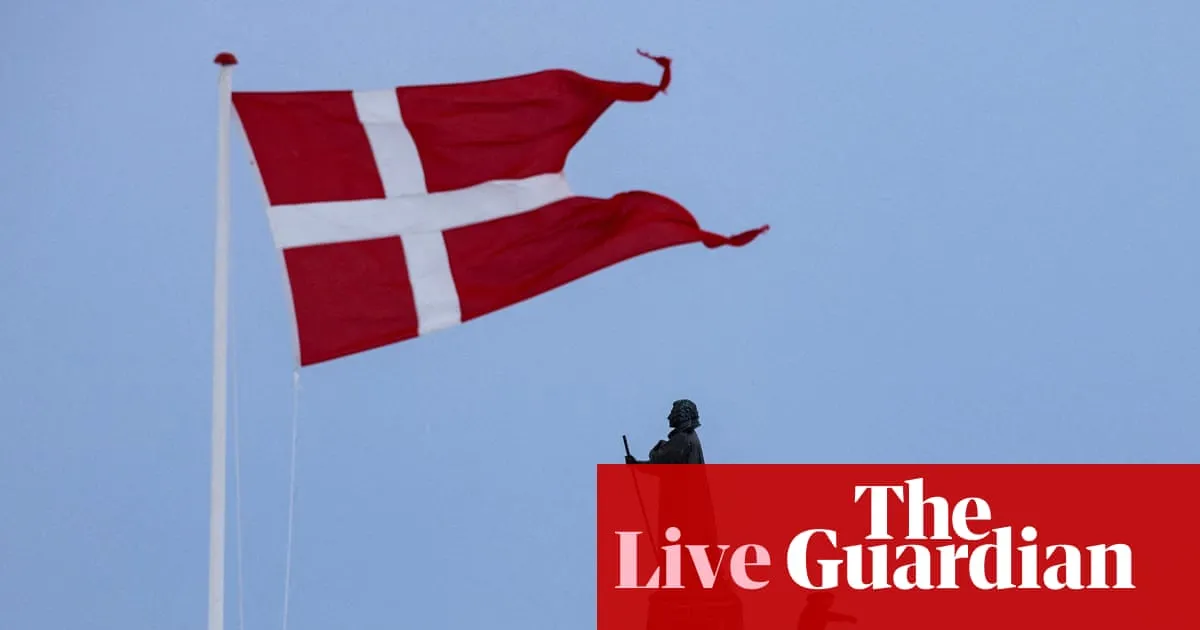
Key events3h agoOpening summaryShow key events onlyPlease turn on JavaScript to use this featureWhat exactly is the US accusing Nicolás Maduro of and what’s in the criminal indictment against him that was unveiled by attorney general Pam Bondi at the weekend?The US alleges the deposed Venezuelan president has spent the past two decades working with international drug trafficking groups.He pleaded not guilty – as did his wife, Cilia Flores, who said she was “completely innocent” – at their court appearance in New York.What are the charges, how comprehensive is the indictment and who might be helping US prosecutors? This explainer has the details.Returning now to Nicolás Maduro’s court appearance in New York, the deposed Venezuelan president pleaded not guilty to drugs, weapons and narco-terrorism charges on Monday, two days after his capture by US forces.The brevity and formality of the arraignment hearing in federal court – barely 30 minutes long, during which Maduro was asked to confirm his name and that he understood the four charges against him – belied the far-reaching consequences of the US action, report Victoria Bekiempis and Richard Luscombe.Maduro, 63, insisted to the judge that he was “still president of my country”, had been illegally “captured” at his Caracas home and was “a prisoner of war”.“I am innocent. I am not guilty. I am a decent man,” Maduro said in Spanish during repeated attempts to speak over the judge.The full report is here:Dara KerrMinutes after Donald Trump announced a “large-scale strike” against Venezuela early on Saturday, false and misleading AI-generated images began flooding social media. There were fake photos of Nicolás Maduro being escorted off a plane by US agents, images of jubilant Venezuelans pouring into the streets of Caracas and videos of missiles raining down on the city – all fake.The fabricated content intermixed with real videos and photos of US aircraft flying over the Venezuelan capital and explosions lighting up the dark sky. A lack of verified information about the raid coupled with AI tools’ rapidly advancing capabilities made discerning fact from fiction about the incursion on Caracas difficult.By the time Trump posted a verified photo of Maduro blindfolded and handcuffed aboard a US warship, the fake images with the US drug enforcement agents had already gone viral. Across X, Instagram, Facebook and TikTok, the AI photos have been seen and shared millions of times, according to the factchecking site NewsGuard.See the full story here:Maduro supporters protest near a mural of him in Caracas on Monday. Photograph: Jonathan Lanza/UPI/ShutterstockFresh from his military operation in Venezuela, Donald Trump has said the US needs Greenland “very badly”, renewing fears of a US invasion of the largely autonomous island that remains part of the Danish kingdom.Greenland prime minister Jens-Frederik Nielsen pushed back on Monday against Trump’s calls to annex the Arctic territory, while Danish prime minister Mette Frederiksen warned that any US attack on a Nato ally would be the end of the military alliance and “post-second world war security”.Here’s a video taking us through it, including Nielsen starting by saying: “First of all I would say that our country is not really the right one to compare with Venezuela.”Denmark, Greenland push back on Trump remarks, say Greenland not for conquest - videoVictoria BekiempisAt noon on Monday in New York, Nicolás Maduro was escorted into a Manhattan federal courtroom following his capture early on Saturday in Caracas, completing the seized Venezuelan leader’s stunning journey from his capital city to a US courtroom.It was a surreal display amid the fallout of a brazen US military operation to grab Maduro that has roiled global politics and stunned observers in the US and overseas.In Manhattan the spectacle played out as Maduro’s larger-than-life persona soon filled Judge Alvin Hellerstein’s courtroom with a mixture of bravado, seriousness, jocularity and defiance.Nicolás Maduro (front, standing) and his wife Cilia Flores (right) in a courtroom sketch. Photograph: Jane Rosenberg/AFP/Getty ImagesMaduro, who was not handcuffed but constrained by ankle shackles, looked forward, toward the jury box, as he walked into court. Before sitting down, Maduro told the public gallery “Happy new year!” in English.His wife, Cilia Flores, followed shortly after, and she had two large Band-Aids on her face.Proceedings started in earnest with an exchange of greetings that did little to hint at the enormous significance of the events playing out in the room.You can read the full account here:David SmithThe United States has faced widespread condemnation for a “crime of aggression” in Venezuela at an emergency meeting of the United Nations security council.Brazil, China, Colombia, Cuba, Eritrea, Mexico, Russia, South Africa and Spain were among countries that have denounced the weekend US attack in Venezuela.“The bombings on Venezuelan territory and the capture of its president cross an unacceptable line … and set an extremely dangerous precedent for the entire international community,” Sérgio França Danese, the Brazilian ambassador to the UN, told the meeting on Monday.Donald Trump’s UN ambassador, Mike Waltz, defended the attack as a legitimate “law enforcement” action to execute longstanding criminal indictments against an “illegitimate” leader, not an act of war.The UN security council meeting in New York. Photograph: Brendan McDermid/ReutersAntónio Guterres, the UN secretary general, warned that the capture of Maduro risked intensifying instability in Venezuela and across the region. He questioned whether the operation respected the rules of international law. I am deeply concerned about the possible intensification of instability in the country, the potential impact on the region, and the precedent it may set for how relations between and among states are conducted. More than a dozen media workers were detained on Monday while covering events in the Venezuelan capital, including a march in support of ousted president Nicolás Maduro and the swearing-in of the country’s new legislature, the Venezuelan press association said.All 14 of those detained in Caracas were later released, the National Union of Press Workers (SNTP) posted on X, though one was a foreign journalist who was deported.Reuters quoted the SNTP as saying those detained included 11 people working with international media outlets and one with a national outlet.Chavismo supporters march in support of the start of the National Assembly in Caracas on Monday. Photograph: Ronald Pena R/EPAOpening summaryWelcome to our live coverage of the continuing aftermath of the US military’s weekend raid on Venezuela and removal of president Nicolás Maduro from power.Venezuelan opposition leader and Nobel peace prize winner María Corina Machado has said in her first televised interview since then that she hasn’t spoken to Donald Trump since October 2025.“Actually, I spoke with president Trump on October 10, the same day the [Noble peace] prize was announced, [but] not since then,” Machado said on Fox News. Machado – widely seen as Maduro’s most credible opponent – left Venezuela last month to travel to Norway to accept the award and hasn’t returned since.“I’m planning to go as soon as possible back home,” she told Fox when asked about her plans to return to Venezuela.Trump on Saturday dismissed the idea of working with Machado, saying: “She doesn’t have the support within or the respect within the country.” US media reported on Monday that a classified CIA assessment presented to Trump concluded that senior Maduro loyalists, including interim president Delcy Rodríguez, were best positioned to maintain stability.Despite this, Machado welcomed the US actions as “a huge step for humanity, for freedom and human dignity”.Delcy Rodríguez (in green) is sworn in as Venezuela’s interim president on Monday after Maduro’s capture by US forces. Photograph: Marcelo Garcia/Miraflores Palace/ReutersIn other key developments: Mike Johnson, the Republican speaker of the US House, emerged from a classified briefing for congressional leaders insisting that “we are not at war” and “this is not a regime change” but “a demand for a change of behaviour by a regime”. Chuck Schumer, the Senate’s Democratic minority leader, expressed discontent with the briefing, calling the Trump administration’s “plan for the US ‘running Venezuela’ … vague, based on wishful thinking and unsatisfying”. The reported appearance of unidentified drones over the presidential palace in Venezuela’s capital on Monday night filled the night sky with the sound of heavy gunfire and tracer fire as the regime’s security forces reacted to what they mistook for another raid. Trump suggested to NBC News that US taxpayers could fund the rebuilding of Venezuela’s infrastructure for extracting and shipping oil. “A tremendous amount of money will have to be spent and the oil companies will spend it, and then they’ll get reimbursed by us or through revenue.” White House adviser Stephen Miller reaffirmed to CNN the Trump administration’s position on Greenland becoming a part of the US.
SRCThe Guardian - World News
LANGEN
LEANCenter-Left
WORDS1 422
ENT9
TUE · 2026-01-06 · 06:43 GMTBRIEF NSR-2026-0106-5900
NSR-2026-0106-5900News Report·EN·Political Strategy
Opposition leader Machado says she hasn’t spoken to Trump since attack as she vows to return to Venezuela – live
Nicolás Maduro, the deposed Venezuelan president, pleaded not guilty in a New York court to US charges of drugs, weapons, and narco-terrorism after being captured by US forces in Caracas. The US alleges Maduro collaborated with international drug trafficking groups for two decades.
Adam FultonThe Guardian - World NewsFiled 2026-01-06 · 06:43 GMTLean · Center-LeftRead · 6 min
The Guardian - World NewsFIG 01
Reading time
6min
Word count
1 422words
Sources cited
6cited
Entities identified
9entities
Quality score
100%
§ 01
Briefing Summary
AI-generatedNEWSAR · AI
Nicolás Maduro, the deposed Venezuelan president, pleaded not guilty in a New York court to US charges of drugs, weapons, and narco-terrorism after being captured by US forces in Caracas. The US alleges Maduro collaborated with international drug trafficking groups for two decades. Following Trump's announcement of a strike against Venezuela, AI-generated fake images flooded social media, depicting Maduro's capture and celebrations in Caracas. These fabricated images, mixed with real footage, spread rapidly across platforms before verified photos of Maduro in custody were released. The US action and the spread of misinformation highlight the challenges of discerning fact from fiction in the digital age.
Confidence 0.90Sources 6Claims 5Entities 9
§ 02
Article analysis
Model · rule-basedFraming
Political Strategy
Conflict
Tone
Mixed Tone
AI-assessed
CalmNeutralAlarmist
Factuality
0.70 / 1.00
Factual
LowHigh
Sources cited
6
Well sourced
FewMany
§ 03
Key claims
5 extracted01
Donald Trump has said the US needs Greenland 'very badly'.
quoteDonald Trump
Confidence
1.00
02
Trump posted a verified photo of Maduro blindfolded and handcuffed aboard a US warship.
factualDara Kerr
Confidence
1.00
03
AI-generated images began flooding social media after Trump announced a 'large-scale strike' against Venezuela.
factualDara Kerr
Confidence
1.00
04
Maduro insisted he was 'still president of my country' and had been illegally 'captured'.
quoteNicolás Maduro
Confidence
1.00
05
Nicolás Maduro pleaded not guilty to drugs, weapons and narco-terrorism charges in New York.
factualVictoria Bekiempis and Richard Luscombe
Confidence
1.00
§ 04
Full report
6 min read · 1 422 words§ 05
Entities
9 identifiedKey playerOppositionContextPositiveNeutralNegative
People5
§ 06
Keywords & salience
8 termsnicolás maduro
1.00
venezuela
0.90
us action
0.80
drug trafficking
0.70
criminal indictment
0.60
fake images
0.50
artificial intelligence
0.50
court appearance
0.40
§ 07
Topic connections
Interactive graph Network visualization showing 51 related topics
View Full Graph Person Organization Location Event|Click node to navigate|Edge numbers = shared articles