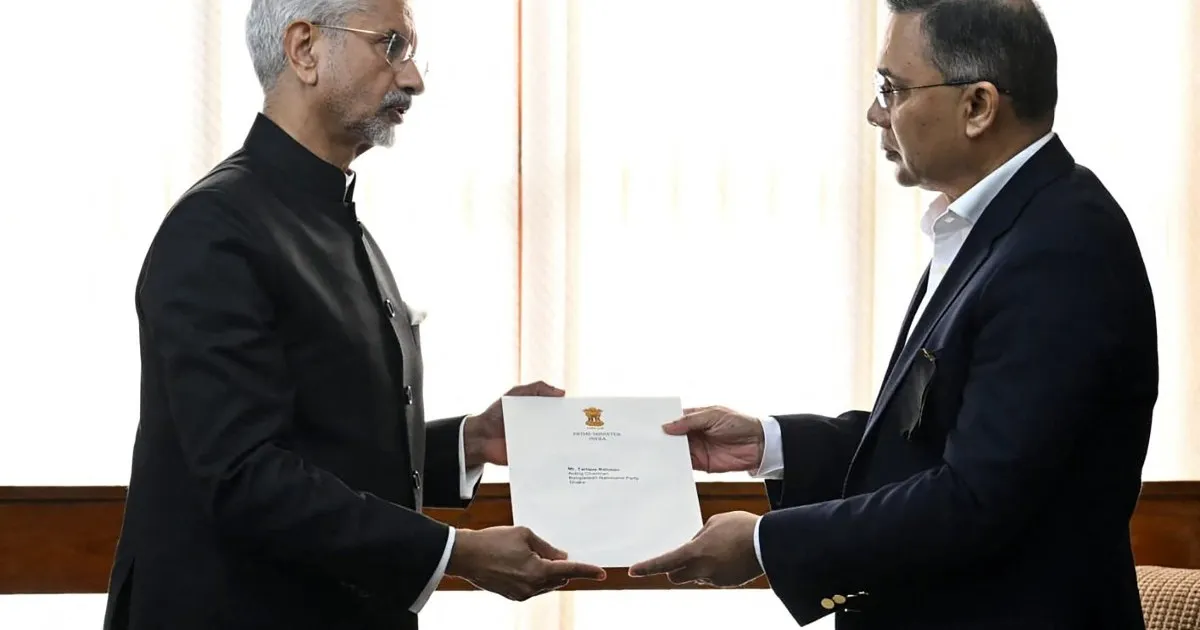
‘New phase’: India eyes Bangladesh thaw with BNP before electionsIn advance of elections in Bangladesh, India and the BNP are trying to reset historically strained ties. Will it work?This handout photograph posted on the X account of India's External Affairs Minister, @DrSJaishankar, on December 31, 2025, shows India's Foreign Minister Subrahmanyam Jaishankar (L) meeting with Bangladesh Nationalist Party (BNP)'s acting chairman, Tarique Rahman, conveying condolences over former Prime Minister Khaleda Zia's death in Dhaka [Photo by X account of India's External Affairs Minister of India @DrSJaishankar/AFP]Published On 6 Jan 2026New Delhi, India – Dressed in black for the occasion, India’s Foreign Minister S Jaishankar met Tarique Rahman, son of the deceased former Bangladeshi Prime Minister Khaleda Zia, with sombre expressions on their faces.Khaleda had passed away the previous day, on December 30, and Jaishankar was among a large group of regional leaders who had gathered in Dhaka, the capital of Bangladesh, for her funeral.Recommended Stories list of 4 itemslist 1 of 4Bangladesh’s big question: Will Khaleda Zia’s son build on her legacy?list 2 of 4Bangladesh bans IPL broadcast amid growing tensions with Indialist 3 of 4Thousands of forced disappearances under Hasina rule in Bangladesh: Inquirylist 4 of 4Handshake in Dhaka: Can India and Pakistan revive ties in 2026?end of listJaishankar handed Rahman, who has taken over the leadership of Khaleda’s Bangladesh Nationalist Party (BNP), a letter from Indian Prime Minister Narendra Modi. Then, in a post on X alongside photos of their meeting, Jaishankar wrote words that demonstrate a dramatic break with New Delhi’s past relationship with the BNP: “Conveyed deepest condolences on behalf of the Government and people of India. Expressed confidence that Begum Khaleda Zia’s vision and values will guide the development of our partnership.”For decades, India had been – at times, publicly, on other occasions, privately – opposed to Khaleda’s “vision and values”.Where for millions of her supporters in Bangladesh, she represented a heroic struggle against military rule in the 1980s that first brought her to power in 1991, India viewed her with suspicion and distrust. For decades, the BNP had an alliance with Jamaat-e-Islami, Bangladesh’s largest Islamist group that advocates for stronger ties with Pakistan, India’s arch-enemy. Meanwhile, India treated Khaleda’s rival, Sheikh Hasina, and her avowedly secular Awami League party as its natural partners.But as Bangladesh prepares for national elections in February, Jaishankar’s comments underscore how India and the BNP appear to be pivoting from their animus towards a closer working relationship.Jaishankar’s “very cordial” meeting with Rahman and his team of confidantes in Dhaka presented the “potential of a new phase in the bilateral relationship”, Humayun Kabir, foreign affairs adviser to Rahman, told Al Jazeera.It’s a shift that circumstances have forced on both India and the Rahman-led BNP, say analysts.BNP’s acting Chairman Tarique Rahman (C) standing alongside chief adviser of the country’s interim government, Muhammad Yunus (2L), during the burial ceremony, on December 31, of Rahman’s mother and the nation’s former Prime Minister Khaleda Zia, a day after her death in Dhaka [Photo by Bangladesh Nationalist Party (BNP) Media Cell/AFP]A new start?Since the student-led July 2024 uprising toppled Sheikh Hasina’s 15-year rule, New Delhi’s decades-long support for the ousted leader has prompted strong anti-India sentiments on Bangladeshi streets.Hasina now lives in exile in New Delhi, and India has so far refused to return her to Bangladesh to face the death penalty, after being convicted in absentia by a tribunal on charges related to the brutal crackdown by her security forces on protesters last year. The United Nations estimates that about 1,400 people died in the crackdown.Bilateral relations have continued to slide further: After a 2024 protest leader who was vocally anti-India was murdered, protests against India picked up again in Bangladesh. A Hindu Bangladeshi man was lynched. Both countries had to temporarily suspend visa services at their respective high commissions.But Hasina’s Awami League is banned from participating in the February elections. And some analysts believe that the BNP is trying to occupy the liberal and centrist political space vacated by the Awami League. It has also broken up with the Jamaat – the Islamist group has since partnered with a party formed by leaders of the 2024 student protest movement, in a formidable alliance.The BNP and the Jamaat-led coalition are seen as the frontrunners competing to form the next government after the February elections. And while India can’t reconcile with the Jamaat’s politics – and its pro-Pakistan tilt – Rahman has in recent days made statements that are far more palatable to New Delhi.Since returning to Dhaka in late December after 17 years in exile, Rahman told supporters that he wanted an inclusive Bangladesh, where minorities are safe.His words suggest that Rahman has “matured during his years in exile”, Harsh Vardhan Shringla, a former Indian foreign secretary who has also served as high commissioner in Dhaka, told Al Jazeera.Indian Prime Minister Atal Bihari Vajpayee (R) and Bangladeshi Prime Minister Khaleda Zia (L) share a light moment during the closing ceremony of the 12th South Asian Association for Regional Cooperation (SAARC) summit, in Islamabad, January 6, 2004. The 12th SAARC summit ended with leaders of the seven nations hailing the three-day meeting as a “watershed” for the region, thanks to breakthrough talks between rivals India and Pakistan and a free trade pact [Emmanuel Dunand/AFP]‘Mutual mistrust and animosity’Like Rahman, the BNP itself has largely been in political exile since it was last in power in 2006 – the party and its leaders were first targeted by an interim military-backed government and then by Hasina’s Awami League government with multiple cases and arrests.Its last stint in office coincided in large part with the last time that Modi’s Bharatiya Janata Party was in power, between 1998 and 2004. At the time, India’s prime minister was Atal Bihari Vajpayee.Areas of contention between the BJP-ruled India and BNP-ruled Bangladesh ranged from trade disputes, border disputes, river water sharing, migration, armed rebellion, and violence against minorities. New Delhi accused Bangladesh of allowing several anti-India armed fighters shelter on its terrain, and the issue became a major irritant in bilateral relations.India also accused the BNP of pandering to Pakistani intelligence agencies. Dhaka denied these accusations.“Essentially, the background has been one of mutual mistrust and animosity that is historic,” said Shringla, who is now a member of the Indian parliament’s upper house, nominated by Modi’s BJP.“Under the BNP years [2001-2006], Bangladesh supported an anti-India line and became very close to Pakistan,” Shringla told Al Jazeera. “And [Tarique] Rahman was a prime mover in that government and had disproportionate influence.”(FILE) Acting chairman of Bangladesh Nationalist Party (BNP), Tarique Rahman, poses for a portrait in a park in southwest London on December 30, 2023. The heir to Bangladesh’s longtime ruling family and a leader of its most powerful political party, Tarique Rahman has returned home after 17 years in exile and before key elections. Rahman, 60, an aspiring prime minister who has lived in London since he fled Bangladesh in 2008, over what he called a politically motivated persecution, arrived in Dhaka on December 25, 2025 [Henry Nicholls/AFP]‘Rahman is safest bet’Yet calculations have changed.When Khaleda was moved to a hospital in critical condition in late November, Modi was quick to wish her a speedy recovery. The BNP responded, thanking him for the wishes.“Rahman seems to understand that for him to be a successful prime minister, he needs India’s support – or, at the least, he doesn’t want India’s antagonism,” said Shringla. “Now, we have to see whether his actions match rhetoric.”From India’s perspective, Rahman is now “saying all the correct things”, said Sreeradha Datta, a professor specialising in South Asian studies at India’s OP Jindal Global University.Rahman’s apparent popularity – hundreds of thousands gathered on the streets of Dhaka to greet him when he arrived from London – suggests that he could bring a sense of stability in the neighbourhood, Datta told Al Jazeera.Analysts say Rahman also represents the “safest bet” for New Delhi going forward, compared with the Jamaat-led alliance and other political actors in Bangladesh.“India sees the student revolutionaries and the Bangladesh Jamaat-e-Islami as the biggest threats to Indian interests,” said Jon Danilowicz, a former US diplomat who spent eight years working in Bangladesh.Rahman’s public statements on returning to Dhaka “have shown great maturity”, Danilowicz said.The pre-poll break between the Jamaat and the BNP also gives New Delhi more confidence in dealing with Rahman, said Michael Kugelman, a South Asia political analyst.“There is a lot of baggage from the past, in addition to the BNP’s longstanding alliance with Jamaat,” Kugelman told Al Jazeera. “For India, memories of that alliance die hard.“[Reaching out to Rahman is] not something that India will do happily, but something that it feels that it will need to do simply by necessity,” he said.Tarique Rahman (4R), son of former Prime Minister Khaleda Zia and Bangladesh Nationalist Party (BNP)’s acting chairman, waves to supporters during a rally after his arrival in Dhaka on December 25, 2025. Aspiring prime minister and political heavyweight Tarique Rahman ended 17 years in self-imposed exile with a promise to deliver safety and justice if his party wins next year’s elections [Munir Uz Zaman/AFP]‘Rekindling people-to-people ties’But photo-ops, handshakes, letters and sentiments of warmth alone may not be enough to repair bilateral ties.Rahman’s adviser Kabir cautioned that for a new start, “there must be a clean break from the past.”While India has insisted that its relationship is with Bangladesh and not with any party or leader in Dhaka, it was closest with Hasina and her Awami League party.During Hasina’s time in office, Dhaka was reduced to a “pet dog” of New Delhi, Kabir said. Rahman, if he comes to power, would keep Bangladesh equidistant from regional powers, like India and China, and keep “Bangladesh first”, Kabir added.“Hasina used India in a bad way to legitimise her own crimes in Bangladesh, so people have a very bitter distaste for India,” Kabir said. He added that the “new Bangladesh” after the July 2024 revolution sees Hasina as a “terrorist”.Kabir said Dhaka would continue to press India for Hasina’s extradition if Rahman is elected to power in February. “The onus to maintain this [bilateral] relationship lies on New Delhi, for keeping Hasina there,” he said.Hasina has publicly criticised Bangladesh’s direction under the Yunus government, angering Dhaka. “India needs to move on from Hasina’s era and should not be seen complicit with her rogue activities to destabilise Bangladesh, while she sits in India,” Kabir said. Otherwise, he cautioned, “widespread anti-India distaste among people makes it difficult for the next elected government to engage [with New Delhi] against the popular sentiment.”Persistent tensions have also played out beyond the worlds of politics and diplomacy in recent days.On Saturday, India’s cricketing body, which governs the popular Indian Premier League, asked the Kolkata Knight Riders franchise to drop Bangladeshi pacer Mustafizur Rahman after BJP leaders protested the player’s participation.Anil Trigunayat, a former Indian diplomat who served in Bangladesh for five years, told Al Jazeera that if Rahman returns to power in Dhaka, “India’s biggest challenge would be to keep a check on Pakistan and other anti-India militant groups being embedded in Bangladesh.”Danilowicz said he agreed that India would harbour those concerns – given the BNP’s past leanings towards Pakistan, when the Jamaat was its ally.But Kabir, Rahman’s adviser, said the BNP leader was focused on “improving and pushing cooperation” with India and other neighbours.“The relationship never existed between India and Bangladesh under Sheikh Hasina; it was just limited to Hasina,” said Kabir. “Now, we need confidence that India means a change of direction and is setting its policy to actually rekindle the relationship between the people of Bangladesh and India.”
SRCAl Jazeera
LANGEN
LEANCenter
WORDS1 934
ENT11
TUE · 2026-01-06 · 07:03 GMTBRIEF NSR-2026-0106-5930
NSR-2026-0106-5930News Report·EN·Political Strategy
‘New phase’: India eyes Bangladesh thaw with BNP before elections
In advance of upcoming elections in Bangladesh, India is attempting to improve its historically strained relationship with the Bangladesh Nationalist Party (BNP). This shift was signaled by a recent meeting in Dhaka between India's Foreign Minister S Jaishankar and Tarique Rahman, the acting chairman of the BNP and son of the late former Prime Minister Khaleda Zia.
Yashraj SharmaAl JazeeraFiled 2026-01-06 · 07:03 GMTLean · CenterRead · 8 min
Al JazeeraFIG 01
Reading time
8min
Word count
1 934words
Sources cited
2cited
Entities identified
11entities
Quality score
100%
§ 01
Briefing Summary
AI-generatedNEWSAR · AI
In advance of upcoming elections in Bangladesh, India is attempting to improve its historically strained relationship with the Bangladesh Nationalist Party (BNP). This shift was signaled by a recent meeting in Dhaka between India's Foreign Minister S Jaishankar and Tarique Rahman, the acting chairman of the BNP and son of the late former Prime Minister Khaleda Zia. Jaishankar conveyed condolences from the Indian government and expressed confidence in Zia's vision, a notable departure from India's past opposition to the BNP. The BNP's long-standing alliance with Jamaat-e-Islami, a group advocating closer ties with Pakistan, had previously fueled India's distrust. This potential thaw comes as India has historically favored Sheikh Hasina and her Awami League.
Confidence 0.90Sources 2Claims 5Entities 11
§ 02
Article analysis
Model · rule-basedFraming
Political Strategy
Diplomatic
Tone
Measured
AI-assessed
CalmNeutralAlarmist
Factuality
0.70 / 1.00
Factual
LowHigh
Sources cited
2
Limited
FewMany
§ 03
Key claims
5 extracted01
Jaishankar conveyed condolences on behalf of the Government and people of India.
quoteJaishankar (via X)
Confidence
1.00
02
Jaishankar met Tarique Rahman, son of the deceased former Bangladeshi Prime Minister Khaleda Zia.
factualAl Jazeera
Confidence
1.00
03
India and the BNP are trying to reset historically strained ties before elections in Bangladesh.
factualAl Jazeera
Confidence
0.90
04
For decades, India had been opposed to Khaleda Zia’s “vision and values”.
factualAl Jazeera
Confidence
0.80
05
Jaishankar’s meeting presented the “potential of a new phase in the bilateral relationship”.
quoteHumayun Kabir, foreign affairs adviser to Rahman
Confidence
0.70
§ 04
Full report
8 min read · 1 934 words§ 05
Entities
11 identifiedKey playerOppositionContextPositiveNeutralNegative
People5
Organizations3
§ 06
Keywords & salience
10 termsbnp
0.90
india bangladesh relations
0.90
bangladesh elections
0.80
political thaw
0.70
khaleda zia
0.70
tarique rahman
0.70
india foreign policy
0.60
awami league
0.50
sheikh hasina
0.50
jamaat-e-islami
0.40
§ 07
Topic connections
Interactive graph Network visualization showing 51 related topics
View Full Graph Person Organization Location Event|Click node to navigate|Edge numbers = shared articles