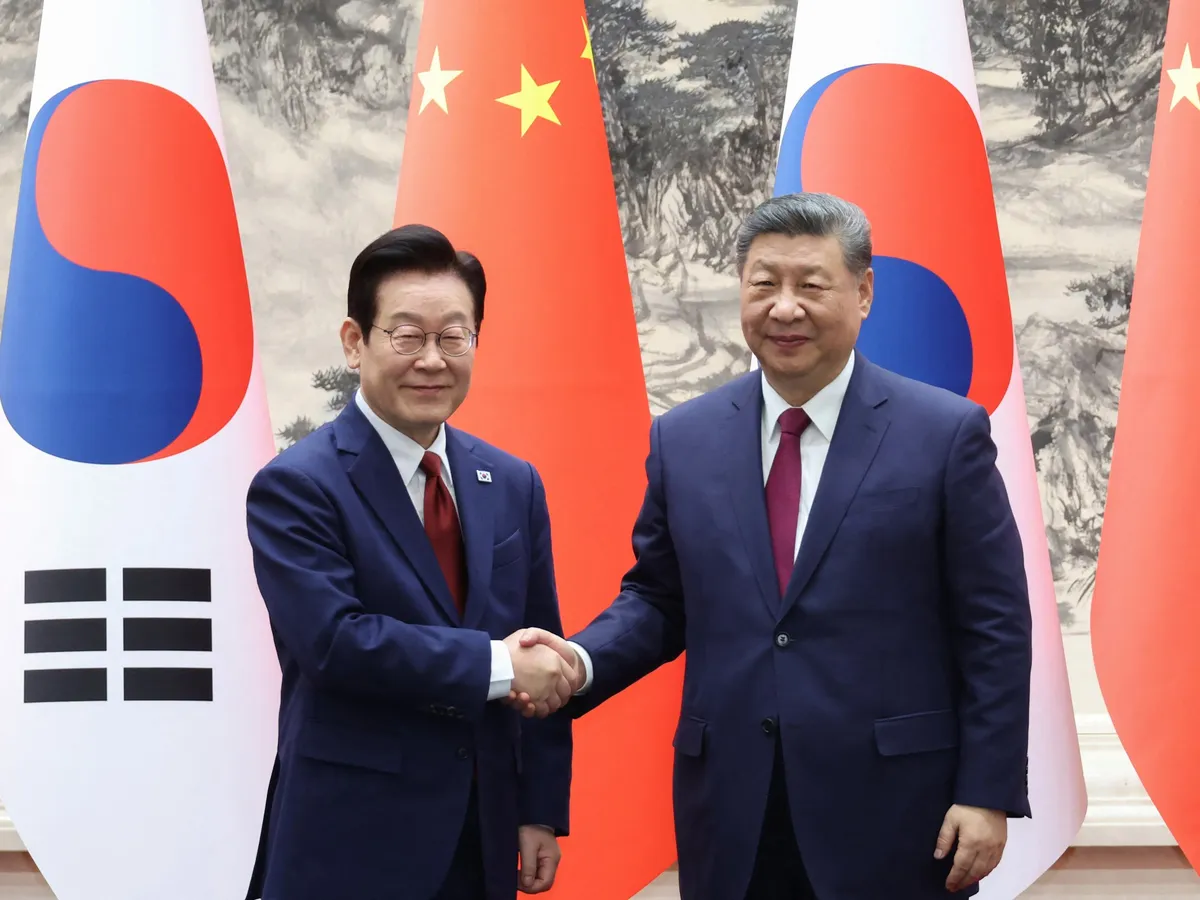
EXPLAINERAnalysts say both countries increasingly rely on each other for economic and security reasons amid geopolitical churn in the Asia Pacific region.South Korea's President Lee Jae Myung (L) shakes hands with China's President Xi Jinping during a memorandum of understanding signing ceremony at the Great Hall of the People in Beijing [AFP]Published On 6 Jan 2026Seoul, South Korea – Chinese President Xi Jinping and his South Korean counterpart, Lee Jae Myung, held their second summit in two months on Monday in a bid to steer the complex ties between their nations amid rising tensions in their neighbourhood.Lee had hosted Xi for talks on the sidelines of the 2025 Asia-Pacific Economic Cooperation (APEC) meeting in Gyeongju.Recommended Stories list of 4 itemslist 1 of 4Israel kills two in Gaza as Palestinians call for Rafah crossing to openlist 2 of 4The Take: What does Israel’s recognition of Somaliland mean for the region?list 3 of 4Battles erupt between Kurdish-led fighters and gov’t forces in north Syrialist 4 of 4‘Great fitness’: Sabalenka says ‘Battle of the Sexes’ match paid offend of listOn Sunday, it was Lee’s turn to make a trip to Beijing, starting a four-day visit – the first to China by a South Korean president since 2019.South Korea finds itself in a complex position: It needs firm relations with China, a key economic partner, but Beijing’s ties with Seoul’s two strongest allies, the United States and Japan, have deteriorated in recent years. China and South Korea have their own differences too, over Taiwan, trade tensions, and maritime claims.Why South Korea needs ChinaAgainst that backdrop, the timing of Lee’s visit is significant, say analysts: Reports suggest that the South Korean president is expected to visit Japan later this month, but he chose to travel to China first.Money clearly matters.China is South Korea’s largest economic partner, its top destination for exports, and a primary source of imports.But Seoul needs Beijing for more than economic reasons.Beijing is important to Seoul because of the influence it wields over North Korea and its leader, Kim Jong Un.The urgency of regional security was underscored by North Korea firing hypersonic missiles over the sea east of its territory just hours before Lee departed for China.What was discussed at the Xi-Lee summit?Monday’s summit opened with warm remarks from both leaders. Xi emphasised that the two nations “highly prioritise the South Korea-China relationship”.“Friends grow closer with each meeting, and neighbours grow closer with each visit,” said Xi, whose visit to South Korea for the APEC summit was the first by a Chinese president since 2014. “As friends and neighbours, South Korea and China must interact more frequently and communicate diligently.”Lee echoed Xi’s sentiments.Mason Richey, a professor of international politics at Hankuk University of Foreign Studies (HUFS) in Seoul, described the summit as the first true “test of Lee’s ability to navigate the tricky South Korean relationship with China”.“This trip is significantly important to South Korea after Lee focused so much on the US over the first seven months of his term,” he told Al Jazeera.But for all the cordial talk, “several critical, contentious issues were not addressed in any serious way,” he said. “In particular, Chinese hybrid threats against South Korea in the Yellow Sea, as well as Chinese coercion of Taiwan and the Philippines.” China insists that self-governing Taiwan belongs to it, and has not ruled out taking it by force. Beijing also held major wargames off Taiwan in December. China and the Philippines, meanwhile, have been locked in tense ties over competing claims to parts of the South China Sea.Lee Dong-gyu, a research fellow at the Asan Institute for Policy Studies, added that “both sides [China and South Korea] share a consensus that relations should be restored, and that economic cooperation is the way forward.“In reality, however, it does not seem easy to find common ground in external relations or in the domains of diplomacy and security.”North KoreaDuring the 90-minute summit, Lee stressed the importance of working with China to bring North Korea back to the dialogue table, at a time when Pyongyang has shown little sign of engaging in diplomacy.China remains North Korea’s principal ally and economic lifeline. Xi has promised economic support to the North – still technically at war with the South. Kim appeared alongside Xi during the Victory Day military parade in Beijing last year. Meanwhile, North Korea has dismissed Lee’s outreach, calling him a “hypocrite” and “confrontational maniac”.“(I) will work together (with China to) explore viable alternatives for peace on the Korean Peninsula so that both countries can jointly contribute to peace, the basic foundation for prosperity and growth,” Lee said in his opening remarks at the summit.While North Korea’s denuclearisation was not directly mentioned, Xi noted that the two countries “bear important responsibilities in safeguarding regional peace and promoting global development, and share broad common interests”.South Korea’s national security adviser Wi Sung Lac told reporters that “the two leaders underscored the importance of resuming dialogue with North Korea,” and said Lee and Xi had agreed to hold annual meetings and expand communication among defence authorities to “build mutual trust and contribute to regional peace and stability”.Silence on TaiwanIn an interview with Chinese state broadcaster CCTV last week, Lee said South Korea believed in “respecting the ‘one China’ principle” – the tenet under which countries must reject diplomatic ties with Taiwan to work with Beijing.However, he has previously advocated a more balanced stance, arguing that South Korea should not directly engage militarily over the Taiwan Strait, a conflict between two outside states.The issue has become more sensitive after statements made by Japanese Prime Minister Sanae Takaichi in November. She warned that a hypothetical Chinese attack on Taiwan could pose an “existential crisis for Japan” and might compel Tokyo to use its military. China-Japan tensions soared as Beijing accused her of interfering in its internal affairs. China issued a travel advisory for Japan and suspended a number of its imports from the country.During Monday’s summit, Xi told Lee that “both countries, with broad common interests, should stand firmly on the right side of history and make correct strategic choices.” Direct mentions of Taiwan were absent from discussions.Instead, Xi highlighted the shared Chinese and Korean experience of resisting Japan during World War II: “More than 80 years ago, China and South Korea made tremendous national sacrifices and won the victory against Japanese militarism,” Chinese state media Xinhua reported.Lee also noted the two neighbouring countries have maintained friendly ties for thousands of years and share a history of resisting the loss of sovereignty and fighting for independence, an apparent reference to Japan’s early 20th-century colonial expansion.US countermeasuresFor all of the apparent bonhomie on display in Beijing, South Korea must maintain a tricky balance, analysts said.The US continues to deepen its military presence in the Asia Pacific, strengthening ties with countries including South Korea, Japan and the Philippines, while conducting joint exercises near the South China Sea, where Chinese territorial claims have been contested for decades.South Korea hosts the largest US military base in Asia with roughly 28,500 soldiers stationed there.Richey from HUFS said: “Lee will ultimately privilege the relationship with the US more than China because he has no choice – neither as a matter of international relations nor domestically, where China is very unpopular.”In November, South Korea and the US agreed to build nuclear-powered submarines. This came after the US lowered tariffs on South Korean products in exchange for $350bn in US industrial investments and cooperation on the “Make American Shipbuilding Great Again” initiative, aimed at countering China’s dominance in the sector.China has previously expressed concern over South Korea acquiring nuclear capabilities although this topic was not discussed at the summit.Lee Dong-gyu from the Asan Institute for Policy Studies noted that China may seek common ground with South Korea regarding the Korean Peninsula and regional security to counter growing US influence in the region.“This is especially true in the period of the Trump administration when the US is increasingly demanding greater responsibility and contributions from its Asian allies to its containment of China. Given this situation, China may look to restore relations with South Korea to ease US-led efforts in the region,” he said.“Especially in the period of the Trump administration, China looks to counter the US’s increasing presence in the region, using its regional allies to continue pressing on China,” he said.South China Sea dramaThe summit also addressed sensitive maritime issues, particularly concerns over Beijing’s steel structures in a jointly managed Provisional Maritime Zone (PMZ) in the Yellow Sea, a shallow water body between mainland China and the Korean Peninsula.Since 2018, China has installed steel structures in the area, which Beijing claims are for fish farming, though concerns persist about territorial assertiveness in the South and East China Seas.Both sides agreed that turning the Yellow Sea into “a peaceful and co-prosperous sea” is essential for stable, long-term relations and that they would continue “constructive” consultations, South Korea’s national security adviser Wi Sung Lak said. They also agreed to hold vice-ministerial talks on the maritime boundary within this year.Lee was accompanied by heads of South Korean conglomerates, including Samsung, SK Group, and LG, as the two sides signed 14 memorandums of understanding in trade, technology, and environmental areas.Nearly half of South Korea’s rare earth minerals, essential for semiconductor production, come from China. China also accounts for a third of Seoul’s annual chip exports, its largest market.Meanwhile, Chinese firm Huawei plans to launch its Ascend 950 AI chips in South Korea next year, providing an alternative to US-based Nvidia for Korean firms, CEO Balian Wang said.China is also South Korea’s largest source of foreign tourists.Under former President Yoon Suk Yeol, South Korea-China relations were strained due to Yoon’s closer alignment with the US, amid intensifying US-China rivalry. But in an era of Trump’s tariffs, Seoul is seeking more of a balance between security ties with Washington and economic links with Beijing.“South Korea and China are like ships sailing in the same sea toward the same direction,” Lee said at a bilateral business forum before his summit with Xi.South Korea’s President Lee Jae Myung (L) and his wife Kim Hea Kyung (2nd L) take a selfie with China’s President Xi Jinping (2nd R) and his wife Peng Liyuan (R) after a dinner at the Great Hall of the People in Beijing [AFP]Continuation of cultural exchangesWhile Beijing does not formally acknowledge restrictions, the two leaders discussed repairing cultural ties to expand Korean entertainment content access in China, which has faced unofficial bans.However, South Korean Presidential Chief of Staff Kang Hoon Sik told a radio interview that Beijing was unlikely to lift the informal ban anytime soon.And while their leaders might have exchanged warm words, the mood on the streets of China and South Korea isn’t very favourable for strong ties, point out analysts, citing anti-China rallies in South Korea and reports referring to anti-Korean sentiment in China.Still, Lee and Xi appeared to make an effort this week to present a different side to bilateral relations.After a state banquet, Lee took a selfie of the presidential couples, including a smiling Xi, using a Chinese-produced Xiaomi smartphone given to him by Xi during his visit to South Korea last year.“The image quality is certainly good, right?” Lee posted on social media, adding a beaming face emoji. “Thanks to you, I got the picture of a lifetime haha,” he added.
SRCAl Jazeera
LANGEN
LEANCenter
WORDS1 887
ENT11
TUE · 2026-01-06 · 11:23 GMTBRIEF NSR-2026-0106-5976
NSR-2026-0106-5976News Report·EN·Diplomatic
Can China and South Korea reset complex ties after Xi-Lee summit?
Chinese President Xi Jinping and South Korean President Lee Jae Myung held a summit in Beijing on Monday, January 6, 2026, during Lee's four-day visit, the first by a South Korean president to China since 2019. The meeting aimed to navigate complex relations amid regional tensions.
David D. LeeAl JazeeraFiled 2026-01-06 · 11:23 GMTLean · CenterRead · 8 min
Al JazeeraFIG 01
Reading time
8min
Word count
1 887words
Sources cited
1cited
Entities identified
11entities
Quality score
100%
§ 01
Briefing Summary
AI-generatedNEWSAR · AI
Chinese President Xi Jinping and South Korean President Lee Jae Myung held a summit in Beijing on Monday, January 6, 2026, during Lee's four-day visit, the first by a South Korean president to China since 2019. The meeting aimed to navigate complex relations amid regional tensions. South Korea relies on China as its largest economic partner and a key influence over North Korea, especially given recent North Korean missile tests. While South Korea needs strong ties with China, Beijing's relations with Seoul's allies, the U.S. and Japan, are strained, and the two countries have disagreements over Taiwan, trade, and maritime issues. The summit follows a previous meeting between the two leaders in Gyeongju in 2025.
Confidence 0.90Sources 1Claims 5Entities 11
§ 02
Article analysis
Model · rule-basedFraming
Diplomatic
Economic Impact
Tone
Measured
AI-assessed
CalmNeutralAlarmist
Factuality
0.70 / 1.00
Factual
LowHigh
Sources cited
1
Limited
FewMany
§ 03
Key claims
5 extracted01
Friends grow closer with each meeting, and neighbours grow closer with each visit.
quoteXi Jinping
Confidence
1.00
02
China is South Korea’s largest economic partner and top destination for exports.
factual
Confidence
1.00
03
Xi Jinping and Lee Jae Myung held their second summit in two months.
factual
Confidence
1.00
04
South Korea needs firm relations with China, a key economic partner.
factual
Confidence
0.90
05
Reports suggest that the South Korean president is expected to visit Japan later this month.
factual
Confidence
0.70
§ 04
Full report
8 min read · 1 887 words§ 05
Entities
11 identifiedKey playerOppositionContextPositiveNeutralNegative
People3
§ 06
Keywords & salience
10 termschina-south korea relations
1.00
xi jinping
0.90
lee jae myung
0.90
summit
0.80
economic partner
0.70
north korea
0.60
regional security
0.60
geopolitical churn
0.60
trade tensions
0.50
asia pacific
0.40
§ 07
Topic connections
Interactive graph Network visualization showing 51 related topics
View Full Graph Person Organization Location Event|Click node to navigate|Edge numbers = shared articles