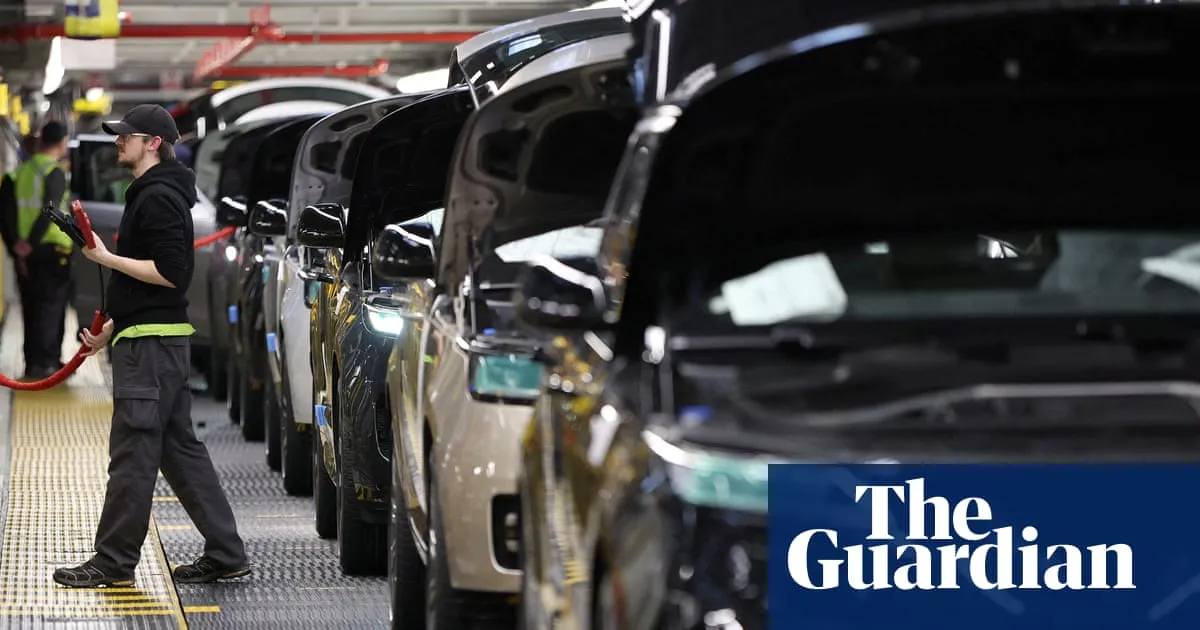
The Somerset battery factory due to supply Jaguar Land Rover is to receive £380m in UK government funding as it pushes ahead with construction despite delays.JLR, Britain’s largest automotive employer, is due to receive batteries from the site to make electric versions of its Range Rover and Jaguar models. The Indian conglomerate Tata owns JLR and the electric vehicle (EV) battery factory under its Agratas subsidiary.The business secretary, Peter Kyle, announced the grant on Thursday during a visit to the construction site in Bridgwater, Somerset. The government said the battery plant – also known as a gigafactory – would employ 4,200 people in the long term.Tata said in 2023 that the project would require as much as £4bn in investment, with a previously undisclosed portion funded by the UK government. However, progress has been slower than expected. Agratas had planned to start production 2026, although it appears increasingly unlikely after JLR last year delayed the launch of its flagship EV the Range Rover electric.EV manufacturers around the world have delayed or in some cases cancelled plans to produce new battery models after previously overestimating how quickly consumers would switch away from petrol.Donald Trump’s war in Iran has pushed up petrol prices significantly in recent weeks. The increase could make EVs more attractive to consumers and help justify the large investments needed from carmakers to switch to electric production.The Agratas plant will be only the second high-volume battery facility in the UK. It will eventually be able to make batteries with 40 gigawatt hours of capacity a year, enough to provide for hundreds of thousands of cars. The other UK gigafactory is run by AESC, a Chinese-owned battery manufacturer in Sunderland, in northern England.The Somerset factory is still only a steel frame, with construction still ongoing with the aim of starting battery production by the end of 2027. Agratas has also scaled back the physical footprint of the first building of the three eventually planned, although it said that was because it had designed more efficient processes rather than cutting planned output.JLR had planned to launch the electric Range Rover in 2025, but the Guardian last year revealed it had been delayed to this year. The vehicle is not yet on sale, although prototypes have been finished for months. The need to rush the car to market was reduced after the UK government watered down electric car sales targets.Tata has previously received a pledge of £500m in government support to upgrade its Welsh steelworks to cleaner electric arc furnaces.Kyle said the Agratas investment and several others in automotive research announced on Thursday would “boost economic growth and our resilience, secure jobs and put more money in people’s pockets”.The business secretary said: “In an unstable world, our modern industrial strategy is providing investors the stability and confidence they need to plan not just for the next year, but for the next 10 years and beyond. That is what sets us apart from the rest, and will help ensure advanced manufacturing remains a thriving sector in the UK for decades to come.”Earl Wiggins, the vice-president of UK manufacturing operations for Agratas, said: “We welcome the UK government’s investment as we build a battery manufacturing facility that will play a vital role in delivering net zero and strengthening the UK’s position as a global leader in battery manufacturing.“This funding will support the development of our Somerset facility, enabling us to produce battery cells for our anchor customer, JLR. Over the next year we will have over 2,200 people working on the site, and that growth will continue over the coming years.”Before the Agratas factory is completed JLR will source batteries from AESC. That deal was confirmed last year by Société Générale, an investment bank, although reference to JLR was removed from the website after the Guardian inquired about it.
SRCThe Guardian - World News
LANGEN
LEANCenter-Left
WORDS635
ENT12
THU · 2026-04-09 · 17:00 GMTBRIEF NSR-2026-0409-60673
NSR-2026-0409-60673News Report·EN·Economic Impact
Battery factory due to supply Jaguar Land Rover to get £380m UK grant
The Agratas battery factory in Somerset, intended to supply Jaguar Land Rover (JLR), will receive £380 million in UK government funding to support its construction. The factory, owned by Tata, JLR's parent company, is projected to employ 4,200 people and produce 40 gigawatt hours of battery capacity annually.
Jasper JollyThe Guardian - World NewsFiled 2026-04-09 · 17:00 GMTLean · Center-LeftRead · 3 min
The Guardian - World NewsFIG 01
Reading time
3min
Word count
635words
Sources cited
2cited
Entities identified
12entities
Quality score
100%
§ 01
Briefing Summary
AI-generatedNEWSAR · AI
The Agratas battery factory in Somerset, intended to supply Jaguar Land Rover (JLR), will receive £380 million in UK government funding to support its construction. The factory, owned by Tata, JLR's parent company, is projected to employ 4,200 people and produce 40 gigawatt hours of battery capacity annually. While Tata initially planned to begin production in 2026, delays, including JLR's postponement of its electric Range Rover launch, have pushed the estimated start date to late 2027. The plant aims to be the UK's second high-volume battery facility, despite scaling back the initial building's footprint due to process efficiencies. The government's investment aims to support the UK's electric vehicle transition, even amidst fluctuating consumer demand and global events impacting petrol prices.
Confidence 0.90Sources 2Claims 5Entities 12
§ 02
Article analysis
Model · rule-basedFraming
Economic Impact
Technology
Tone
Measured
AI-assessed
CalmNeutralAlarmist
Factuality
0.80 / 1.00
Factual
LowHigh
Sources cited
2
Limited
FewMany
§ 03
Key claims
5 extracted01
The Agratas plant will be able to make batteries with 40 gigawatt hours of capacity a year.
factual
Confidence
1.00
02
Tata said in 2023 that the project would require as much as £4bn in investment.
factualTata
Confidence
1.00
03
The battery plant would employ 4,200 people in the long term.
factualgovernment
Confidence
1.00
04
The Somerset battery factory is to receive £380m in UK government funding.
factual
Confidence
1.00
05
Construction is ongoing with the aim of starting battery production by the end of 2027.
factual
Confidence
0.90
§ 04
Full report
3 min read · 635 words§ 05
Entities
12 identifiedKey playerOppositionContextPositiveNeutralNegative
Organizations5
§ 06
Keywords & salience
9 termsbattery factory
1.00
electric vehicles
0.90
uk government funding
0.80
jaguar land rover
0.70
battery production
0.60
gigafactory
0.60
agratas
0.50
tata
0.50
range rover electric
0.40
§ 07
Topic connections
Interactive graph Network visualization showing 14 related topics
View Full Graph Person Organization Location Event|Click node to navigate|Edge numbers = shared articles