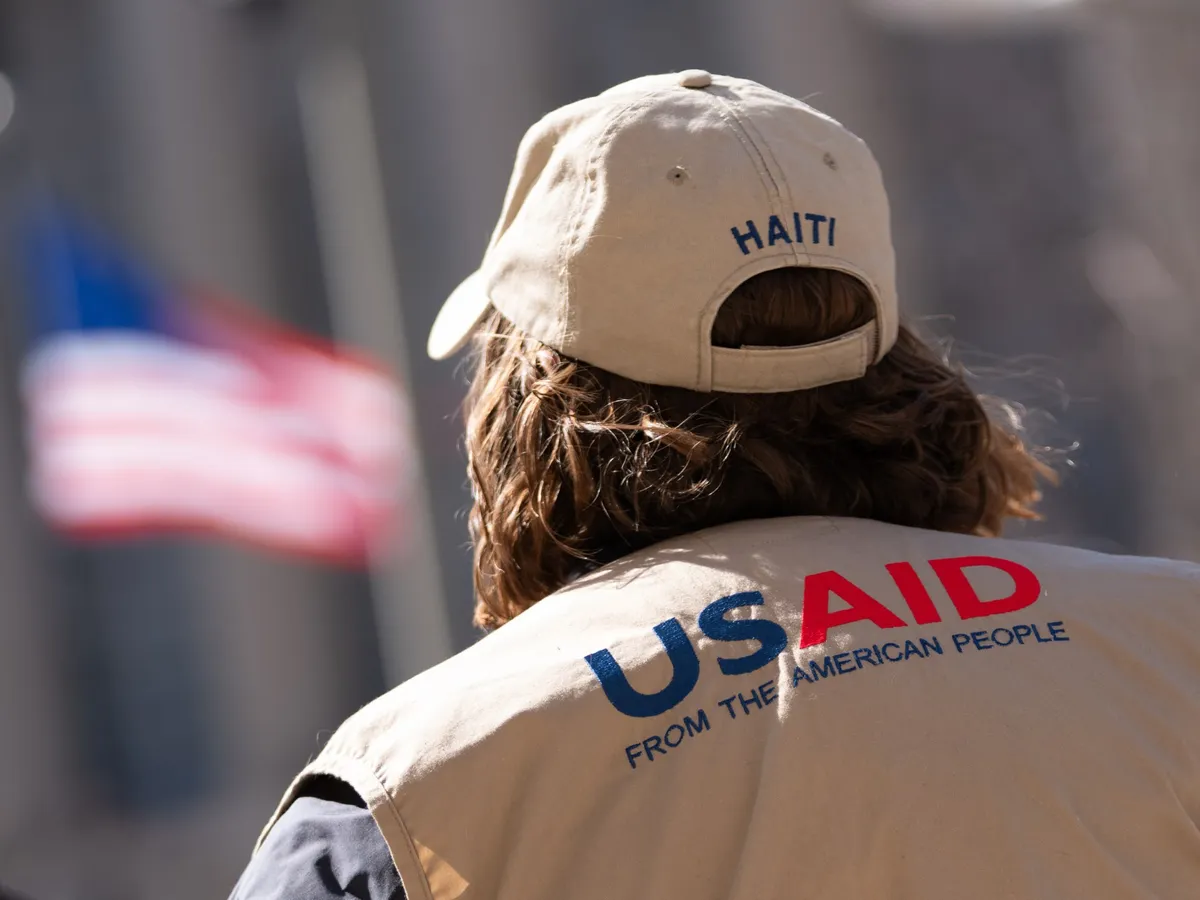
A forum of top economies in Europe and the Americas says aid from members declined 23 percent as humanitarian needs grow.Former staff from the US Agency for International Development (USAID) rally to mark one year since the agency was dismantled in Washington, DC [File: Allison Robbert/The Associated Press]Published On 9 Apr 2026Washington, DC – Preliminary data from the Organisation for Economic Co-operation and Development (OECD) has found that international development aid from its members dropped by about 23 percent from 2024 to 2025.Much of that decline was attributed to a major shortfall in funding from the United States.Recommended Stories list of 3 itemslist 1 of 3US slashes UN humanitarian aid to $2bn, huge cut as Trump demands reformslist 2 of 3‘Waiting to die’: Hunger, devastation in Tigray a year after US aid cutslist 3 of 3Trump is the ‘elephant in the room’ as the African Union holds new summitend of listThe forum, which includes many of the the largest economies across Europe and the Americas, said on Thursday that the US saw a nearly 57 percent drop in foreign aid in 2025.The OECD’s four other top contributors — Germany, the United Kingdom, Japan and France — also saw declines in their foreign aid assistance.The report marked the first time foreign development assistance from all five of the OECD’s top donors simultaneously declined. The total assistance for 2025 totaled only $174.3bn, down from $214.6bn the year before, representing the largest annual drop since the OECD began recording the data.OECD officials warned the dramatic decrease comes at a time when global economic and food security has been cast into doubt amid the stresses of the US-Israeli war with Iran.“It’s deeply concerning to see this huge drop in [development funding] in 2025, due to dramatic cuts among the very top donors,” OECD official Carsten Staur said in a statement.Thursday’s preliminary data shows that only eight member countries met or exceeded their funding from 2024.“We are in a time of increasing humanitarian needs,” Staur added, citing growing global uncertainty and extreme poverty. “I can only plead that DAC donors reverse this negative trend and start to increase their [assistance].”The data covers the 34 members of the OECD’s Development Assistance Committee (DAC), which provide the vast majority of global foreign assistance.But the numbers offer an incomplete picture of global development aid, as it fails to include influential non-DAC members including Turkiye, the United Arab Emirates, Qatar and China.The data tracked by the OECD distinguishes official development assistance from other forms of aid, including military funds.US drives ‘three-quarters of the decline’In its preliminary assessment, the OECD noted that the US “alone drove three-quarters of the decline” in 2025, the first year of President Donald Trump’s second term.Trump has overseen widespread cuts to the US’s aid infrastructure, including dissolving the US Agency for International Development (USAID) as part of a wider effort to shrink government spending.The US contributed about $63bn in official development assistance in 2024, which was cleaved to just short of $29bn in 2025, according to OECD.Research this year from the University of Sydney has suggested that cuts to US funding over the past year have corresponded with an increase in armed conflict in Africa, as state resources grow more scarce.Other experts have noted that the slashed assistance is likely to prompt upticks in cases of HIV-AIDS, malaria and polio.Analysts at the Center for Global Development have projected that the US cuts were linked to between 500,000 and 1,000,000 deaths globally in 2025 alone. A recent article published in the medical journal The Lancet found that a “continuation of current downward trends” in development funding could lead to over 9.4 million new deaths by 2030.The Trump administration, meanwhile, has maintained it is transforming, not eschewing, the US aid model.In recent months, it has struck a handful of bilateral assistance agreements with African countries that it says are in line with its “America First” agenda.But while the details of such deals have not been made public, critics note that some negotiations appear to have involved requests for African countries to share mineral access or health data.‘Turning their backs’Oxfam, a confederation of several non-governmental aid organisations, was among those calling on wealthy countries to change course following Thursday’s report.“Wealthy governments are turning their backs on the lives of millions of women, men and children in the Global South with these severe aid cuts,” Oxfam’s Development Finance Lead Didier Jacobs said in a statement.Jacobs added that governments are “cutting life-saving aid budgets while financing conflict and militarisation”.As an example, he pointed to the US, where the Trump administration is expected to request between $80bn and $200bn for the US-Israeli war with Iran, which has currently been paused amid a tenuous ceasefire.The administration has separately requested a historic $1.5 trillion for the US military for fiscal year 2027.“Governments must restore their aid budgets and shore up the global humanitarian system that faces its most serious crisis in decades,” Jacobs said.
SRCAl Jazeera
LANGEN
LEANCenter
WORDS821
ENT12
THU · 2026-04-09 · 19:01 GMTBRIEF NSR-2026-0409-60918
NSR-2026-0409-60918News Report·EN·Economic Impact
US led ‘historic’ foreign aid decline in 2025 amid Trump cuts: OECD
A report by the Organisation for Economic Co-operation and Development (OECD) revealed a significant decline in international development aid in 2025. Aid from OECD members, primarily top economies in Europe and the Americas, dropped by 23 percent compared to 2024.
Joseph StepanskyAl JazeeraFiled 2026-04-09 · 19:01 GMTLean · CenterRead · 4 min
Al JazeeraFIG 01
Reading time
4min
Word count
821words
Sources cited
2cited
Entities identified
12entities
Quality score
100%
§ 01
Briefing Summary
AI-generatedNEWSAR · AI
A report by the Organisation for Economic Co-operation and Development (OECD) revealed a significant decline in international development aid in 2025. Aid from OECD members, primarily top economies in Europe and the Americas, dropped by 23 percent compared to 2024. The United States experienced the most substantial decrease, with a nearly 57 percent reduction in foreign aid. Germany, the United Kingdom, Japan, and France, also saw declines, marking the first time all five top donors simultaneously reduced assistance. The OECD officials expressed concern that this decrease, totaling $174.3 billion in 2025, occurs amidst growing global humanitarian needs and economic uncertainty.
Confidence 0.90Sources 2Claims 5Entities 12
§ 02
Article analysis
Model · rule-basedFraming
Economic Impact
Political Strategy
Tone
Mixed Tone
AI-assessed
CalmNeutralAlarmist
Factuality
0.80 / 1.00
Factual
LowHigh
Sources cited
2
Limited
FewMany
§ 03
Key claims
5 extracted01
The US “alone drove three-quarters of the decline” in 2025.
factualOECD
Confidence
1.00
02
It’s deeply concerning to see this huge drop in [development funding] in 2025, due to dramatic cuts among the very top donors.
quoteCarsten Staur, OECD official
Confidence
1.00
03
Total assistance for 2025 totaled only $174.3bn, down from $214.6bn the year before.
statisticOECD
Confidence
1.00
04
The US saw a nearly 57 percent drop in foreign aid in 2025.
statisticOECD
Confidence
1.00
05
International development aid from OECD members dropped by about 23 percent from 2024 to 2025.
statisticOrganisation for Economic Co-operation and Development (OECD)
Confidence
1.00
§ 04
Full report
4 min read · 821 words§ 05
Entities
12 identifiedKey playerOppositionContextPositiveNeutralNegative
Organizations3
§ 06
Keywords & salience
9 termsforeign aid
1.00
development aid
0.90
oecd
0.80
aid decline
0.70
us
0.60
humanitarian needs
0.60
funding shortfall
0.50
economic security
0.40
food security
0.40
§ 07
Topic connections
Interactive graph Network visualization showing 51 related topics
View Full Graph Person Organization Location Event|Click node to navigate|Edge numbers = shared articles