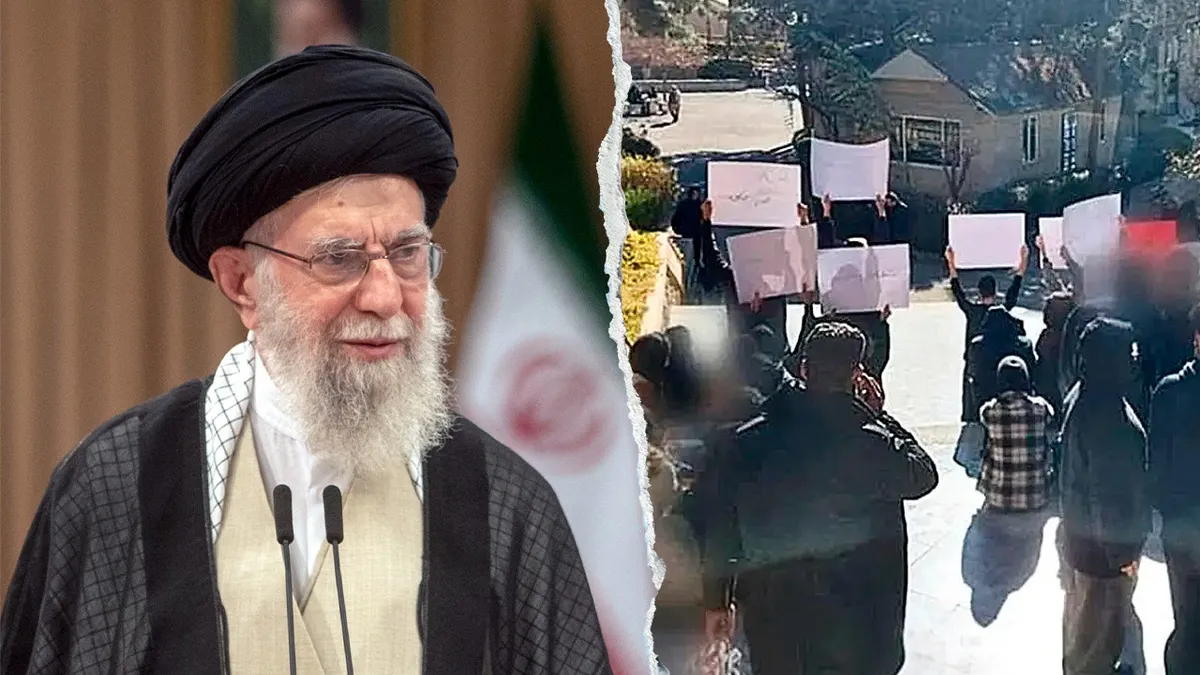
The State Department has intensified its criticism of Iran’s regime on its Persian-language account since the outbreak of nationwide protests against the ayatollahs, mirroring President Donald Trump’s forceful warning to Tehran. Trump recently posted, "If Iran shots (sic) and violently kills peaceful protesters, which is their custom, the United States of America will come to their rescue. We are locked and loaded and ready to go. Thank you for your attention to this matter! President DONALD J.TRUMP." "President Trump’s latest truth social post regarding Iran speaks for itself," a U.S. State Department spokesperson told Fox News Digital on Tuesday. Iran PROTESTS PROMPT NEW TRUMP WARNING OVER DEADLY GOVERNMENT CRACKDOWNS The State Department’s reinforcement of Trump’s pledge to aid Iranian demonstrators comes amid reports that protesters had taken control of many streets in Abdanan, in Ilam province in western Iran , on Tuesday. They chanted "Death to Khamenei" and "This year is a year of blood, Seyed Ali (Khamenei) will be overthrown," according to videos sent to Iran International news organization. The State Department’s Persian-language account , @USABehFarsi, appeared to issue a stark warning to Iran’s totalitarian rulers. "President Trump is a man of action. If you didn’t know before, now you do. Don’t mess with President Trump." The black-and-white picture showed Trump with his leadership team watching elite U.S. army forces seize the former Iran-backed Venezuelan dictator Nicolás Maduro. Iran’S KHAMENEI LASHES OUT AT PROTESTERS AS NATIONWIDE ANTI-REGIME UNREST GROWS Trump's social media posts and the statements coming from the State Department's account have emboldened Iranians both inside and outside of the country. Potkin Azarmehr, a British-Iranian journalist, noted the contrast with previous administrations. "Well, what a contrast to Obama’s time when protesters in Iran in 2009 were angrily chanting, ‘Obama, are you with us or with them?' Any international support, whether at grassroots level or government level is encouraging. Knowing that the world knows about you," he added that "The question is where are the Western activist elite protesters? Why are they not protesting? Are they on the side of the ayatollahs? An archaic religious apartheid?" Iran analyst Alirzeza Nader said, "I think State is right to say that the alternative to the current regime will come from inside Iran. And that Iranians will choose their own leaders. Yes, it’s definitely better now. Unfortunately, the Obama and Biden administrations pushed the reformist line (the Reformist line espoused by Rouhani and Khatami). My advice to the Trump administration: stay neutral when it comes to the opposition’s leadership. Let Iranians figure it out." TRUMP SIGNS 'MAKE Iran GREAT AGAIN' HAT ALONGSIDE LINDSEY GRAHAM The former Iranian presidents, Hassan Rouhani and Mohammad Khatami, promised mild reforms but remain wedded to the Islamic Republic of Iran — a regime that has been repeatedly classified by the State Department as a leading state sponsor of terrorism. Navid Mohebbi, who worked as a Persian media analyst for the State Department's Public Affairs Bureau, said about the State Department’s Persian-language X account that "During the Biden administration, this account was effectively turned into a ghost town and largely lost its relevance and impact." He said, "Following President Trump’s recent tweet, we have seen a renewed level of activity reminiscent of his first term — an approach that has again drawn the attention of Iranians. Trump’s message effectively removed the account’s excessive caution, and over the past four days its anti-regime tone has noticeably intensified." Mohebbi said, "The account should avoid involvement in opposition infighting, remain sensitive to Iranian public sentiment, and operate in alignment with the prevailing mood of Persian Twitter. I hope Trump’s warning message to the regime will serve as a catalyst for upgrading the messaging strategy of this account and restoring its former effectiveness." Reza Parchizadeh, an Iranian-American expert on the regime, said, "The State Department’s Persian-language account is performing effectively. Its messaging is deliberately structured to project a sense of American support and hope toward Iranian protesters, while also attempting to reflect the breadth and diversity of protest activity rather than treating it episodically or selectively. In itself, this represents a notable shift in approach." He noted, "The Obama era was fundamentally different in orientation and intent. That administration prioritized reaching a diplomatic accommodation with the Islamic Republic and reintegrating the regime into the international system. Within that framework, popular protests and organized opposition inside Iran were largely downplayed by the State Department in order to avoid complicating negotiations or signaling regime vulnerability."
SRCFox News - World
LANGEN
LEANCenter-Right
WORDS741
ENT9
TUE · 2026-01-06 · 19:36 GMTBRIEF NSR-2026-0106-6094
NSR-2026-0106-6094News Report·EN·Political Strategy
Iran protesters emboldened by Trump admin’s Persian messaging after Obama-Biden inaction, activists say
Amid ongoing protests in Iran, the U.S. State Department has amplified its Persian-language messaging, echoing President Trump's warnings to Tehran against violently suppressing demonstrators.
Benjamin WeinthalFox News - WorldFiled 2026-01-06 · 19:36 GMTLean · Center-RightRead · 3 min
Fox News - WorldFIG 01
Reading time
3min
Word count
741words
Sources cited
4cited
Entities identified
9entities
Quality score
100%
§ 01
Briefing Summary
AI-generatedNEWSAR · AI
Amid ongoing protests in Iran, the U.S. State Department has amplified its Persian-language messaging, echoing President Trump's warnings to Tehran against violently suppressing demonstrators. The State Department's account, @USABehFarsi, issued a stark warning to Iran's leaders, highlighting Trump's decisiveness. Activists say this forceful approach contrasts with the Obama-Biden administration's perceived inaction during past Iranian protests, and has emboldened Iranian protesters both domestically and abroad. Protesters in Iran have reportedly taken control of streets in some areas, chanting slogans against Supreme Leader Khamenei. The State Department maintains that any alternative to the current regime will emerge from within Iran, with Iranians choosing their own leaders.
Confidence 0.90Sources 4Claims 5Entities 9
§ 02
Article analysis
Model · rule-basedFraming
Political Strategy
Human Rights
Tone
Mixed Tone
AI-assessed
CalmNeutralAlarmist
Factuality
0.70 / 1.00
Factual
LowHigh
Sources cited
4
Well sourced
FewMany
§ 03
Key claims
5 extracted01
Trump posted, 'If Iran shots (sic) and violently kills peaceful protesters...the United States of America will come to their rescue.'
quoteDonald Trump
Confidence
1.00
02
The State Department has intensified its criticism of Iran’s regime on its Persian-language account.
factualArticle
Confidence
1.00
03
Obama and Biden administrations pushed the reformist line.
factualAlirzeza Nader
Confidence
0.90
04
Protesters had taken control of many streets in Abdanan, in Ilam province in western Iran.
factualArticle
Confidence
0.80
05
Trump's social media posts and the statements coming from the State Department's account have emboldened Iranians.
factualArticle
Confidence
0.70
§ 04
Full report
3 min read · 741 words§ 05
Entities
9 identifiedKey playerOppositionContextPositiveNeutralNegative
People3
Organizations1
§ 06
Keywords & salience
9 termsiran protests
1.00
trump administration
0.90
persian messaging
0.80
state department
0.70
regime criticism
0.60
government crackdowns
0.50
obama administration
0.50
khamenei
0.40
anti-regime unrest
0.40
§ 07
Topic connections
Interactive graph Network visualization showing 51 related topics
View Full Graph Person Organization Location Event|Click node to navigate|Edge numbers = shared articles