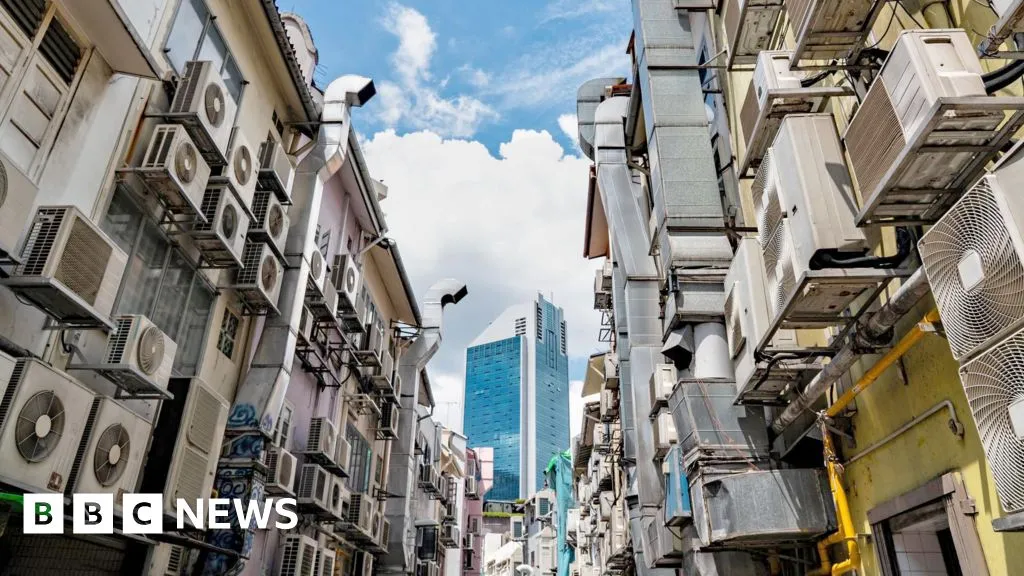
Hot in the city: Energy crisis tests Singapore's air-con addiction2 hours agoOsmond ChiaBusiness reporterGetty ImagesSingapore is infamous in Asia for its widespread use of air-conditioningSingapore - infamous for its widespread use of air-conditioning - has told government employees to bring up the temperature in offices to at least 25C (77F) as it grapples with rising energy prices caused by the Iran war.The city-state's public offices will also install power-efficient technology like LED lights and smart sensors to help conserve energy.Singapore joins other countries in Asia" class="entity-link entity-location" data-entity-id="6234" data-entity-type="location">South East Asia that have taken steps to save energy, like Thailand, which also asked people to keep air conditioners at 26-27C.The region is heavily reliant on oil and gas shipments that pass through the Strait of Hormuz, which has been effectively shut since the war began. In 1999, Lee Kuan Yew, widely seen as the founding father of modern Singapore, famously credited air-conditioning with having "changed the lives of people in tropical regions" by enabling work indoors despite the heat outside.The former prime minister is quoted as saying: "The first thing I did upon becoming prime minister was to install air conditioners in buildings where the civil service worked. This was key to public efficiency."Lee, who died in 2015, is often credited as being the mastermind of Singapore's post colonial transformation from a resource-scarce island to one of Asia's most advanced economies.Today, there are very few offices in the country without air-conditioning - though some will argue that its use tends to be quite excessive. It is not uncommon for employees to bring in cardigans or sweaters to wear in office hours because temperatures are maintained at such low levels. And unlike many cities in Asia" class="entity-link entity-location" data-entity-id="6234" data-entity-type="location">South East Asia with open-air shopping streets, Singapore's malls are almost entirely air-conditioned.In fact, pedestrians on Singapore's streets will often find themselves blasted with a shock of icy cold air as they walk past entrances to malls and department stores. All the city's buses and trains are also air-conditioned.Most homes are also fitted with air-conditioning units - often left on overnight. Singapore's Ministry of Sustainability and the Environment said on 8 April that the government was "taking the lead" in its energy-saving effort as the Iran war has hit global fuel supply chains.Government employees are being told to set the air-conditioning to 25C and closely manage how long they are in use."Each degree raised reduces energy needs by around 10%," the ministry said.Workers are also being urged to switch to fans and to take public transportation to cut the use of fuel.Businesses and members of the public have also been encouraged to do the same.Fuel prices in Singapore have risen and the authorities have issued warnings to the public to be prepared for more economic disruptions caused by war in the Middle East.The republic has yet to draw from its fuel reserves or introduce rationing measures since the war.Getty ImagesSingapore is known for being a shopping destinationAbout two-thirds of Singapore's crude oil imports come from countries in the Middle East, according to the US Energy Information Administration.Thailand has also implemented urgent energy-saving measures including ordering public office employees to work from home. People in Thailand have also been asked to keep air conditioning at 26-27C and to conserve fuel by carpooling or using public transport.South Korea, which imports more than two-thirds of its energy from the Gulf, has launched an energy-saving campaign, encouraging people to take shorter showers and to use washing machines only on weekends.The economic fallout of the Iran war can be described as the "Asian crisis", said Ichiro Kutani from Japan's Institute of Energy Economics.Developing countries were being hit especially hard, due to the sheer number of petrol cars as well as households that rely on gas, he said.In the long term, this was a tough lesson for Asia "to learn from this crisis and aim to use oil efficiently and diversify our sources of supply", said Kutani.
SRCBBC News - World
LANGEN
LEANCenter
WORDS651
ENT8
THU · 2026-04-09 · 22:03 GMTBRIEF NSR-2026-0410-61089
NSR-2026-0410-61089News Report·EN·Economic Impact
Hot in the city: Energy crisis tests Singapore's air-con addiction
Singapore, known for its heavy air-conditioning use, is implementing energy-saving measures in response to rising energy prices caused by the Iran war. Government employees are instructed to set office air conditioning to at least 25C and utilize energy-efficient technology like LED lights.
BBC News - WorldFiled 2026-04-09 · 22:03 GMTLean · CenterRead · 3 min
BBC News - WorldFIG 01
Reading time
3min
Word count
651words
Sources cited
2cited
Entities identified
8entities
Quality score
100%
§ 01
Briefing Summary
AI-generatedNEWSAR · AI
Singapore, known for its heavy air-conditioning use, is implementing energy-saving measures in response to rising energy prices caused by the Iran war. Government employees are instructed to set office air conditioning to at least 25C and utilize energy-efficient technology like LED lights. This action aligns with similar efforts in Southeast Asia, such as Thailand's temperature guidelines, due to the region's reliance on oil and gas shipments through the Strait of Hormuz, which is impacted by the war. Singapore's widespread air-conditioning, credited by its founding father Lee Kuan Yew for boosting productivity, is now being re-evaluated as the government takes the lead in energy conservation. The initiative aims to mitigate the impact of global fuel supply chain disruptions.
Confidence 0.90Sources 2Claims 5Entities 8
§ 02
Article analysis
Model · rule-basedFraming
Economic Impact
Environmental
Tone
Measured
AI-assessed
CalmNeutralAlarmist
Factuality
0.70 / 1.00
Factual
LowHigh
Sources cited
2
Limited
FewMany
§ 03
Key claims
5 extracted01
Each degree raised reduces energy needs by around 10%.
statisticSingapore's Ministry of Sustainability and the Environment
Confidence
1.00
02
Lee Kuan Yew credited air-conditioning with having 'changed the lives of people in tropical regions'.
quoteLee Kuan Yew
Confidence
1.00
03
Singapore's public offices will install power-efficient technology like LED lights and smart sensors to conserve energy.
factualnull
Confidence
1.00
04
Singapore has told government employees to raise office temperatures to at least 25C due to rising energy prices.
factualnull
Confidence
1.00
05
The region is heavily reliant on oil and gas shipments that pass through the Strait of Hormuz.
factualnull
Confidence
0.90
§ 04
Full report
3 min read · 651 words§ 05
Entities
8 identifiedKey playerOppositionContextPositiveNeutralNegative
§ 06
Keywords & salience
9 termsair-conditioning
1.00
singapore
0.90
energy crisis
0.90
energy prices
0.70
energy conservation
0.70
iran war
0.60
fuel supply chains
0.60
south east asia
0.50
public efficiency
0.40
§ 07
Topic connections
Interactive graph Network visualization showing 51 related topics
View Full Graph Person Organization Location Event|Click node to navigate|Edge numbers = shared articles