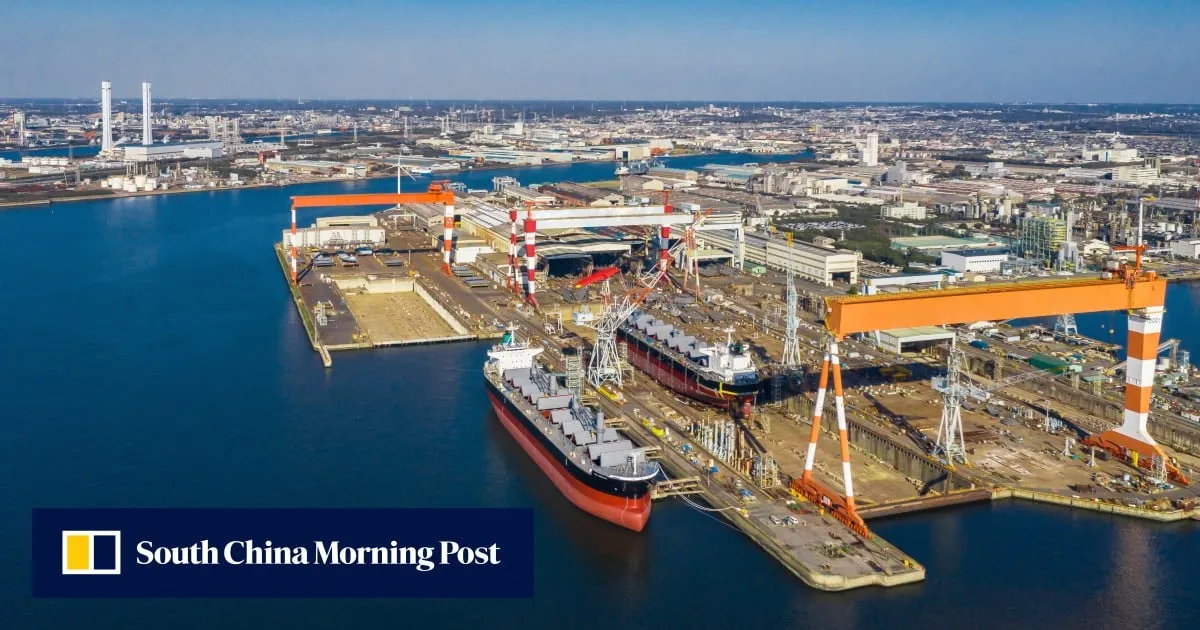
Japan is forging ahead with an investment plan that could see as much as 1 trillion yen (US$6.3 billion) pumped into its shipbuilding sector as it tries to wrest back greater control of a key strategic industry.However, analysts said money alone would not be enough to restore Japan’s former standing in a sector now dominated by China, with higher costs, labour shortages and years of lost capacity all standing in the way.The effort has taken on greater urgency as turmoil in the Middle East has exposed the vulnerabilities of global shipping routes, with Tokyo increasingly viewing shipbuilding as both an economic and security priority.Concern over Japan’s declining role in the global shipbuilding sector has persisted for more than a decade, but attitudes shifted more sharply after Donald Trump returned to the White House in January last year and shipbuilding emerged as an area for possible cooperation between Japan and the US.For Tokyo, repairing and building US warships in the eastern Pacific was seen as a way to offset the tariffs Trump imposed early in his second administration.In June, the ruling Liberal Democratic Party’s special committee on marine transport set up a new forum to examine shipbuilding’s links to economic security. Before the end of the month, a proposal for large-scale investment totalling 1 trillion yen had been put forward.Japan’s private sector has offered to contribute 350 billion yen of that total, while the government is proposing to match that figure over the first 10 years and meet its full commitment in the years that follow. The initial target is to double domestic shipbuilding production by 2035.“Japan is still the third-largest shipbuilding country in the world by tonnage output, so not insignificant, but it is clearly far behind China and South Korea,” said Darron Wadey, an industry analyst with shipping consultancy Dynamar BV of the Netherlands.A shipbuilding yard in Chongqing, China. Photo: AFPJapan accounts for about 13 per cent of annual global output, according to the UN Conference on Trade and Development, around half its share at the turn of the decade. The number of shipbuilding facilities across the country fell from 194 in 2018 to 178 in 2024.South Korea’s share has been “pressurised” but is still around 28 per cent, according to Wadey, while China has dramatically expanded its shipbuilding sector and now controls about 55 per cent of global output.Wadey told This Week in Asia that rebuilding the sector and making Japan competitive again would not be as simple as injecting funds, regardless of the amount.“Much like ships take years to build, it will similarly take years to rebuild any manufacturing capacity. And to make these investments work will require backing from both the state and commercial sectors in the form of vessel orders,” he said.Further Reading“It is not a case of ‘build the yards and the orders will come’. Owners need sound reasons to order in Japan.”Japan’s shipbuilding sector is looking to pivot towards “more complex, higher-end vessels than standardised, easy-to-produce types”, according to Wadey – a tactic already adopted by both Europe and South Korea, though one that “would suggest the days of Japan’s tonnage-based production dominance will never be regained”.Details of how the funds will be allocated have yet to be released, though outline plans exist for a “national dockyard” scheme under which the central government would finance the construction of new yards, refurbish unused facilities and equip them before handing site operations to the private sector.Investment will also be needed in training skilled engineers, as the industry shed around 10,000 skilled jobs in the six years to 2024.A shipbuilding yard of Hanhwa Ocean in Geoje, South Korea. Photo: NurPhoto via Getty ImagesTimothy Renshaw, an industry analyst and editor of Vancouver-based Substack Shipping News, cautions that Japan cannot afford to repeat the mistakes successive US administrations have made.“Aside from Korea and Europe, the rest of the world – including Canada and the US – has been relegated to a paltry 5 per cent,” he said, noting that shipyards were unable to compete with China’s “market-distortion tactics” in steel, labour and other areas.“For North America, that abdication of shipbuilding power is proving to be a calamitous mistake that will take many years and many multibillions of investment dollars to reverse.”Wadey believes Japan needs to harness its skills across industries to regenerate the shipbuilding sector.“Quite clearly, Japan is a highly developed and technologically advanced country that across its industries consistently looks for innovation. I cannot see why the country’s shipbuilding sector would not show the same spirit and application,” he said.“Furthermore, Japan has a loyal shipping sector who would prefer to order locally if at all possible. This is not unique to Japan, but the raw potential is there with shipping concerns as “K” Line, MOL and NYK, plus others whose fleets number the many hundreds of vessels and criss-cross the globe.”Hurdles beyond funding remain, however. “Japan has similar challenges being faced by other industrialised nations, namely a higher cost base, principally labour, and an ageing workforce as labour-based work becomes less attractive to the newer generations entering the workforce,” Wadey said.00:57World’s largest container ship leaves dry dock in ShanghaiWorld’s largest container ship leaves dry dock in ShanghaiThat cost premium explains why shipbuilding initially migrated from Europe and the US to Japan, then to South Korea and ultimately China.In 2025, Taiwan’s Yang Ming ordered three 8,000-container vessels from Japan’s Nihon Shipbuilding at around US$120 million apiece. By contrast, Doun Kisen of Japan ordered a pair of 8,800-container ships from a South Korean yard for US$105 million each.“Geopolitical events have highlighted the vulnerabilities of dependence, think here of maritime routes through Hormuz or the Red Sea,” Wadey said.“Shipbuilding is increasingly being seen as a national strategic issue, with moves to improve the state of the sector in the US, for example, even predating the current administration.”Europe, Japan and South Korea may still have narrow qualitative and technological advantages, according to Wadey, but they no longer enjoy standardised – and therefore cheaper – production capacity.That means balancing cost, quality and capacity would be the challenge for Japan to overcome if it wanted to effectively regain control of its own shipping capacity, he added.
SRCSouth China Morning Post
LANGEN
LEANCenter-Right
WORDS1 023
ENT8
FRI · 2026-04-10 · 00:00 GMTBRIEF NSR-2026-0410-61108
NSR-2026-0410-61108News Report·EN·Economic Impact
Can Japan regain shipbuilding might with US$6.3 billion funding plan?
Japan is launching a US$6.3 billion investment plan to revitalize its shipbuilding industry, aiming to regain market share lost to China and South Korea. The initiative, driven by economic and security concerns heightened by global shipping route vulnerabilities, seeks to double domestic shipbuilding production by 2035.
Julian RyallSouth China Morning PostFiled 2026-04-10 · 00:00 GMTLean · Center-RightRead · 5 min
South China Morning PostFIG 01
Reading time
5min
Word count
1 023words
Sources cited
1cited
Entities identified
8entities
Quality score
100%
§ 01
Briefing Summary
AI-generatedNEWSAR · AI
Japan is launching a US$6.3 billion investment plan to revitalize its shipbuilding industry, aiming to regain market share lost to China and South Korea. The initiative, driven by economic and security concerns heightened by global shipping route vulnerabilities, seeks to double domestic shipbuilding production by 2035. While the private sector will contribute 350 billion yen, the government plans to match that figure over the first 10 years. Analysts note that Japan's shipbuilding facilities have declined, and the country now accounts for approximately 13% of global output, significantly less than China's 55%. The effort also aims to strengthen cooperation with the US in shipbuilding, particularly for repairing and building US warships in the eastern Pacific.
Confidence 0.90Sources 1Claims 5Entities 8
§ 02
Article analysis
Model · rule-basedFraming
Economic Impact
National Security
Tone
Measured
AI-assessed
CalmNeutralAlarmist
Factuality
0.70 / 1.00
Factual
LowHigh
Sources cited
1
Limited
FewMany
§ 03
Key claims
5 extracted01
China now controls about 55 per cent of global output in shipbuilding.
statisticDarron Wadey, Dynamar BV
Confidence
1.00
02
Japan accounts for about 13 per cent of annual global output.
statisticUN Conference on Trade and Development
Confidence
1.00
03
The initial target is to double domestic shipbuilding production by 2035.
factual
Confidence
1.00
04
Japan is planning to invest up to 1 trillion yen (US$6.3 billion) in its shipbuilding sector.
factual
Confidence
1.00
05
Rebuilding the sector will require backing from both the state and commercial sectors in the form of vessel orders.
quoteDarron Wadey, Dynamar BV
Confidence
0.90
§ 04
Full report
5 min read · 1 023 words§ 05
Entities
8 identifiedKey playerOppositionContextPositiveNeutralNegative
Organizations2
§ 06
Keywords & salience
8 termsshipbuilding
1.00
japan
0.90
china
0.70
investment plan
0.70
economic security
0.60
global shipping
0.50
us
0.50
labor shortages
0.40
§ 07
Topic connections
Interactive graph Network visualization showing 51 related topics
View Full Graph Person Organization Location Event|Click node to navigate|Edge numbers = shared articles