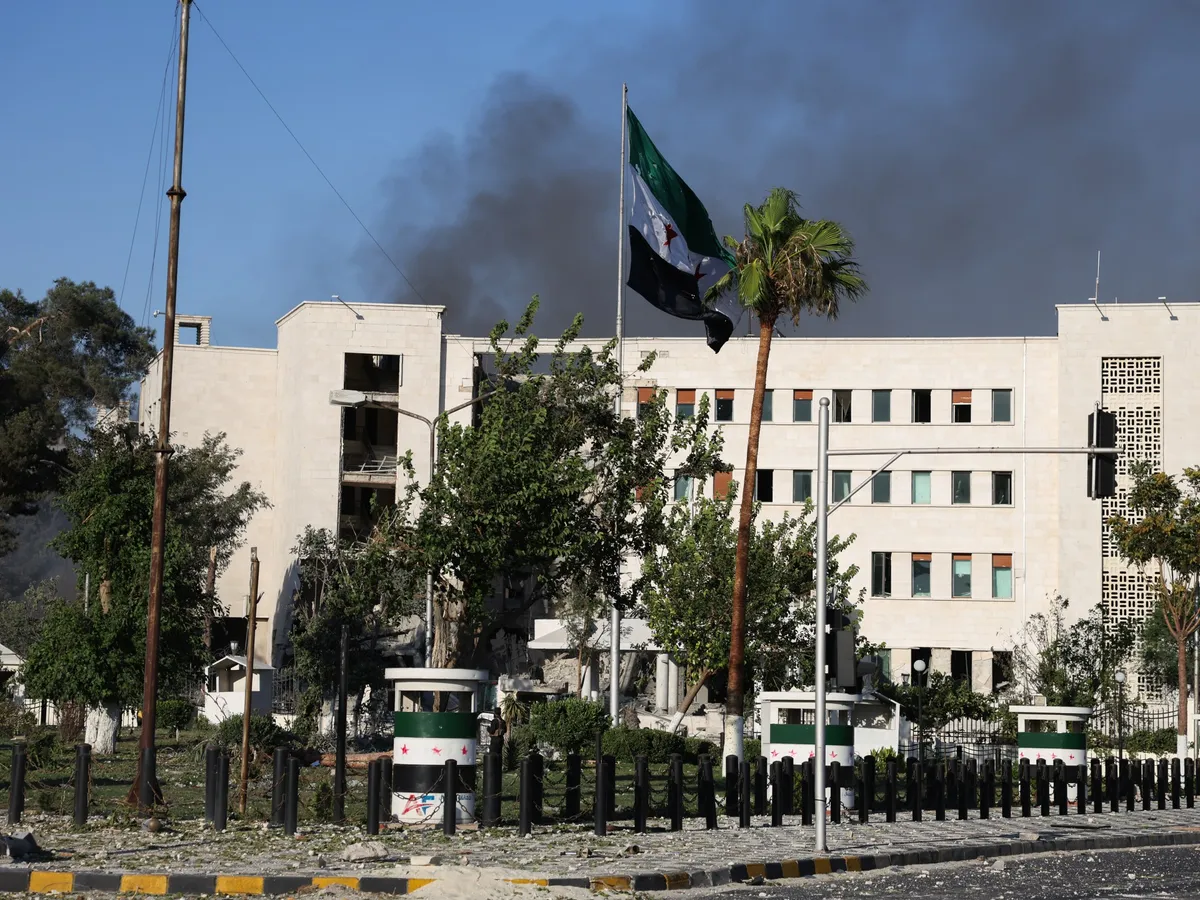
Smoke rises in the aftermath of an Israeli airstrike on Syria's defence ministry headquarters on July 16, 2025 in Damascus, Syria. [Ali Haj Suleiman/Getty Images]Published On 7 Jan 2026Syria and Israel have agreed to set up a joint mechanism after US-mediated talks in Paris on Tuesday, in what they are calling a “dedicated communication cell” aimed at sharing intelligence and coordinating military de-escalation.The two countries have had a US-backed security agreement in place since 1974. However, when the Assad regime fell on December 8, 2024, Israel began attacking Syrian military infrastructure and pushed their troops into the demilitarised zone that is Syrian territory.Syria and Israel have been engaging in intermittent negotiations over the last year to find a security agreement that would stop Israel’s repeat aggression against Syrians and Syrian territory.Here’s everything you need to know about these talks.What is the mechanism?“The mechanism will serve as a platform to address any disputes promptly and work to prevent misunderstandings,” a joint statement released by the two countries said after the agreement on Tuesday.The idea is to have a body that will deal with grievances and resolve disputes between Israel and Syria, ideally in a way that brings Israeli attacks on Syrian land and people to an end. Both sides may also hope it can pave the way to a renewed security agreement.What does Syria want?A government source told state media SANA, that the focus for Syria is to reactivate “the 1974 Disengagement Agreement, with the aim of ensuring the withdrawal of Israeli forces to the lines in place prior to Dec. 8, 2024 within a reciprocal security agreement that prioritizes full Syrian sovereignty and guarantees the prevention of any form of interference in Syria’s internal affairs.”The Syrian government, led by President Ahmed al-Sharaa, will want Israel to respect Syrian sovereignty by pulling back its forces and stopping attacks but also to stop meddling in domestic affairs.The Washington Post reported that Israel has supported figures opposed to Syria’s new government, including Suwayda’s Hikmat al Hijri. Israel has previously said they want to protect Syria’s minority Druze community.What does Israel want?Three things mainly, according to Al Jazeera’s senior correspondent Resul Serdar.“For Israel, it’s about more land, patronage of minorities, and long term leverage,” he said.Israel has tried to paint the new government in Syria as extremist and a threat to its security. It has called for the area south of Damascus to be demilitarised, while also trying to build relations with Syrian minorities, particularly the Druze in Suwayda.Analysts believe this could be part of a strategy by Israel to keep its neighbours weak.Israel has come to the table at least partially due to US leverage and influence. US President Donald Trump and his Special Envoy Tom Barrack have both built warm relations with al-Sharaa.But Israel may also want to counter Turkish influence in Syria. Israel has previously accused Turkiye of turning Syria into its protectorate.What does the US want?“For Washington the priority is containment,” Serdar said.The US also sees Damascus as a crucial partner in the fight against ISIL. Stability in Syria, particularly under a central government in Damascus, could mean pulling US troops out of eastern Syria.But the US also wants a strong Syria to avoid the return of Iranian influence in the country and to avoid any wider regional violence.For his part, Trump is eager to expand the Abraham Accords that sees Arab and Muslim countries sign normalisation agreements with Israel and has said he hopes Syria will do so. Syria, however, has said they do not intend to sign the Abraham Accords.Will the mechanism work?There are doubts.A Syrian official told Reuters news agency that his country isn’t willing to move forward on “strategic files” without an enforced timeline over Israel’s withdrawal from Syrian territory taken after December 2024.In addition to moving into Syrian territory, Israel has conducted numerous attacks on Damascus, including on the Syrian Ministry of Defense building.A similar mechanism between Israel and Lebanon was created after the November 2024 ceasefire there, with France and the United States involved to enforce the deal. However, the mechanism has not stopped near-daily attacks by Israel on Lebanese territory, nor has it led to the withdrawal of Israeli troops from five occupied points in Lebanon.For the mechanism to work, the United States will have to do something it has rarely done in recent years: hold Israel accountable.Israel has illegally occupied areas of the Syrian Golan Heights since 1967.Israeli officials have indicated they are not willing to return the Golan Heights to the new Syrian government.After the fall of the Assad regime, Israel expanded into Syrian territory and seized the strategic outlook of Jabal al-Sheikh, a mountain that lies between Syria, Lebanon and Israel.For now, Syria appears to be focused on getting Israel out of the areas it occupied since December 2024.
SRCAl Jazeera
LANGEN
LEANCenter
WORDS799
ENT10
WED · 2026-01-07 · 10:46 GMTBRIEF NSR-2026-0107-6151
NSR-2026-0107-6151News Report·EN·Diplomatic
Everything you need to know about the Syria – Israel deal in Paris
In Paris on Tuesday, mediated by the US, Syria and Israel agreed to establish a "dedicated communication cell" for intelligence sharing and military de-escalation. This mechanism aims to address disputes and prevent misunderstandings following a year of negotiations prompted by Israeli attacks on Syrian military infrastructure after the fall of the Assad regime in December 2024.
Al JazeeraFiled 2026-01-07 · 10:46 GMTLean · CenterRead · 4 min
Al JazeeraFIG 01
Reading time
4min
Word count
799words
Sources cited
5cited
Entities identified
10entities
Quality score
100%
§ 01
Briefing Summary
AI-generatedNEWSAR · AI
In Paris on Tuesday, mediated by the US, Syria and Israel agreed to establish a "dedicated communication cell" for intelligence sharing and military de-escalation. This mechanism aims to address disputes and prevent misunderstandings following a year of negotiations prompted by Israeli attacks on Syrian military infrastructure after the fall of the Assad regime in December 2024. Syria seeks the reactivation of the 1974 Disengagement Agreement, demanding the withdrawal of Israeli forces to pre-2024 lines and a guarantee of non-interference in its internal affairs. Israel's objectives reportedly include securing more land, protecting minorities, and maintaining long-term leverage in the region, with some reports suggesting support for figures opposed to the current Syrian government.
Confidence 0.90Sources 5Claims 5Entities 10
§ 02
Article analysis
Model · rule-basedFraming
Diplomatic
National Security
Tone
Measured
AI-assessed
CalmNeutralAlarmist
Factuality
0.70 / 1.00
Factual
LowHigh
Sources cited
5
Well sourced
FewMany
§ 03
Key claims
5 extracted01
The mechanism will serve as a platform to address any disputes promptly and work to prevent misunderstandings.
quoteJoint statement by Syria and Israel
Confidence
1.00
02
Syria and Israel have agreed to set up a joint mechanism after US-mediated talks in Paris.
factualArticle
Confidence
1.00
03
Syria wants to reactivate the 1974 Disengagement Agreement and ensure the withdrawal of Israeli forces.
factualSyrian government source via SANA
Confidence
0.90
04
Israel has supported figures opposed to Syria’s new government.
factualThe Washington Post
Confidence
0.80
05
Israel wants more land, patronage of minorities, and long term leverage in Syria.
quoteAl Jazeera’s senior correspondent Resul Serdar
Confidence
0.70
§ 04
Full report
4 min read · 799 words§ 05
Entities
10 identifiedKey playerOppositionContextPositiveNeutralNegative
Locations5
§ 06
Keywords & salience
9 termssyria-israel deal
1.00
security agreement
0.80
military de-escalation
0.70
joint mechanism
0.70
syrian sovereignty
0.60
israeli attacks
0.60
us-mediated talks
0.50
intelligence sharing
0.50
disengagement agreement
0.40
§ 07
Topic connections
Interactive graph Network visualization showing 51 related topics
View Full Graph Person Organization Location Event|Click node to navigate|Edge numbers = shared articles