KMT leader Cheng Li-wun stressed shared cultural heritage and suggested she would slow-down Taiwan’s military build up.Cheng Li-wun, chairperson of the Kuomintang (KMT), Taiwan's largest opposition party, greets China's President Xi Jinping at the Great Hall of the People in Beijing, China April 10, 2026 [CTI via REUTERS TV]Published On 10 Apr 2026Taipei, Taiwan – Opposition leader Cheng Li-wun and Chinese President Xi Jinping have met in Beijing, where both leaders stated their opposition to Taiwan independence and expressed a desire for a “peaceful” resolution to the long-running dispute over the island’s future.They posed for photos at the Great Hall of the People and exchanged public remarks, in addition to holding their closed-door meeting.Recommended Stories list of 4 itemslist 1 of 4Palestinian journalist describes losing prosthetic eye in Israeli prisonlist 2 of 4Energy prices may take ‘months’ to normalise, despite ceasefire: Analystslist 3 of 4Iran war: Ceasefire talks to Lebanon, what’s happening on day 42?list 4 of 4Tyson Fury insists he’s ‘still got it’ ahead of Makhmudov comeback fightend of listCheng is the highest-ranking Taiwanese leader to meet Xi since President Ma Ying-jeou talked with the Chinese leader in Singapore in 2015. They met again in China two years ago when Ma was a private citizen.Both Cheng and Ma are members of the Kuomintang, the conservative-leaning Taiwanese political party that advocates for greater engagement with China by Taiwan’s self-ruled democratic government.During her public remarks, Cheng stressed that Chinese and Taiwanese leaders should work to “transcend political confrontation and mutual hostility”.“Through the unremitting efforts of our two parties, we hope the Taiwan-strait" class="entity-link entity-location" data-entity-id="5508" data-entity-type="location">Taiwan Strait will no longer become a potential flashpoint of conflict, nor a chessboard for external powers,” Cheng said, according to an English translation.“Instead, it should become a strait that connects family ties, civilisation and hope – a symbol of peace jointly safeguarded by Chinese people on both sides,” she said.Cheng’s remarks were sprinkled with well-known Chinese Communist Party talking points, praising its success in eradicating absolute poverty to its goal of achieving the “great rejuvenation of the Chinese nation.”“During their open-door meeting, Xi also emphasised Taiwan and China’s shared history and culture, stating that “people of all ethnic groups, including Taiwanese compatriots,” had “jointly written the glorious history of China.”“All sons and daughters of China share the same Chinese roots and the same Chinese spirit. This originates from blood ties and is deeply embedded in our history – it cannot be forgotten and cannot be erased,” Xi said.He added that together with the KMT and other members of Taiwanese society, Beijing was ready to “work for peace” across the Taiwan-strait" class="entity-link entity-location" data-entity-id="5508" data-entity-type="location">Taiwan Strait.Both leaders said they oppose “foreign meddling” in Taiwan-China relations – a reference to US interference – while Cheng suggested that she would slow Taiwan’s military build up, according to Wen-ti Sung, a nonresident fellow with the Atlantic Council’s Global China Hub.“She talked about the ‘institutional arrangement for war prevention,’ which was a euphemism for saying that under her leadership, the KMT would not be seeking a defence and deterrence-oriented approach to war prevention,” he told Al Jazeera.The message, in short, was that “Taiwan ought to slow down on defence buildup and buying US arms,” Sung said.Taiwan’s military expansion has been a hotly debated issue in the legislature, where the KMT has for months blocked a $40bn special budget to acquire US weapons. The opposition party alleges that the defence bill is too large and too vague. It offered a smaller $12bn alternative instead.Writing on Facebook ahead of the meeting, Taiwanese President Lai Ching-te of the Democratic Progressive Party (DPP) wrote that the KMT continues to “deliberately avoid cross-party negotiations” while delaying approval of the special defence budget.Lai said that his government also supports peace, but not “unrealistic fantasies”. Despite promises of peace from Xi, China has steadily ramped up its military presence in the waters and airspace around Taiwan in recent years. Since 2022, China’s armed forces have had six rounds of multi-day live-fire military drills in the Taiwan-strait" class="entity-link entity-location" data-entity-id="5508" data-entity-type="location">Taiwan Strait, the 180-kilometre wide waterway dividing Taiwan from mainland Asia.“History tells us that compromising with authoritarian regimes only sacrifices sovereignty and democracy; it will not bring freedom, nor will it bring peace,” Lai wrote on Facebook.China accuses the ruling DPP’s leadership of pushing a “separatist” agenda. The DPP advocates for a distinct Taiwanese identity and, over the past decade, has tried to raise Taiwan’s profile on the world stage — which has provoked anger in Beijing.The Chinese leadership cut off formal contact with Taipei shortly after the DPP came to power in 2016, although it continues to communicate through different groups, including the KMT.That is partly why Cheng’s trip to China has been viewed with scepticism in some corners of Taiwan, particularly among the ruling DPP.Speaking to reporters after the meeting, Cheng sidestepped questions of whether she supported Taiwanese and Chinese unification, but said her main goal was to seek “reconciliation” based on shared history and culture.However, the KMT and the Chinese Communist Party have not always got along.They fought a bloody civil war from the 1920s to the 1940s during China’s republican era, only pausing to fight the Japanese during the Second World War.The KMT-led Republic of China government later retreated to Taiwan, a former Japanese colony, in the late 1940s, vowing to one day return to China. The conflict was never fully resolved. The CCP continues to claim Taiwan as a province, and remains committed to annexing it one day, peacefully or by force.Taiwan’s Mainland Affairs Council – which sets Taiwan’s policy towards China – said this week that Cheng’s talking point that Taiwan and China are “one family” mischaracterises Taiwan’s sovereignty dispute as an internal disagreement rather than one between two governments.While still formally known as the Republic of China, Taiwan has undergone a cultural and political sea change since democratisation in the 1990s, accompanied by a rise in Taiwanese nationalism.In 2025, a national identity survey by the National Chengchi University in Taiwan found that 62 per cent of respondents identified as “Taiwanese”, up from 17.6 per cent in 1992, the first year of the survey.The percentage of respondents who identify as “Taiwanese and Chinese” has fallen from 46.4 per cent to 31.7 per cent over the same period, while respondents identifying as “Chinese” fell from 25.5 to 2.5 per cent.
SRCAl Jazeera
LANGEN
LEANCenter
WORDS1 045
ENT11
FRI · 2026-04-10 · 10:39 GMTBRIEF NSR-2026-0410-61816
NSR-2026-0410-61816News Report·EN·Diplomatic
Taiwan opposition leader calls for ‘reconciliation’ after meeting Xi
Taiwanese opposition leader Cheng Li-wun, chairperson of the Kuomintang (KMT), met with Chinese President Xi Jinping in Beijing on April 10, 2026. Both leaders expressed opposition to Taiwan independence and a desire for a peaceful resolution to the ongoing dispute over Taiwan's future.
Erin HaleAl JazeeraFiled 2026-04-10 · 10:39 GMTLean · CenterRead · 5 min
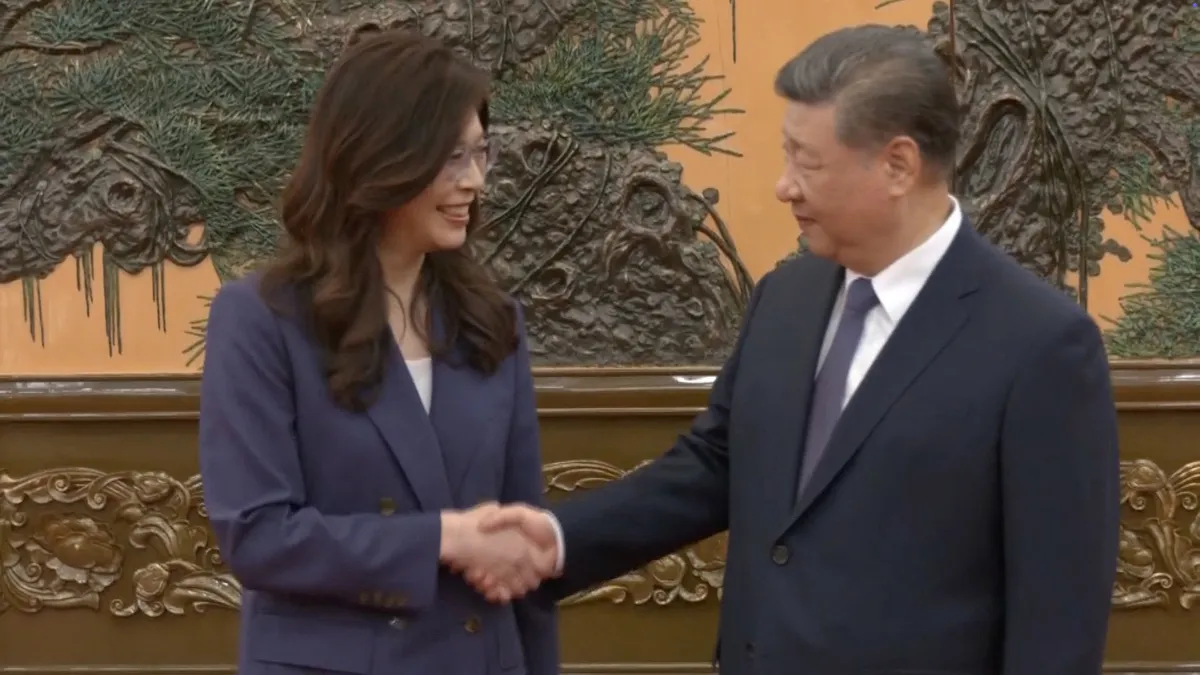
Al JazeeraFIG 01
Reading time
5min
Word count
1 045words
Sources cited
2cited
Entities identified
11entities
Quality score
100%
§ 01
Briefing Summary
AI-generatedNEWSAR · AI
Taiwanese opposition leader Cheng Li-wun, chairperson of the Kuomintang (KMT), met with Chinese President Xi Jinping in Beijing on April 10, 2026. Both leaders expressed opposition to Taiwan independence and a desire for a peaceful resolution to the ongoing dispute over Taiwan's future. Cheng emphasized shared cultural heritage and suggested slowing Taiwan's military buildup, advocating for greater engagement with China. Xi highlighted the shared history and culture between Taiwan and China. Cheng's visit marks the highest-level meeting between Taiwanese and Chinese leaders since 2015, signaling a potential shift towards reconciliation. The KMT, Taiwan's largest opposition party, generally favors closer ties with mainland China.
Confidence 0.90Sources 2Claims 5Entities 11
§ 02
Article analysis
Model · rule-basedFraming
Diplomatic
Political Strategy
Tone
Measured
AI-assessed
CalmNeutralAlarmist
Factuality
0.80 / 1.00
Factual
LowHigh
Sources cited
2
Limited
FewMany
§ 03
Key claims
5 extracted01
Xi emphasised Taiwan and China’s shared history and culture.
factualArticle
Confidence
1.00
02
Chinese and Taiwanese leaders should work to “transcend political confrontation and mutual hostility”.
quoteCheng Li-wun
Confidence
1.00
03
Cheng is the highest-ranking Taiwanese leader to meet Xi since President Ma Ying-jeou in 2015.
factualArticle
Confidence
1.00
04
Both leaders stated their opposition to Taiwan independence and expressed a desire for a “peaceful” resolution.
factualArticle
Confidence
1.00
05
Opposition leader Cheng Li-wun and Chinese President Xi Jinping met in Beijing.
factualArticle
Confidence
1.00
§ 04
Full report
5 min read · 1 045 words§ 05
Entities
11 identifiedKey playerOppositionContextPositiveNeutralNegative
People3
§ 06
Keywords & salience
10 termstaiwan
1.00
china
0.90
reconciliation
0.80
cheng li-wun
0.80
xi jinping
0.70
taiwan independence
0.70
kmt
0.60
peaceful resolution
0.60
shared cultural heritage
0.50
military build up
0.40
§ 07
Topic connections
Interactive graph No topic relationship data available yet. This graph will appear once topic relationships have been computed.