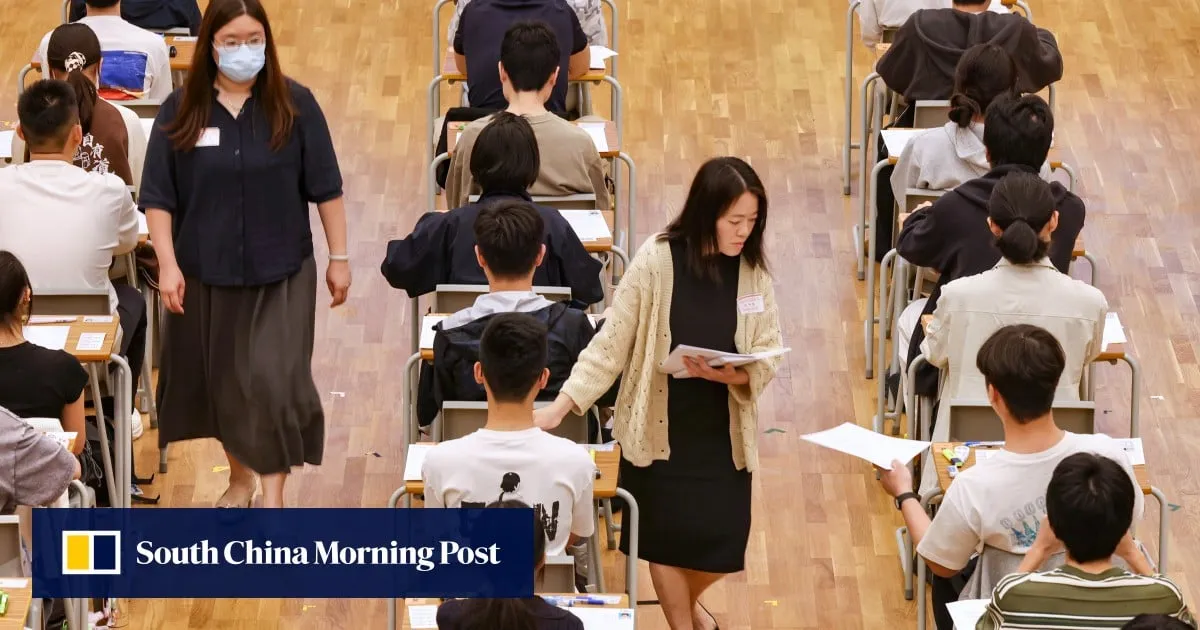
Hong Kong students taking the English paper in university entrance exams on Friday were pleasantly surprised by relatable topics such as bubble tea and starting a YouTube channel.But many candidates sitting the Diploma of Secondary Education (DSE) exam were caught off guard by the inclusion of two poems in the reading section for the first time.About 53,000 students sat the reading and writing papers, while the listening test will be held on Saturday. More than 58,000 candidates are taking this year’s exams, up from 55,000 last year. The exams will end on May 5, with results due on July 15.Despite the unexpected format, teachers said this year’s content remained manageable. The exam steered clear of niche topics, unlike in past years when pop culture icons and autobiographies featured more prominently.Eleni Mak, a 17-year-old candidate from Good Hope School, felt that this year’s reading exam was easier than last year’s.“They are straightforward and the topics are related to daily life,” she said.All candidates were required to attempt Part A, which covered relatable topics such as bubble tea. In Part B, they could choose between B1, on the growing trend of YouTube channels, or B2, on holidays – the latter being more difficult.While Eleni was surprised by the inclusion of two poems – Vacation by Rita Dove and Gio Evan’s Travel – she found them manageable.“I thought literary devices would be tested, but luckily they weren’t, so the questions were quite doable,” she said.According to Alan Chan, a tutor at King’s Glory Education Centre, this year’s exam was much easier than those from the past two years and included themes that were relatable for teenagers.He believed the Hong Kong Examinations and Assessment Authority (HKEAA) might have adjusted the exam’s difficulty in response to the higher number of candidates. But he cautioned that the cut-off score might rise, making it harder for weaker students to pass.Further ReadingEnglish teacher at a secondary school, said the approachable topics meant the candidates did not have to spend too much time trying to grasp unfamiliar concepts or decipher difficult jargon.“Even the poems are easy to comprehend as no literary techniques are required. To be honest, there’s no need to panic when you read it,” she said, adding that candidates simply had to focus on the writer’s feelings and intentions.But Roniya Law, a student at CCC Kei Yuen College, was taken aback by the poems, as she had little practice with them.“I think the reading exam is harder than my expectations because of the poems. But overall, I still had time to proofread my answers,” she said.The 18-year-old also noted that the HKEAA seemed to have a penchant for food this year. While the reading exam featured bubble tea and coffee, the speaking exam held last month included topics on two-dish rice and local Hong Kong snacks.Thursday’s Chinese exam focused on desserts and tuck shop food.Janice pointed out that by focusing the exam themes on such everyday topics, the HKEAA had levelled the playing field this year, allowing more students to perform well.“While the topics are manageable, the margin for error is still slim. Candidates are still required to express themselves clearly and to pay close attention to structural grammar details,” she said.Students praised the relatable topics from everyday life such as bubble tea featured in the English exam paper. Photo: GettyShe expected some students to lose marks in the summary proofreading task, which tests comprehension and grammatical accuracy. This is because students often overlook errors in subject-verb agreement within complex sentences, as well as inconsistencies in tenses and articles.Another common pitfall is the subtle misuse of connectives, which can alter a sentence’s meaning.Additionally, weaker students may struggle with sections of the reading passages that require identifying an analogy connecting two different concepts, such as the example of how gummy bears bridge the cultural gap between Western tastes and Asian bubble tea.Similarly, in the writing exam, most candidates found the topics generally straightforward.DSE candidate Eleni described the questions as very down-to-earth.“Students could easily draw inspiration for their writing from everyday life,” she said.She was able to complete all the questions and felt calm and confident about the listening paper.Chan said this year’s writing exam offered a good range of questions.Instead of being confined to standard essays, students could choose from formats such as letters to the editor or dialogue scripts, while topics were relatable and did not demand specialised knowledge.“Even the work-related questions, such as those about social media security, were easy to handle without needing expert experience,” he said.Chan predicts Saturday’s listening exam will cover topics such as, speech and script writing, report and proposal writing, and replies to letters to the editor.“The exams should not be difficult, but students must focus on the fundamentals to avoid losing marks. Pay close attention to your grammar, specifically parts of speech, homophones, tenses and spelling,” he said.*Name changed at interviewee’s request
SRCSouth China Morning Post
LANGEN
LEANCenter-Right
WORDS812
ENT11
FRI · 2026-04-10 · 13:09 GMTBRIEF NSR-2026-0410-61930
NSR-2026-0410-61930News Report·EN·Human Interest
Bubble tea and YouTube topics please Hong Kong DSE exam takers, as poems add twist
Hong Kong students taking the Diploma of Secondary Education (DSE) English exam on Friday encountered relatable topics like bubble tea and YouTube channels. Around 53,000 students sat for the reading and writing papers, with the listening test scheduled for Saturday.
Doris WaiSouth China Morning PostFiled 2026-04-10 · 13:09 GMTLean · Center-RightRead · 4 min
South China Morning PostFIG 01
Reading time
4min
Word count
812words
Sources cited
4cited
Entities identified
11entities
Quality score
100%
§ 01
Briefing Summary
AI-generatedNEWSAR · AI
Hong Kong students taking the Diploma of Secondary Education (DSE) English exam on Friday encountered relatable topics like bubble tea and YouTube channels. Around 53,000 students sat for the reading and writing papers, with the listening test scheduled for Saturday. For the first time, the reading section included two poems, surprising some candidates. Teachers and students generally found the exam manageable, noting the absence of niche topics and complex literary analysis. An education tutor suggested the exam's difficulty may have been adjusted due to the increased number of test-takers, cautioning that the passing score may rise. The DSE exams will conclude on May 5, with results released on July 15.
Confidence 0.90Sources 4Claims 5Entities 11
§ 02
Article analysis
Model · rule-basedFraming
Human Interest
Tone
Measured
AI-assessed
CalmNeutralAlarmist
Factuality
0.70 / 1.00
Factual
LowHigh
Sources cited
4
Well sourced
FewMany
§ 03
Key claims
5 extracted01
More than 58,000 candidates are taking this year’s exams, up from 55,000 last year.
statisticnull
Confidence
1.00
02
About 53,000 students sat the reading and writing papers.
statisticnull
Confidence
1.00
03
This year’s exam was much easier than those from the past two years and included themes that were relatable for teenagers.
quoteAlan Chan, a tutor at King’s Glory Education Centre
Confidence
0.90
04
Hong Kong students taking the English paper in university entrance exams were pleasantly surprised by relatable topics.
factualnull
Confidence
0.90
05
The HKEAA might have adjusted the exam’s difficulty in response to the higher number of candidates.
predictionAlan Chan, a tutor at King’s Glory Education Centre
Confidence
0.60
§ 04
Full report
4 min read · 812 words§ 05
Entities
11 identifiedKey playerOppositionContextPositiveNeutralNegative
People5
Organizations4
Locations1
§ 06
Keywords & salience
9 termsdse exam
1.00
poems
0.80
bubble tea
0.70
hong kong
0.70
youtube channel
0.70
university entrance exams
0.60
exam difficulty
0.60
reading comprehension
0.50
exam takers
0.50
§ 07
Topic connections
Interactive graph Network visualization showing 51 related topics
View Full Graph Person Organization Location Event|Click node to navigate|Edge numbers = shared articles