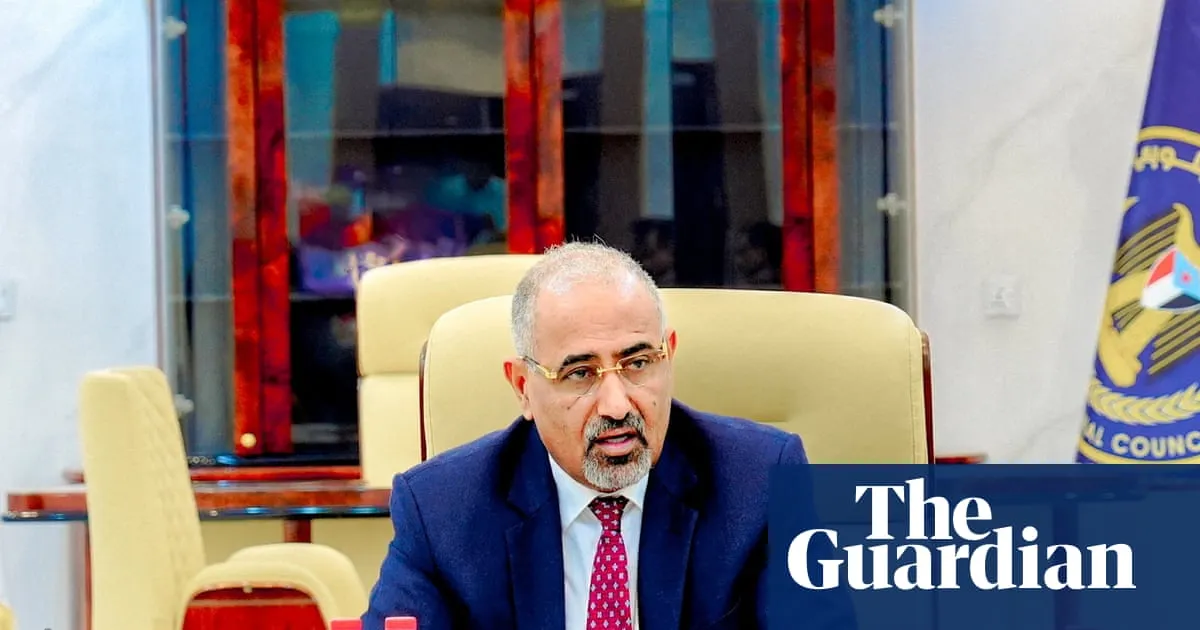
The leader of Yemen’s routed southern separatist movement, Aidarous al-Zubaidi, has decided to make a defiant last stand in Aden, his supporters say, rejecting a Saudi ultimatum to travel to Riyadh for talks and – for now – a plan to flee the southern capital.Al-Zubaidi, the president of the Southern Transitional Council (STC), has been gathering his remaining troops in Aden as rival Saudi-backed forces seek to take control of Aden. His supporters said his mood was to fight it out although he knew it was likely there would be an attempt to kill him.The UN-recognised government of national unity that supports the retention of a unified Yemen has accused him of high treason for unilaterally raising the flag of independence for southern Yemen. A former military leader turned politician, he was sacked from the government’s presidential leadership council as a result.Al-Zubaidi’s refusal to travel to Riyadh on Tuesday night, defying a demand from the Saudi defence minister, Prince Khalid bin Salman, prompted Saudi Arabia to launch airstrikes on his remaining military camps in his stronghold in the Zubaid area of Dhale region.One of al-Zubaidi’s advisers, Amr al-Baid, told a briefing: “Al-Zubaidi is on the ground in Aden conducting his duties,” saying there would be chaos if Saudi-backed forces tried to capture the city as was being threatened.Al-Baid said: “Al-Zubaidi was told: ‘Either you come to Riyadh or we bomb you, and that is your last chance.’ That does not create a conducive atmosphere for dialogue.” Al-Zubaidi’s village is being bombed by the Saudis and so far about 14 civilians have been injured and two killed.There had also been concerns that if al-Zubaidi travelled to Riyadh, he would be arrested. A 50-strong STC delegation that did fly to Riyadh for talks had not been contactable, al-Baid said, explaining: “They arrived at 3am and observers told us that they took them to a black bus. Their phones are ringing but no one is picking up. It is very worrying.”Members of the Southern Giants Brigade or al-Amaliqa, a pro-government militia, deployed in Aden on Monday. Photograph: Saleh al-Obeidi/AFP/Getty ImagesYemen’s deputy foreign minister, Awsan al-Aud, said: “Through its rebellion, the STC has become a banned entity. The ongoing battle will not last long. The STC has to be dismantled, or at the very least, it will have to give up arms and become a political organisation only.”Al-Zubaidi’s unilateral attempt to unfurl the flag of independence for southern Yemen started to collapse once his external backers the United Arab Emirates deserted him after it became clear that Saudi Arabia was willing to use force not just against the STC to prevent Yemen’s fragmentation, but also against UAE arms supplies reaching Yemen through the port city of Mukalla.After carefully extending his base beyond Aden over the past three years, al-Zubaidi in early December took the unilateral step of sending tens of thousands of well-equipped troops into the eastern governorates of oil-rich Hadramaut and al-Mahrah, bordering Oman. With Saudi Arabia hesitating militarily, and the UAE backing the STC, large-scale pro-independence demonstrations were held in the capital of Hadramaut.Codenamed Operation Promising Future, the campaign’s swift territorial gains – and the apparent popular support – meant that by 9 December the STC had taken control of most areas spanning the six governorates of the former southern Yemen.The turning point came when on 30 December, the royal Saudi air force carried out airstrikes on the STC-controlled Mukalla, targeting what it said was a shipment of weapons that had arrived from the UAE. Abu Dhabi denied that the shipments contained weapons, but the UN-recognised Yemeni government ordered all UAE forces to leave Yemeni territory within 24 hours, announcing a 72-hour air, land, and sea blockade, and declared a 90-day state of emergency.Pro-government fighters ride on a pick-up truck in the city of Mukalla on Sunday, as the government said it had retaken control of the key eastern port and capital of Hadramaut province from the STC. Photograph: ReutersSaudi Arabia also assembled a large Gulf diplomatic alliance to oppose the splitting of Yemen, saying such a split would weaken the fight against the Houthis in northern Yemen. Later that day, the UAE announced it would voluntarily withdraw its remaining counter-terrorist forces from Yemen, but in reality it also removed much of the command and control structure it had been providing to the STC, hobbling the council’s operation.The withdrawal has resulted in the Saudi-backed forces regaining Hadramaut and al-Mahrah. At the weekend a previously STC-oriented Shabwah governorate returned to the STC fold, signalling the full-scale collapse of the revolt. Late last week the UAE in effect advised the STC it was on its own in future, ending more than six years of cooperation.In his letter to al-Zubaidi summoning him to visit, Prince Khaled said he wanted to “hear directly from you, ‘What happened?’ and what are the justifications for what occurred?”It adds: “You and the Prince must reconcile, meet, and engage in a serious, brotherly discussion so that he clearly understands the justifications for your military operation and your position in Hadramaut and al-Mahra, and this matter is closed. “The Prince will discuss with you the Transitional Council’s needs in full, including its forces, operational mechanisms, and communication channels. The Kingdom has assumed responsibility for this file following the UAE’s withdrawal. “The Prince will discuss with you future coordination and cooperation, both at the southern level and regarding the overall solution and the Yemeni situation. Any delay or failure to respond to the invitation to come to Riyadh, or any procrastination in doing so, will have serious consequences.”Daily life resumes in Mukalla after the pro-government forces took control of the city from the separatists. Photograph: Anadolu/Getty ImagesThe UAE has been backing the separatist STC since its formation in 2017 partly because it was seen as a bulwark against Muslim Brotherhood and Salifist forces inside Yemen, but also because the STC was seen as a route for Abu Dhabi to control Red Sea ports. The STC under UAE influence had also shown a willingness to cooperate with Israel. Saudi Arabia, which shares a border with Yemen, opposes Yemen’s fragmentation, believing it will weaken the fight against the Houthis that control the north of Yemen.The UAE, finding itself isolated over Yemen, is now likely to review its strategy elsewhere in the region including in Sudan where it has been backing a different faction to Riyadh.Reuters and Agence France-Presse have contributed to this report
SRCThe Guardian - World News
LANGEN
LeanCenter-Left
WORDS1,069
ENT6
WED · 2026-01-07 · 12:47 GMTBRIEF NSR-2026-0107-6199
NSR-2026-0107-6199News Report·EN·Conflict
Yemen separatist leader to make last stand after rejecting Saudi ultimatum, supporters say
Yemen's Southern Transitional Council (STC) leader, Aidarous al-Zubaidi, is preparing for a "last stand" in Aden after rejecting a Saudi ultimatum to attend talks in Riyadh. Al-Zubaidi's refusal prompted Saudi airstrikes on his military camps.
Patrick Wintour Diplomatic editorThe Guardian - World NewsFiled 2026-01-07 · 12:47 GMTLean · Center-LeftRead · 5 min
The Guardian - World NewsFIG 01
Reading time
5min
Word count
1,069words
Sources cited
5cited
Entities identified
6entities
NEWSAR · AI
Yemen's Southern Transitional Council (STC) leader, Aidarous al-Zubaidi, is preparing for a "last stand" in Aden after rejecting a Saudi ultimatum to attend talks in Riyadh. Al-Zubaidi's refusal prompted Saudi airstrikes on his military camps. The UN-recognized government accuses al-Zubaidi of treason for seeking southern Yemen's independence. Al-Zubaidi's advisor expressed concern over the safety of an STC delegation that traveled to Riyadh. Pro-government forces are deploying in Aden, and Yemen's deputy foreign minister stated the STC is now a banned entity that must disarm or become a political organization.
Confidence 0.90Sources 5Claims 5Entities 6
Framing
Conflict
Political Strategy
Tone
Mixed Tone
AI-assessed
CalmNeutralAlarmist
Factuality
0.70 / 1.00
Factual
LowHigh
Sources cited
5
Well sourced
FewMany
01
The STC has to be dismantled, or at the very least, it will have to give up arms and become a political organisation only.
quoteAwsan al-Aud
Confidence
0.90
02
Saudi Arabia launched airstrikes on al-Zubaidi’s remaining military camps in the Zubaid area of Dhale region.
factualnull
Confidence
0.90
03
Al-Zubaidi’s unilateral attempt to unfurl the flag of independence for southern Yemen started to collapse.
factualnull
Confidence
0.80
04
Aidarous al-Zubaidi has decided to make a defiant last stand in Aden, rejecting a Saudi ultimatum.
quotesupporters
Confidence
0.80
05
Al-Zubaidi's village is being bombed by the Saudis and so far about 14 civilians have been injured and two killed.
factualAmr al-Baid
Confidence
0.70
§ 04
Full report
5 min read · 1,069 wordsKey playerOppositionContextPositiveNeutralNegative
yemen
1.00
aidarous al-zubaidi
0.90
southern separatist movement
0.90
aden
0.80
southern transitional council
0.70
saudi arabia
0.70
ultimatum
0.60
airstrikes
0.50
independence
0.40
§ 07
Connections
Who appears together in the newsIn this articleWider coverageLine weight = articles in common
Laying out network…
Strongest ties articles in common
- 441
- 163
- 96
- 80
- 52
- 28
Recurring context not named in this article
- LHadramoutlinks 6
- OSaudi-led coalitionlinks 6
- OHouthislinks 6
- LSomalilandlinks 6
- LSanaalinks 6
- LUnited Arab Emirateslinks 6
- PRashad al-Alimilinks 6
- LAbu Dhabilinks 6