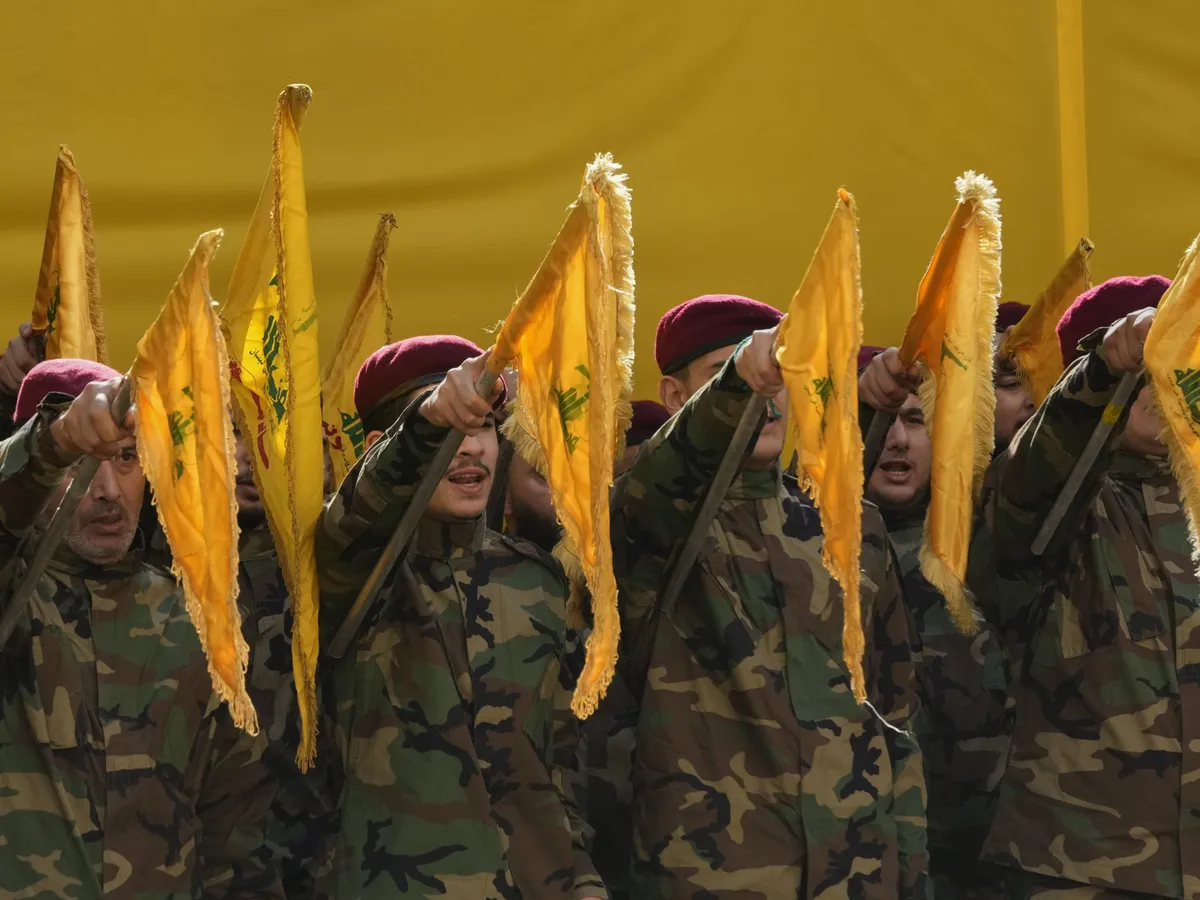
Army commander to brief government on the progress of the mission to disarm Hezbollah amid complex tensions.Hezbollah fighters raise their group's flags and chant slogans as they attend the funeral procession of Hezbollah's chief of staff, Haytham Tabatabai, killed in an Israeli air strike [Hussein Malla/AP]Published On 8 Jan 2026Beirut, Lebanon – At the end of last year, Lebanon’s army first took journalists and then international diplomats on tours that were meant to show what had been achieved in terms of dismantling Hezbollah’s military infrastructure along the country’s southern border with Israel.At the time, Israel was increasing threats to expand its attacks if Lebanon failed to disarm Hezbollah.Recommended Stories list of 4 itemslist 1 of 4Israel-Lebanon talks: Everything you need to knowlist 2 of 4Israel, Lebanon officials meet as pressure mounts to disarm Hezbollahlist 3 of 4Lebanon claims first phase of Hezbollah’s disarmament close to completelist 4 of 4Hezbollah weapons deadline: What’s next for Lebanon amid Israeli strikes?end of listThe end of 2025 was the army’s self-imposed deadline to complete the first phase of its plan to bring all weapons in the country under state control.Army commander Rodolphe Haykal said the tours were intended to highlight the army’s commitment to the efforts despite “its limited capabilities”. But he blamed Israel’s continued military actions and occupation of Lebanese territory along the border as complicating and undermining these efforts.On January 8, Haykal will brief Lebanon’s government on the progress of the disarming mission. He’s expected to announce the completion of the plan’s first phase, which involves clearing the area between the Litani River, about 30km (19 miles) at its deepest point in Lebanon, and the country’s southern border with Israel.But Israel already has a verdict on the army’s performance.It says Hezbollah still has a presence close to the border and is rebuilding its military capabilities “faster than the army is dismantling [them]”. The United Nations peacekeeping force in southern Lebanon has a different take. It says there is “no evidence” that Hezbollah’s infrastructure has been rebuilt.Israel also sent another message through its military actions days before the cabinet meeting.It carried out intense air strikes on what it said were positions north of the Litani River some kilometres (miles) from the border in what a western diplomat said showed “Israel has no intention to wait for the army to move to the next phase to dismantle Hezbollah’s weapons.”Litani River“Israel has already shifted focus to phase two,” Joe Macaron, global fellow at the Wilson Center, told Al Jazeera. “And this phase is going to be different, difficult and challenging for the army.”The second phase involves operations expanding north of the Litani River up to the Awali River north of the city of Sidon. “Hezbollah has made it clear there will be no disarmament north of the Litani, which means there is the possibility of political tension,” Macaron added.Hezbollah, which has dismissed efforts to disarm it as a United States-Israeli plan, believes it has complied with a ceasefire agreement agreed with Israel because it understands the truce to apply “exclusively south of the Litani River”.The November 2024 truce ended more than a year of hostilities between Hezbollah and Israel. The group’s critics in Lebanon say the ceasefire calls for the implementation of UN Resolution 1701, which mentions the disarmament of all non-state actors across Lebanon.“With the Israeli enemy not implementing any of the steps of the agreement … Lebanon is no longer required to take any action on any level before the Israelis commit to what they are obligated to do,” Hezbollah’s Secretary-General Naim Qassem said.Political consensusHezbollah was long considered the strongest military force in Lebanon, although it has been weakened by the war with Israel, when much of its leadership was killed.The group retains the support of Lebanon’s Shia community, which it emerged from.“Assuming the Lebanese state and the army commander would try to disarm Hezbollah north of the Litani, Hezbollah and also the majority of the Shia community is going to rise and try to prevent this. They will act and there will be a violent reaction if that scenario will happen,” Ali Rizk, a political and security analyst, told Al Jazeera. “The community feels they are facing a twin threat … one from Israel and the other from the new regime in Syria, so that is why they are more supportive of Hezbollah’s weapons.”Lebanese Army commander Hakyal reportedly told a recent military meeting that the army is carefully planning for the next phases of disarmament. Officials know that without political consensus, there is a risk of internal conflict.But Lebanon’s leadership, which pledged to reassert full state sovereignty, is under pressure. Israel has publicly said it will act “as necessary” if Lebanon fails to take steps against Hezbollah.“The state is ready to move on to the second phase – namely [confiscating weapons] north of the Litani River – based on the plan prepared by the Lebanese army pursuant to a mandate from the government,” Lebanon’s Prime Minister Nawaf Salam said.And then there is Iran.Coinciding with Lebanon’s government meeting, Iran’s Foreign Minister Abbas Araghchi will arrive in Beirut.“There is no doubt there is a link between his visit and the army submitting its report before moving to phase 2,” Rizk explained. “Hezbollah is by far Iran’s number one ideological and strategic ally, and it will stop at nothing to prevent Hezbollah’s complete elimination by getting rid of its weapons.”
SRCAl Jazeera
LANGEN
LEANCenter
WORDS895
ENT7
THU · 2026-01-08 · 06:21 GMTBRIEF NSR-2026-0108-6324
NSR-2026-0108-6324News Report·EN·National Security
Lebanon’s mission to complete disarmament plan of Hezbollah
In January 2026, Lebanon's army commander Rodolphe Haykal will brief the government on the progress of its mission to disarm Hezbollah, a plan initiated in late 2025 under pressure from Israel. The army aimed to bring all weapons under state control, with a self-imposed deadline to complete the first phase by the end of 2025, which involved clearing the area between the Litani River and the southern border with Israel.
Zeina KhodrAl JazeeraFiled 2026-01-08 · 06:21 GMTLean · CenterRead · 4 min
Al JazeeraFIG 01
Reading time
4min
Word count
895words
Sources cited
3cited
Entities identified
7entities
Quality score
100%
§ 01
Briefing Summary
AI-generatedNEWSAR · AI
In January 2026, Lebanon's army commander Rodolphe Haykal will brief the government on the progress of its mission to disarm Hezbollah, a plan initiated in late 2025 under pressure from Israel. The army aimed to bring all weapons under state control, with a self-imposed deadline to complete the first phase by the end of 2025, which involved clearing the area between the Litani River and the southern border with Israel. While the army claims progress, citing tours for journalists and diplomats, Israel asserts that Hezbollah maintains a presence and is rebuilding its capabilities. The UN peacekeeping force in southern Lebanon disputes Israel's claim of rebuilt infrastructure. Israel has conducted air strikes north of the Litani River, signaling its impatience with the disarmament process.
Confidence 0.90Sources 3Claims 5Entities 7
§ 02
Article analysis
Model · rule-basedFraming
National Security
Political Strategy
Tone
Measured
AI-assessed
CalmNeutralAlarmist
Factuality
0.70 / 1.00
Factual
LowHigh
Sources cited
3
Well sourced
FewMany
§ 03
Key claims
5 extracted01
The army's self-imposed deadline to complete the first phase of disarmament was the end of 2025.
factualAl Jazeera
Confidence
1.00
02
Israel threatened to expand attacks if Lebanon failed to disarm Hezbollah.
factualAl Jazeera
Confidence
1.00
03
UN peacekeeping force says there is 'no evidence' that Hezbollah's infrastructure has been rebuilt.
quoteUnited Nations
Confidence
0.90
04
Israel says Hezbollah is rebuilding its military capabilities faster than the army is dismantling them.
quoteIsrael
Confidence
0.90
05
Lebanon's army took journalists and diplomats on tours to show progress dismantling Hezbollah's military infrastructure.
factualAl Jazeera
Confidence
0.90
§ 04
Full report
4 min read · 895 words§ 05
Entities
7 identifiedKey playerOppositionContextPositiveNeutralNegative
§ 06
Keywords & salience
9 termshezbollah disarmament
1.00
lebanon
0.90
israel
0.80
military infrastructure
0.70
southern border
0.60
litani river
0.50
army commander
0.50
military actions
0.40
state control
0.40
§ 07
Topic connections
Interactive graph Network visualization showing 51 related topics
View Full Graph Person Organization Location Event|Click node to navigate|Edge numbers = shared articles