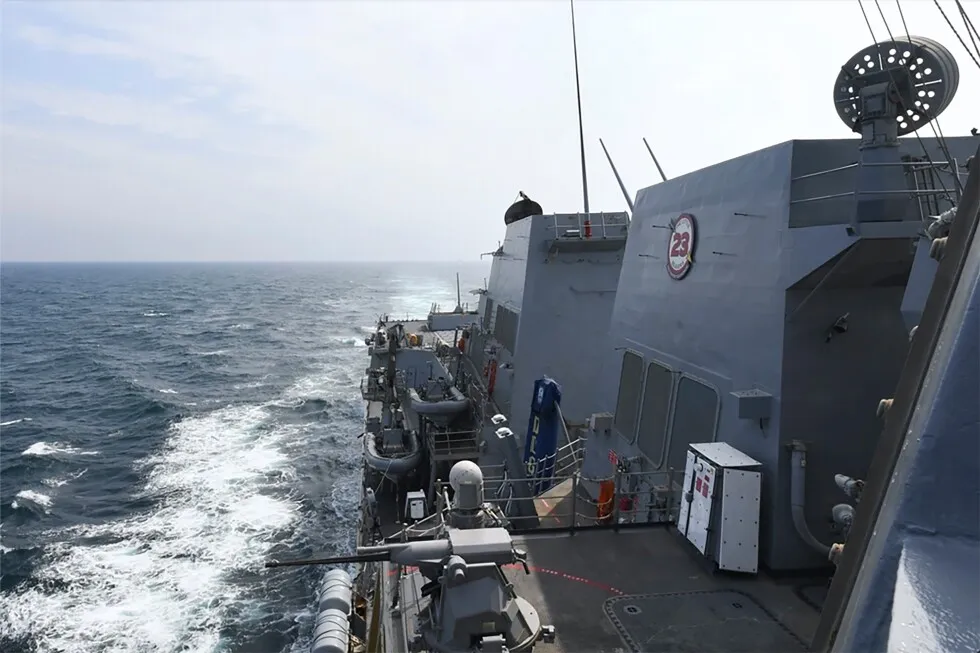
In this photo provided by the
U.S. Navy, the Arleigh Burke-class guided-missile destroyer USS Halsey (DDG 97) conducts routine underway operations while transiting through the
Taiwan Strait, May 8, 2024. (Mass Communication Specialist 3rd class Ismael Martinez/
U.S. Navy via AP, File) 2026-04-12T04:02:18Z WASHINGTON (AP) — In 2011, President
Barack Obama declared it was time for America to leave behind the wars in Iraq and Afghanistan and “pivot” to
Asia to counter the rise of
China. Fifteen years later, the U.S. finds itself still at war in the
Middle East and has pulled military assets from the
Asia-Pacific as it aims to eliminate the threat posed by
Iran’s nuclear and missile programs. The demands of the
Iran war also caused President
Donald Trump to delay by several weeks his highly anticipated trip to
China, deepening worries that the U.S. is once again getting distracted at the cost of its strategic interests in
Asia, where Beijing seeks to unseat the U.S. as the regional leader. Those skeptical of the U.S. involvement in the
Middle East say the war is preventing Trump from adequately preparing for his summit with Chinese leader
Xi Jinping next month, when economic interests are on the line, and they warn that a failure to focus on
Asia and maintain strong deterrence could lead to greater instability, if
China should believe the time is ripe to seize the self-governed island of
Taiwan . freestar.queue.push(function () { window.fsAdCount = window.fsAdCount + 1 || 0; let customChannel = '/dynamic_' + fsAdCount; let adList = document.querySelectorAll(".fs-feed-ad") let thisAd = adList[fsAdCount]; let randId = Math.random().toString(36).slice(2); thisAd.id = randId; let thisPlacement = fsAdCount == 0 ? "apnews_story_feed" : "apnews_story_feed_dynamic"; freestar.newAdSlots({ placementName: thisPlacement, slotId: randId }, customChannel); }); “This is precisely the wrong time for the
United States to turn away and be sucked into another intractable
Middle East conflict,” said
Danny Russel, a distinguished fellow at the
Asia-society-policy-institute" class="entity-link entity-organization" data-entity-id="19006" data-entity-type="organization">
Asia Society Policy Institute. “Rebalancing to
Asia is highly relevant to America’s national interests, but it has been undercut by many bad decisions.” Others defend the president’s approach, arguing that the forceful steps he is taking elsewhere, including in Venezuela and
Iran, serve to counter
China globally. /* Desktop-first: fully collapse by default */ #ap-readmore-embed { display: none; margin: 0; padding: 0; height: 0; min-height: 0; overflow: hidden; text-align: center; position: relative; z-index: 2; } /* Only show on mobile */ @media (max-width: 767px) { #ap-readmore-embed { display: block; margin: 28px 0; height: auto; overflow: visible; } } #ap-readmore-embed .ap-readmore-btn { appearance: none; -webkit-appearance: none; border: 0; background: #000; color: #fff; cursor: pointer; display: inline-flex; align-items: center; justify-content: center; gap: 10px; padding: 14px 22px; border-radius: 999px; font-family: inherit, "AP Sans", -apple-system, BlinkMacSystemFont, "Helvetica Neue", Arial, sans-serif; font-weight: 700; font-size: 16px; letter-spacing: 0.2px; line-height: 1; box-shadow: 0 10px 18px rgba(0,0,0,0.12); transition: transform 120ms ease, box-shadow 120ms ease, opacity 120ms ease; touch-action: manipulation; -webkit-tap-highlight-color: transparent; position: relative; z-index: 3; } #ap-readmore-embed .ap-readmore-btn:hover { transform: translateY(-1px); box-shadow: 0 14px 22px rgba(0,0,0,0.16); } #ap-readmore-embed .ap-readmore-btn:active { transform: translateY(0); box-shadow: 0 10px 18px rgba(0,0,0,0.12); opacity: 0.95; } #ap-readmore-embed .ap-readmore-btn:focus-visible { outline: 3px solid rgba(228, 0, 43, 0.35); outline-offset: 3px; } #ap-readmore-embed .ap-readmore-icon { width: 10px; height: 10px; border-right: 2px solid currentColor; border-bottom: 2px solid currentColor; transform: rotate(45deg); margin-top: -2px; } #ap-readmore-embed .ap-readmore-fade { display: none; height: 48px; margin-top: -48px; pointer-events: none; background: linear-gradient(to bottom, rgba(255,255,255,0), rgba(255,255,255,1)); } Read More (function () { var APRM_EMBED_ID = "ap-readmore-embed"; var APRM_MOBILE_MQ = "(max-width: 767px)"; function APRM_onReady(fn) { if (document.readyState === "loading") { document.addEventListener("DOMContentLoaded", fn); } else { fn(); } } APRM_onReady(function () { var APRM_embedEl = document.getElementById(APRM_EMBED_ID); if (!APRM_embedEl) return; // 🚨 DESKTOP: remove entire module wrapper and bail early if (!window.matchMedia(APRM_MOBILE_MQ).matches) { var APRM_rootModule = APRM_embedEl.closest(".HTMLModuleEnhancement") || APRM_embedEl.closest(".HtmlModule"); if (APRM_rootModule && APRM_rootModule.parentNode) { APRM_rootModule.parentNode.removeChild(APRM_rootModule); } else if (APRM_embedEl.parentNode) { APRM_embedEl.parentNode.removeChild(APRM_embedEl); } return; // stop the rest of the script from running } }); })(); (function () { var EMBED_ID = "ap-readmore-embed"; var BTN_ID = "apReadMoreBtn"; var FADE_ID = "apReadMoreFade"; var STOP_SELECTOR = ".Page-below"; var SIGN_IN_GATE_SELECTOR = ".sign-in-gate-content"; var HIDDEN_ATTR = "data-ap-readmore-hidden"; var MOBILE_MQ = "(max-width: 767px)"; function ready(fn) { if (document.readyState === "loading") { document.addEventListener("DOMContentLoaded", fn); } else { fn(); } } function isElementNode(n) { return n && n.nodeType === 1; } function cancelEvent(e) { if (!e) return; if (typeof e.preventDefault === "function") e.preventDefault(); if (typeof e.stopPropagation === "function") e.stopPropagation(); if (typeof e.stopImmediatePropagation === "function") e.stopImmediatePropagation(); e.cancelBubble = true; e.returnValue = false; } function collapseDesktopEmbed(embed) { if (!embed) return true; if (!window.matchMedia(MOBILE_MQ).matches) { var maybeWrappers = [ embed.parentElement, embed.closest(".html-embed"), embed.closest("[data-type='htmlembed']"), embed.closest("[class*='embed']"), embed.closest("[class*='Embed']") ].filter(Boolean); embed.style.display = "none"; embed.style.margin = "0"; embed.style.padding = "0"; embed.style.height = "0"; embed.style.minHeight = "0"; embed.style.overflow = "hidden"; maybeWrappers.forEach(function (el) { el.style.margin = "0"; el.style.padding = "0"; el.style.height = "0"; el.style.minHeight = "0"; el.style.overflow = "hidden"; }); if (embed.parentNode) { embed.parentNode.removeChild(embed); } return true; } return false; } ready(function () { var embed = document.getElementById(EMBED_ID); var btn = document.getElementById(BTN_ID); var fade = document.getElementById(FADE_ID); if (!embed || !btn) return; if (collapseDesktopEmbed(embed)) return; var signInGate = document.querySelector(SIGN_IN_GATE_SELECTOR); if (signInGate) { embed.innerHTML = ""; return; } // — Analytics: impression when embed enters viewport — if ("IntersectionObserver" in window) { var io = new IntersectionObserver(function (entries, observer) { if (entries[0].isIntersecting) { window.dataLayer = window.dataLayer || []; window.dataLayer.push({ event: "ap_readmore_impression" }); observer.disconnect(); } }, { threshold: 0 }); io.observe(btn); } var stopEl = document.querySelector(STOP_SELECTOR); if (!stopEl) return; var rootCandidates = [ embed.closest(".Page"), embed.closest("article"), embed.closest("main"), document.body ].filter(Boolean); var root = rootCandidates.find(function (c) { return c.contains(stopEl); }) || document.body; var all = root.getElementsByTagName("*"); var hidden = []; for (var i = 0; i “Beijing is the chief sponsor for the adversaries that President Trump is dealing with sequentially, and it’s wise to do this sequentially,” Matt Pottinger, who served as a deputy national security adviser in the first Trump administration, said in a recent podcast. freestar.queue.push(function () { window.fsAdCount = window.fsAdCount + 1 || 0; let customChannel = '/dynamic_' + fsAdCount; let adList = document.querySelectorAll(".fs-feed-ad") let thisAd = adList[fsAdCount]; let randId = Math.random().toString(36).slice(2); thisAd.id = randId; let thisPlacement = fsAdCount == 0 ? "apnews_story_feed" : "apnews_story_feed_dynamic"; freestar.newAdSlots({ placementName: thisPlacement, slotId: randId }, customChannel); }); NATO Secretary General Mark Rutte also said conflicts may not be confined to a single theater, suggesting that
China could call upon its “junior partners” elsewhere to divert U.S. attention if it should move against
Taiwan. “Most likely it will not be limited, something in the Indo-Pacific to the Indo-Pacific,” Rutte said, speaking Thursday at the Ronald Reagan Institute in Washington. “It will be a multi-theater issue.” Repercussions in
Asia of the
Iran war Sen. Jeanne Shaheen, the top Democrat on the Senate Foreign Relations Committee, recently led a bipartisan group of senators to
Taiwan, Japan and South Korea, where they heard concerns about the impact of the war on energy costs and about the departure of U.S. military assets, including missile defense systems from South Korea and a rapid-response Marine unit from Japan. She sought to reassure them of the U.S. commitment to deterring conflicts in
Asia and shoring up regional stability. “Failure is not an option,” Shaheen told The Associated Press after returning from
Asia. “We know
China has already said they intend to take
Taiwan by force if they need to, and they’re on an expedited time schedule. And we also know that what happened in Europe, in the war in Ukraine, in the
Middle East is affecting those calculations.” freestar.queue.push(function () { window.fsAdCount = window.fsAdCount + 1 || 0; let customChannel = '/dynamic_' + fsAdCount; let adList = document.querySelectorAll(".fs-feed-ad") let thisAd = adList[fsAdCount]; let randId = Math.random().toString(36).slice(2); thisAd.id = randId; let thisPlacement = fsAdCount == 0 ? "apnews_story_feed" : "apnews_story_feed_dynamic"; freestar.newAdSlots({ placementName: thisPlacement, slotId: randId }, customChannel); }); Kurt Campbell, who served as deputy secretary of state in the Biden administration, said he’s worried that the military capabilities that the U.S. had patiently accumulated in the Indo-Pacific region might not return in full even after the
Iran war ends. The longer the conflict goes on, the more it will pull resources and focus away from
Asia, said Zack Cooper, a senior fellow at the American Enterprise Institute who studies the U.S. strategy in
Asia. He added that future arms sales to the region also will be negatively affected. “The
United States has expended substantial numbers of munitions in the
Middle East and will have to keep an increased force presence there, some of which has been redirected from
Asia,” Cooper said. “Meanwhile,
Xi Jinping’s wisdom in preparing a ‘war time’ economy by stockpiling and adding alternate energy sources has shown itself to be beneficial.” freestar.queue.push(function () { window.fsAdCount = window.fsAdCount + 1 || 0; let customChannel = '/dynamic_' + fsAdCount; let adList = document.querySelectorAll(".fs-feed-ad") let thisAd = adList[fsAdCount]; let randId = Math.random().toString(36).slice(2); thisAd.id = randId; let thisPlacement = fsAdCount == 0 ? "apnews_story_feed" : "apnews_story_feed_dynamic"; freestar.newAdSlots({ placementName: thisPlacement, slotId: randId }, customChannel); }); Shaheen said the U.S. defense industry will struggle to meet the demand to replenish the weapons stockpile. “We’re working on a number of strategies to improve that, but at this point, timelines for weapons delivery are slipping,” she said. The senator from New Hampshire said she’s encouraged that
Taiwan, Japan and South Korea are stepping up their own defense. After 15 years and 3 presidents, pivot to
Asia remains elusive Obama’s strategic rebalance to
Asia reflected his understanding that the U.S. must be a player in the Pacific to harness the region’s growth and ensure continued U.S. leadership in the face of
China’s rising influence. “After a decade in which we fought two wars that cost us dearly, in blood and treasure, the
United States is turning our attention to the vast potential of the
Asia-Pacific region,” Obama said in a speech to the Australian Parliament. “So make no mistake, the tide of war is receding, and America is looking ahead to the future that we must build.” freestar.queue.push(function () { window.fsAdCount = window.fsAdCount + 1 || 0; let customChannel = '/dynamic_' + fsAdCount; let adList = document.querySelectorAll(".fs-feed-ad") let thisAd = adList[fsAdCount]; let randId = Math.random().toString(36).slice(2); thisAd.id = randId; let thisPlacement = fsAdCount == 0 ? "apnews_story_feed" : "apnews_story_feed_dynamic"; freestar.newAdSlots({ placementName: thisPlacement, slotId: randId }, customChannel); }); But the strategy was set back when a proposed trade agreement known as the Trans-Pacific Partnership with key U.S. regional partners failed to get through the U.S. Senate. After Trump first took office in 2017, he withdrew the U.S. from the partnership and launched a tariff war with
China. His Democratic successor, Joe Biden, kept Trump’s tariffs on
China and tightened export controls on advanced technology, while strengthening regional alliances to counter
China.
Middle East again grabs US attention By the time Trump rolled out his national security strategy in late 2025, the U.S. strategy in
Asia had been narrowed to military deterrence in the
Taiwan Strait and the First Island Chain, a string of U.S.-aligned islands off
China’s coast that restrict its access to the Western Pacific. The national security document says it’s in the economic interest of the U.S. to secure access to advanced chips, which are sourced primarily from
Taiwan and are needed to power everything from computers to missiles, and to protect shipping lanes in the South
China Sea. “Hence deterring a conflict over
Taiwan, ideally by preserving military overmatch, is a priority,” the document says. “We will build a military capable of denying aggression anywhere in the First Island Chain.” The
Middle East, it says, should be getting less attention: “As this administration rescinds or eases restrictive energy policies and American energy production ramps up, America’s historic reason for focusing on the
Middle East will recede.” Then came the
Iran war. ___ AP writer Stephen Groves contributed to this report. DIDI TANG Tang joined the AP Washington bureau in 2023 after spending 11 years in Beijing as a
China correspondent. She covers anything related to the Indo-Pacific region with a focus on U.S.-
China competitions mailto 获取更多RSS: https://feedx.net https://feedx.site