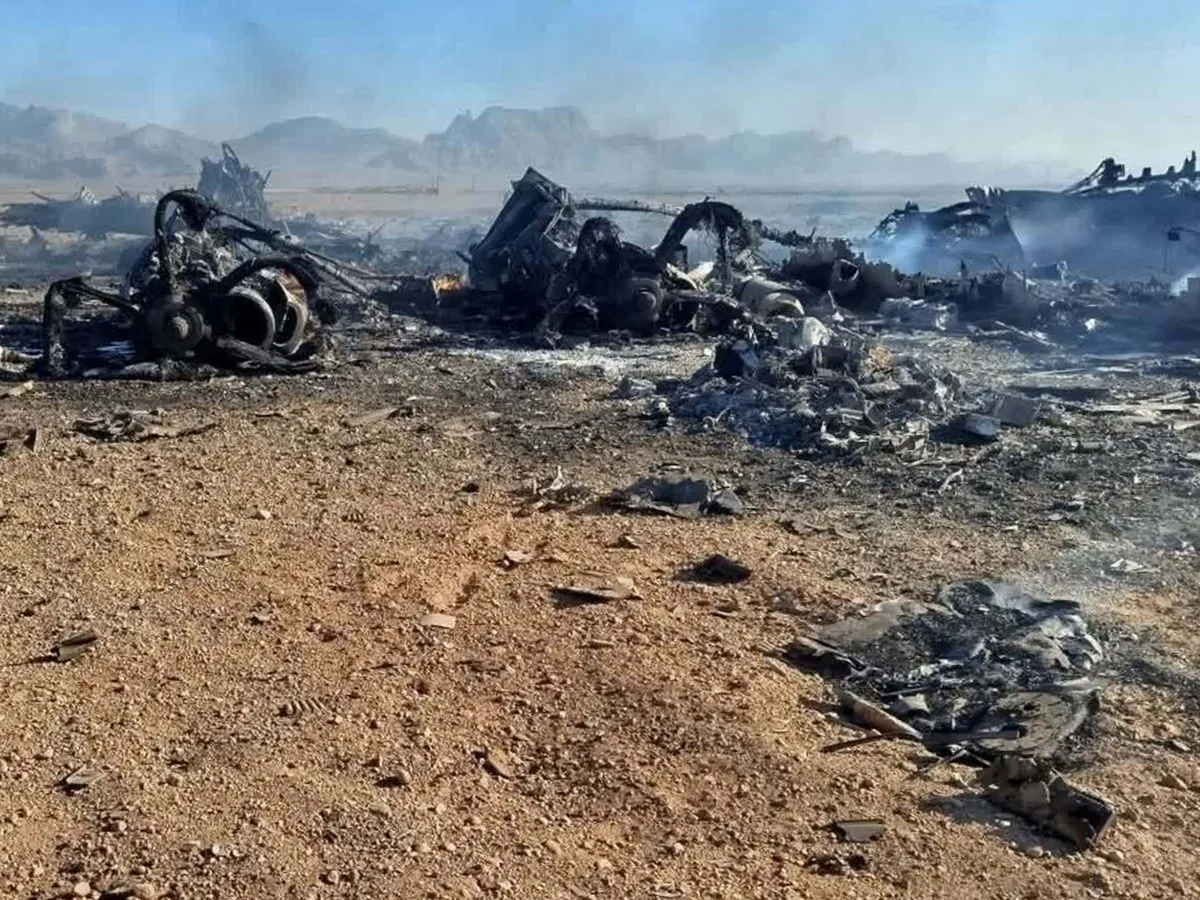
The past month and a half have shown that the nature of modern warfare is shifting.Published On 12 Apr 2026The wreckage of a crashed aircraft in central Iran, on April 5, 2026 [Sepah News/IRGC via AFP]On Saturday, the United States and Iran held direct negotiations for the first time in more than a decade. The talks ended without a deal, as the US and Iranian positions remain far apart.While it is unclear what will happen next, the past month and a half of fighting has cast light on important lessons to be learned not just about this conflict but also the nature of modern warfare. These may turn into key considerations for decision-makers in Washington as they determine what to do next.Scale and geography matterIran operates on a scale that immediately complicates any direct confrontation. With a landmass of approximately 1.64 million sq km (more than 633,200sq miles) and a population exceeding 90 million, the country dwarfs the environments in which recent major wars have taken place.By comparison, Iraq — invaded by a US-led coalition in 2003 — has roughly one quarter of Iran’s land area and half its population. Afghanistan and Ukraine, while sizeable, are still significantly smaller in both territory and demographic weight.This matters because military operations scale nonlinearly. Larger territory does not simply require more troops and weapons; it requires exponentially more logistics, longer supply lines, and expanded intelligence coverage.If scale complicates the planning of a war, geography compounds it even more.The US invasion of Iraq benefitted from favourable terrain. Coalition forces advanced rapidly through the relatively flat southern desert and river valleys, enabling a swift push towards Baghdad. Russian forces also benefitted from the relatively even landscape in Ukraine, easily crossing through the steppe in the eastern part of the country.The problem with flat terrain is that it exposes troops to enemy attacks, as their movements can easily be detected.Afghanistan presented the opposite challenge: mountainous terrain that limited conventional operations and forced reliance on airpower, special forces, and local allies.Iran, however, combines the worst of both environments at a much larger scale.The Zagros Mountains stretch along Iran’s western frontier, forming a natural defensive barrier. The Alborz Mountains in the north protect key population centres, including Tehran. The central plateau introduces vast desert expanses that can complicate military manoeuvres and sustainment. Meanwhile, Iran’s long coastline along the Gulf and the Gulf of Oman introduces maritime vulnerabilities, but also defensive depth.Iran’s mountainous terrain not only makes a ground invasion almost impossible but also provides plenty of opportunities to hide missile launchers, military production facilities, and even air defences. This means that even a conflict limited to an air campaign could be stretched over many months, as Iran retains the capability to retaliate.Strong and cohesive defenceThe assumption that internal diversity translates into vulnerability is often overstated. Iran is ethnically diverse, with minorities such as the Azerbaijanis, Kurds, Arabs, Baloch, and others forming a significant part of its population. Yet historical experience suggests that external threats tend to strengthen national cohesion rather than fracture it.Ukraine provides the most recent example. Despite linguistic and regional differences, Russia’s invasion reinforced Ukrainian national identity and resistance.Iran followed a similar trajectory. External military pressure did not dissolve the state; it consolidated it.This is particularly significant given Iran’s military structure. With more than 800,000 active personnel, including both the regular army and the Islamic Revolutionary Guard Corps (IRGC), Iran possesses a layered defence system designed for both conventional and asymmetric warfare. Its doctrine emphasises dispersal, survivability, and long-term resistance.Unlike Iraq in 2003, whose military had been weakened by sanctions and prior conflict, Iran maintains a functioning state apparatus, integrated command structures, and extensive missile and drone capabilities.Here, Ukraine offers another important lesson: even a large, modern military can fail to achieve decisive results against a smaller but determined and organised defender.Russia entered Ukraine with a large force, hoping for a swift victory and regime change. Yet the war quickly evolved into a protracted conflict, with high costs and limited strategic gains.Limits of conventional armsThere are also lessons to be learned about the effectiveness of conventional arms. The past month and a half has shown that even overwhelming air superiority does not necessarily translate into decisive results when deployed against a state designed to absorb and outlast attacks.Iran’s ballistic missile and drone capabilities are central to this dynamic. Rather than relying on concentrated, high-value assets that can be quickly neutralised, Iran has developed a dispersed and layered system. Missile launchers, storage facilities and production sites have been embedded in mountainous terrain or hardened underground infrastructure, making them difficult to detect and eliminate. This reinforces the broader point: geography is not just a backdrop to conflict; it is actively integrated into Iran’s defensive strategy.At the same time, Iran’s increasing reliance on drones and relatively low-cost missile systems introduces a different kind of challenge. These systems do not need to achieve precision or dominance; they only need to survive and sustain pressure over time. In doing so, they impose a continuous operational burden on even the most advanced air defence systems.This creates a structural imbalance. Highly sophisticated and expensive military platforms are used to counter weapons that are significantly cheaper and easier to reproduce. Over time, this dynamic does not necessarily result in victory on the battlefield, but it erodes the ability to achieve decisive outcomes.The result is a shift in how military power functions in practice. Conventional superiority remains important, but its role becomes more limited. It can disrupt, degrade, and contain, but it struggles to decisively defeat an adversary that is territorially embedded, operationally dispersed, and strategically prepared for a prolonged confrontation.What this means strategicallyIran is not Afghanistan in 2001, nor Iraq in 2003, nor Ukraine in 2022. It is a hybrid of all three — combining scale, complexity and resilience.Taken together, these factors reinforce a central conclusion of this conflict: Iran is not simply a harder target; it fundamentally alters the strategic calculus of war.The combination of scale, geography, and resilience means that any conflict is likely to become prolonged, costly, and uncertain in outcome. This helps explain why, despite sustained military pressure, the war did not produce a decisive shift on the ground. Instead, it moved towards a temporary pause, reflecting the difficulty of translating military action into clear strategic gains.This does not suggest that future conflict is unlikely. Rather, it indicates that the nature of such conflict could be different from what we saw in this month and a half. Direct, large-scale confrontation becomes less attractive when the probability of a quick victory is low, and the costs of escalation are high. Instead, what emerges is a pattern of limited engagements, calibrated responses, and strategic signalling — forms of conflict that fall short of full-scale war but stop well short of lasting resolution.
SRCAl Jazeera
LANGEN
LEANCenter
WORDS1 130
ENT10
SUN · 2026-04-12 · 13:10 GMTBRIEF NSR-2026-0412-64600
NSR-2026-0412-64600Analysis·EN·National Security
Lessons from the Iran war
In April 2026, the United States and Iran held unsuccessful direct negotiations for the first time in over a decade. The recent conflict highlights important lessons about modern warfare, particularly regarding scale and geography.
Abdulla Banndar Al-EtaibiAl JazeeraFiled 2026-04-12 · 13:10 GMTLean · CenterRead · 5 min
Al JazeeraFIG 01
Reading time
5min
Word count
1 130words
Sources cited
0cited
Entities identified
10entities
Quality score
100%
§ 01
Briefing Summary
AI-generatedNEWSAR · AI
In April 2026, the United States and Iran held unsuccessful direct negotiations for the first time in over a decade. The recent conflict highlights important lessons about modern warfare, particularly regarding scale and geography. Iran's large landmass and population complicate military operations, requiring extensive logistics and intelligence. Its diverse terrain, including the Zagros and Alborz Mountains, and vast deserts, presents challenges. Unlike the relatively flat terrains of Iraq and Ukraine, Iran's geography combines the difficulties of both Afghanistan's mountainous regions and open landscapes, but on a much larger scale. These factors are crucial for decision-makers to consider when determining future strategies.
Confidence 0.90Claims 4Entities 10
§ 02
Article analysis
Model · rule-basedFraming
National Security
Political Strategy
Tone
Measured
AI-assessed
CalmNeutralAlarmist
Factuality
0.70 / 1.00
Factual
LowHigh
Sources cited
0
No named sources
FewMany
§ 03
Key claims
4 extracted01
The US and Iranian positions remain far apart.
factual
Confidence
1.00
02
Iran operates on a scale that immediately complicates any direct confrontation, with a large landmass and population.
factual
Confidence
1.00
03
The United States and Iran held direct negotiations for the first time in more than a decade.
factual
Confidence
1.00
04
Iran's mountainous terrain makes a ground invasion almost impossible and provides opportunities to hide military assets.
factual
Confidence
0.90
§ 04
Full report
5 min read · 1 130 words§ 05
Entities
10 identifiedKey playerOppositionContextPositiveNeutralNegative
§ 06
Keywords & salience
10 termsmodern warfare
0.90
iran war
0.80
military operations
0.70
scale and geography
0.70
logistics
0.60
supply lines
0.60
terrain
0.50
intelligence coverage
0.50
direct negotiations
0.40
united states
0.40
§ 07
Topic connections
Interactive graph Network visualization showing 51 related topics
View Full Graph Person Organization Location Event|Click node to navigate|Edge numbers = shared articles