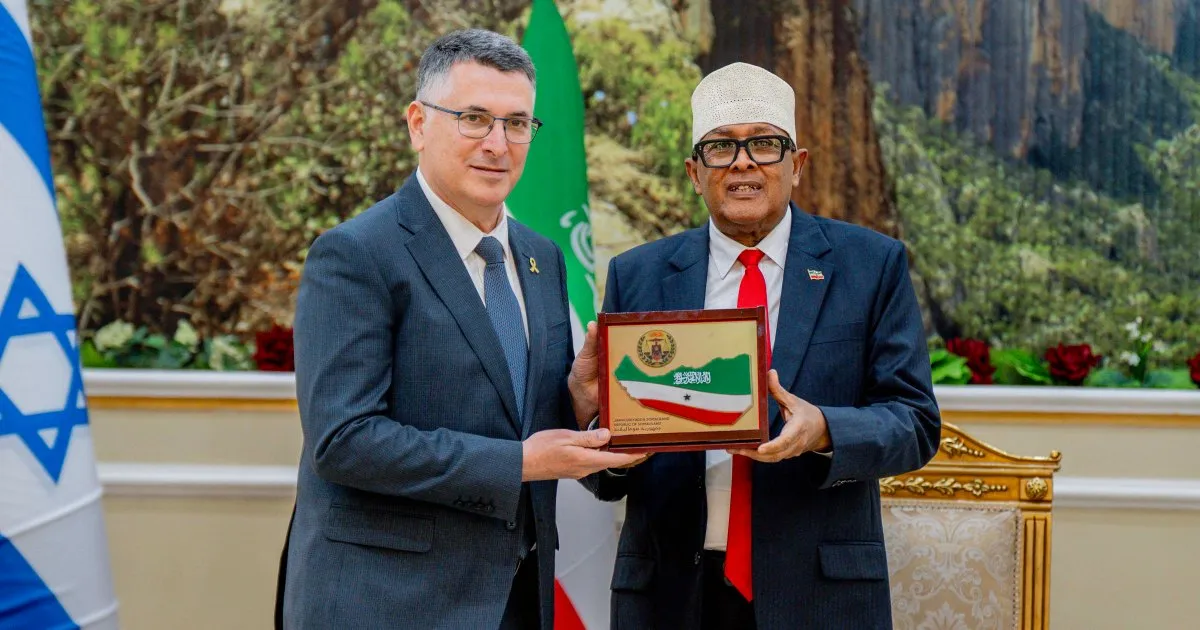
Critics view Israel’s moves in the Horn of Africa as part of Netanyahu’s expansive conflict and influence agenda.This handout photograph taken and released by the Somaliland Presidential Office on January 6, 2026 shows Somaliland's President Abdirahman Abdullahi Mohamed, right, posing for a photograph with Israel's Foreign Minister Gideon Saar, left, at the Presidential Palace in Hargeisa [Somaliland Presidential Office/AFP]Published On 9 Jan 2026When Israeli Foreign Minister Gideon Saar visited Somaliland on Tuesday, he became the first Israeli official to visit the breakaway republic since his country established full diplomatic relations with it in the closing days of last year.Israeli Prime Minister Benjamin Netanyahu announced the diplomatic recognition of Somaliland – a breakaway part of Somalia – on December 26. He said that the recognition was in keeping with “the spirit of the Abraham Accords”, referring to the United States-led initiative encouraging a number of Arab countries to normalise relations with Israel in return for diplomatic and financial concessions from the US.Recommended Stories list of 4 itemslist 1 of 4Somalia condemns Israel’s visit to Somalilandlist 2 of 4Somaliland recognition for forced transfer of Palestinians? ‘Not worth it’list 3 of 4What does Israel’s recognition of Somaliland mean for the region?list 4 of 4Top Somaliland official defends Israel ties amid Arab backlashend of listBut Israel’s recognition of Somaliland has prompted protests within Somalia and complaints from dozens of countries and organisations, including Turkiye, Saudi Arabia and the African Union.Meeting with Somaliland President Abdirahman Mohamed Abdullahi in the Somaliland capital of Hargeisa on Tuesday, Saar told reporters that Israel had not been discouraged by criticism of its decision.“We hear the attacks, the criticism, the condemnations,” he said. “Nobody will determine for Israel who we recognise and who we maintain diplomatic relations with.”HegemonIsrael’s recognition of Somaliland comes after more than two years of its genocidal war on Gaza, and attacks on regional countries, including Lebanon, Iran, Syria, Yemen, and Qatar.Attacks on Lebanon continue, and there are new indications that Israel may be seeking to launch renewed attacks on Iran, its main regional nemesis.Israel’s wars appear to be an attempt to portray itself – with US backing – as the regional hegemon, uninterested in compromising with its enemies.Recognition of Somaliland, despite regional opposition, marks the latest part of that strategy.And Israel has found a new ally in the Horn of Africa on the back of its decision.Despite being self-governing for more than 30 years, Somaliland has failed to gain international recognition, despite maintaining its own currency, passport and army.Recognition has been elusive, meaning that even if there are qualms from some over ties with Israel, many are willing to overlook them in the hope that this decision will pave the path for other countries to follow.“Clans, militias and corruption have ruined Somalia,” Somali journalist and human rights activist Abdalle Mumin, who was previously imprisoned by his country’s authorities, told Al Jazeera, “At least in Somaliland they have achieved some kind of peace and stability.”“Many hope that other countries will follow Israel,” Mumin continued.Residents wave Somaliland flags as they gather to celebrate Israel’s announcement recognising Somaliland’s statehood in downtown Hargeisa [Farhan Aleli/AFP]Why has Israel recognised Somaliland?Nevertheless, speculation over why Israel chose to recognise Somaliland has mounted since Netanyahu’s announcement, with analysts pointing to its strategic location at the crossroads between the Red Sea and the Indian Ocean.Somaliland’s port of Berbera lies close to some of the world’s busiest maritime routes, which have come under attack over the past two years from Yemen’s Houthi rebel movement, a sworn enemy of Israel.These were all factors in Israel’s recognition, former Israeli peace negotiator Daniel Levy said, acknowledging that the Netanyahu government also benefitted from preserving the suggestion that Somaliland may take in Palestinians forced out of Gaza.However, Levy suspects Israel’s ambitions may be grander still, including increasing the country’s value to its chief sponsor, the US.By securing an ally in a strategically important region,The key dynamic, according to Levy, is momentum.“If you set out to do something like this, you can’t just stop [at recognition],” he told Al Jazeera. “You have to keep taking steps: more aircraft, more presence, more moves. Once you’ve committed to this kind of game, you need to stay at the table.”The timing of the move, shortly before Netanyahu’s meeting with US President Donald Trump on December 29, also held significance, Levy said.Israel was trying to place itself more firmly on what it imagines Washington’s agenda to be, and how it imagines great power competition in the Horn of Africa, particularly with China, which maintains a base in neighbouring Djibouti, might play out.“We’ve seen before that Israel can put something on the table and the Americans follow later,” he said.Israel may be implicitly telling the US, “We’re active, and we’re positioned in a way that helps you. Having us there helps you.”Map of Somalia showing Puntland and Somaliland regions [Al Jazeera]MomentumAccording to many observers, the past two years of war have already fundamentally changed the nature of Israel, with the strain of its genocidal war on Gaza, plus news assaults upon its regional neighbours, leaving the country fractured, isolated and with the hard right firmly in the ascendancy.How enthusiastic the country might be for additional adventures in the Horn of Africa, a region, according to many observers, that remains largely unknown to much of the Israeli public, is unclear.“Israelis have no idea what or where Somaliland is. It’s a non-issue in Israel,” Alon Pinkas, a former Israeli ambassador and consul general in New York, told Al Jazeera.“The first time the news came out, it was published alongside maps showing the Horn of Africa, the Red Sea and its position across the Gulf of Aden. They had to show people where it was,” he said, dismissing the suggestion that Israel may ever station troops there.“No, this is Netanyahu doing what he’s been doing ever since October 7, 2023: expanding the theatre of conflict,” he said. “Be that to Lebanon, Syria, Yemen or Iran. Now, it’s Somaliland. There’s no other rationale behind it. It’s about always moving forward.”
SRCAl Jazeera
LANGEN
LEANCenter
WORDS1 000
ENT11
FRI · 2026-01-09 · 07:51 GMTBRIEF NSR-2026-0109-6573
NSR-2026-0109-6573News Report·EN·Political Strategy
Somaliland recognition: Israel’s foothold in the Horn of Africa
In late December 2025, Israeli Prime Minister Benjamin Netanyahu announced Israel's recognition of Somaliland, a breakaway region of Somalia. This move, framed as aligning with the "spirit of the Abraham Accords," has drawn criticism and protests from Somalia, Turkiye, Saudi Arabia, and the African Union.
Simon Speakman CordallAl JazeeraFiled 2026-01-09 · 07:51 GMTLean · CenterRead · 4 min
Al JazeeraFIG 01
Reading time
4min
Word count
1 000words
Sources cited
4cited
Entities identified
11entities
Quality score
100%
§ 01
Briefing Summary
AI-generatedNEWSAR · AI
In late December 2025, Israeli Prime Minister Benjamin Netanyahu announced Israel's recognition of Somaliland, a breakaway region of Somalia. This move, framed as aligning with the "spirit of the Abraham Accords," has drawn criticism and protests from Somalia, Turkiye, Saudi Arabia, and the African Union. In early January 2026, Israeli Foreign Minister Gideon Saar visited Hargeisa, Somaliland, marking the first official Israeli visit since the establishment of diplomatic relations. Saar defended Israel's decision, stating that external criticism would not dictate its diplomatic choices. Critics view Israel's actions as part of a broader strategy to assert regional dominance, particularly following its war on Gaza and attacks on other regional countries.
Confidence 0.90Sources 4Claims 5Entities 11
§ 02
Article analysis
Model · rule-basedFraming
Political Strategy
Conflict
Tone
Mixed Tone
AI-assessed
CalmNeutralAlarmist
Factuality
0.60 / 1.00
Mixed
LowHigh
Sources cited
4
Well sourced
FewMany
§ 03
Key claims
5 extracted01
Nobody will determine for Israel who we recognise and who we maintain diplomatic relations with.
quoteSaar
Confidence
1.00
02
Somaliland has failed to gain international recognition, despite maintaining its own currency, passport and army.
factual
Confidence
1.00
03
Israeli Prime Minister Benjamin Netanyahu announced the diplomatic recognition of Somaliland on December 26.
factualIsraeli Prime Minister Benjamin Netanyahu
Confidence
1.00
04
Israel’s recognition of Somaliland has prompted protests within Somalia and complaints from dozens of countries.
factual
Confidence
0.90
05
Israel’s wars appear to be an attempt to portray itself – with US backing – as the regional hegemon.
factual
Confidence
0.60
§ 04
Full report
4 min read · 1 000 words§ 05
Entities
11 identifiedKey playerOppositionContextPositiveNeutralNegative
Organizations1
Locations7
§ 06
Keywords & salience
9 termssomaliland recognition
1.00
israel
0.90
horn of africa
0.80
diplomatic relations
0.70
abraham accords
0.60
benjamin netanyahu
0.60
somalia
0.50
regional hegemon
0.50
gideon saar
0.40
§ 07
Topic connections
Interactive graph Network visualization showing 51 related topics
View Full Graph Person Organization Location Event|Click node to navigate|Edge numbers = shared articles