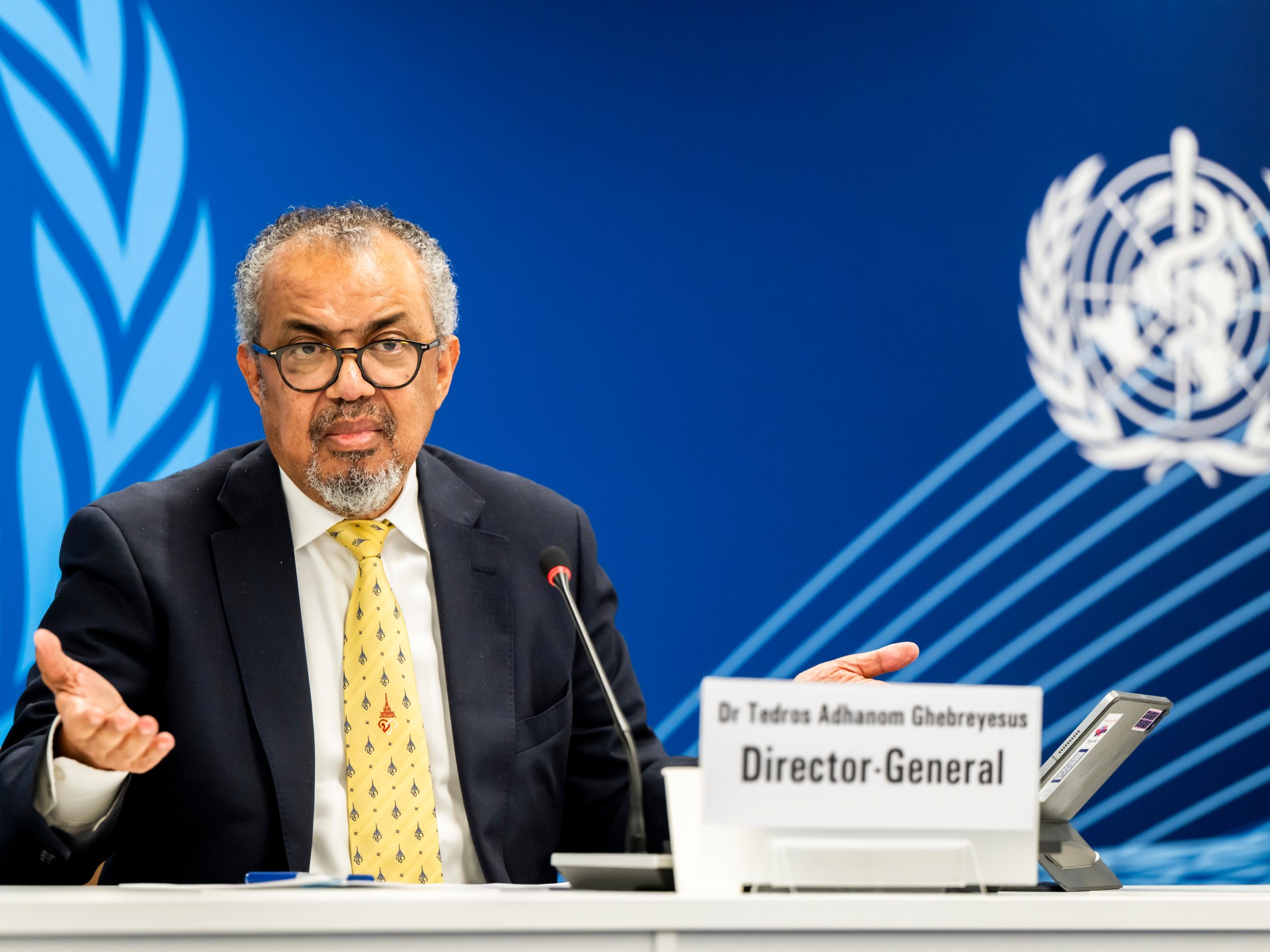
The successes and setbacks of 2025 show why international cooperation matters more than ever.Director-General of the World Health Organization.Published On 9 Jan 2026Tedros Adhanom Ghebreyesus, Director General of the World Health Organization (WHO), briefs the media during a press conference, at the WHO headquarters in Geneva, Switzerland, 11 December 2025 [Martial Trezzini/EPA].As we look back on 2025, the world experienced a year of both remarkable achievement and profound challenge in global health. Multilateralism, science and solidarity were tested as never before, underscoring a fundamental truth: International cooperation is not optional. It is essential if we are to protect and promote health for everyone, everywhere in 2026 and beyond.Perhaps the most significant milestone was the adoption by WHO Member States of the Pandemic Agreement, a landmark step towards making the world safer from future pandemics. Alongside this, amendments to the International Health Regulations came into force, including a new “pandemic emergency” alert level designed to trigger stronger global cooperation. And to sustainably finance the WHO’s work, governments in a historic show of support increased their contributions to our core budget. Together, these measures demonstrate what multilateralism can deliver when countries choose collaboration over division.Countries are now negotiating the Pathogen Access and Benefit Sharing system of the Pandemic Agreement. This aims to ensure rapid sharing of pathogens and genetic sequence data, as well as equitable access to vaccines, diagnostics and therapeutics. We hope this work will be completed by this coming May, allowing the overall Agreement to begin its entry into force as international law.Beyond pandemic preparedness, the WHO advanced public health on multiple fronts in 2025. We validated the safety and life-saving effect of vaccines; issued guidance on innovations such as injectable lenacapavir for HIV prevention and GLP-1 therapies for obesity; responded to humanitarian crises from Gaza and Sudan to Ukraine; supported countries in achieving universal health coverage through locally tailored solutions and sustainable financing; and saw the UN General Assembly adopt a landmark political declaration to tackle noncommunicable diseases and mental health challenges – the deadliest and most widespread health threats of our era.Science matters. Evidence matters. Trust matters.That is why the WHO and its partners devoted sustained effort throughout 2025 to strengthening vaccine safety, effectiveness and use. We commit to sustaining this as a priority in 2026. Immunisation remains one of the most powerful public-health interventions in history, saving millions of lives every year. Its effect is clear: Global measles deaths have fallen by 88% since 2000; malaria vaccines are now being rolled out in 24 African countries; and 86 million girls have been vaccinated against human papillomavirus, helping prevent cervical cancer.At the same time, WHO reaffirmed the safety of vaccines, and emphasised the importance of routine immunisation to protect children against highly contagious diseases such as measles, polio, hepatitis B and diphtheria. Over the past 25 years, global under-five mortality has fallen by more than half – from 11 million deaths annually to 4.8 million – and vaccines have been central to this progress. Immunisation is not a luxury; it is an essential health service. It is a cornerstone of universal health coverage and essential for children to be able to grow into healthy adults.In 2025, the WHO also validated major achievements in disease elimination. The Maldives became the first country to achieve triple elimination of mother-to-child transmission of HIV, syphilis and hepatitis B. Burundi, Egypt and Fiji eliminated trachoma; Guinea and Kenya eliminated sleeping sickness; Niger became Africa’s first country to eliminate river blindness; and Brazil eliminated mother-to-child transmission of HIV. Georgia, Suriname and East Timor were certified malaria-free. We look forward to more such successes this year.Last year also marked a major step in addressing obesity, one of the fastest-growing global health challenges. More than one billion people worldwide live with obesity, a chronic and relapsing condition that drives other noncommunicable diseases and worsens outcomes for infectious diseases. The WHO issued its first guideline on the use of GLP-1 therapies for obesity, with conditional recommendations recognising that obesity requires comprehensive, lifelong care. Medication alone will not solve the obesity crisis. But evidence-based tools, used responsibly and equitably, can reduce suffering and improve quality of life.Rapid advances in digital technologies – including artificial intelligence, robotics, genomics and advanced data sciences – are also transforming healthcare. In 2026, the WHO will continue helping countries integrate these innovations into their health systems and translate them into scalable solutions. Initiatives such as digital self-monitoring of blood pressure among pregnant women show how innovation can strengthen primary healthcare and expand access, particularly in rural and remote settings.Universal health coverage remains our shared destination. Since 2000, access to health services and financial protection have improved for about one-third of people, but progress has stalled. Today, 4.6 billion people still lack access to essential health services, and more than one in four face financial hardship due to health costs. This is not inevitable; we can and must make progress.In response to crises, the WHO supported 48 emergencies in 79 countries in 2025, reaching more than 30 million people. This took place amid increased dangers on the ground and drastic cuts to foreign health aid that threaten to persist into 2026. The WHO’s work ranged from cholera vaccination campaigns in Sudan to evacuating severely ill and injured patients from Gaza for treatment abroad. And we will continue working to alleviate the suffering of people in crisis, working with partners to do so. Still, conflict continues to exact a heavy toll, with rising attacks on healthcare in violation of international law. Healthcare must never be a target.The past year highlighted the resilience of the global health community and the power of collaboration. The Pandemic Agreement’s adoption and successes in disease elimination reflect our capacity for progress. However, ongoing inequalities and funding cuts persist, putting the world’s most vulnerable at continued risk.As we move into 2026, we must prioritise our collective health to ensure universal health coverage and a healthier world for everyone. By doing so, we can fulfil the vision of the World Health Organization from 1948, where people achieve the highest standard of health, not as a privilege for some, but as a right for all.The views expressed in this article are the author’s own and do not necessarily reflect Al Jazeera’s editorial stance.
SRCAl Jazeera
LANGEN
LEANCenter
WORDS1 040
ENT8
FRI · 2026-01-09 · 12:18 GMTBRIEF NSR-2026-0109-6610
NSR-2026-0109-6610Opinion·EN·Public Health
Global health’s defining test
In a retrospective on 2025, the Director-General of the World Health Organization (WHO) highlights the year's global health achievements and challenges, emphasizing the critical role of international cooperation. A key milestone was the adoption of the Pandemic Agreement by WHO Member States, along with amendments to the International Health Regulations, designed to improve global pandemic preparedness and response.
Dr Tedros Adhanom GhebreyesusAl JazeeraFiled 2026-01-09 · 12:18 GMTLean · CenterRead · 5 min
Al JazeeraFIG 01
Reading time
5min
Word count
1 040words
Sources cited
1cited
Entities identified
8entities
Quality score
100%
§ 01
Briefing Summary
AI-generatedNEWSAR · AI
In a retrospective on 2025, the Director-General of the World Health Organization (WHO) highlights the year's global health achievements and challenges, emphasizing the critical role of international cooperation. A key milestone was the adoption of the Pandemic Agreement by WHO Member States, along with amendments to the International Health Regulations, designed to improve global pandemic preparedness and response. Member states also increased contributions to the WHO's core budget. Negotiations continue on the Pathogen Access and Benefit Sharing system. Beyond pandemic efforts, the WHO advanced public health in areas such as vaccine validation, HIV prevention, obesity treatment, humanitarian crisis response, universal health coverage, and addressing noncommunicable diseases and mental health. The WHO emphasizes the importance of science, evidence, and trust in global health initiatives.
Confidence 0.90Sources 1Claims 5Entities 8
§ 02
Article analysis
Model · rule-basedFraming
Public Health
Diplomatic
Tone
Measured
AI-assessed
CalmNeutralAlarmist
Factuality
0.60 / 1.00
Mixed
LowHigh
Sources cited
1
Limited
FewMany
§ 03
Key claims
5 extracted01
Malaria vaccines are now being rolled out in 24 African countries.
factualTedros Adhanom Ghebreyesus
Confidence
1.00
02
Global measles deaths have fallen by 88% since 2000.
statisticTedros Adhanom Ghebreyesus
Confidence
1.00
03
Governments increased their contributions to WHO's core budget.
factualTedros Adhanom Ghebreyesus
Confidence
1.00
04
Amendments to the International Health Regulations came into force, including a new “pandemic emergency” alert level.
factualTedros Adhanom Ghebreyesus
Confidence
1.00
05
WHO Member States adopted the Pandemic Agreement, a step towards making the world safer from future pandemics.
factualTedros Adhanom Ghebreyesus
Confidence
1.00
§ 04
Full report
5 min read · 1 040 words§ 05
Entities
8 identifiedKey playerOppositionContextPositiveNeutralNegative
Organizations2
§ 06
Keywords & salience
9 termsglobal health
1.00
international cooperation
0.90
pandemic agreement
0.80
world health organization
0.70
pandemic preparedness
0.60
multilateralism
0.60
universal health coverage
0.50
noncommunicable diseases
0.40
mental health
0.40
§ 07
Topic connections
Interactive graph Network visualization showing 50 related topics
View Full Graph Person Organization Location Event|Click node to navigate|Edge numbers = shared articles