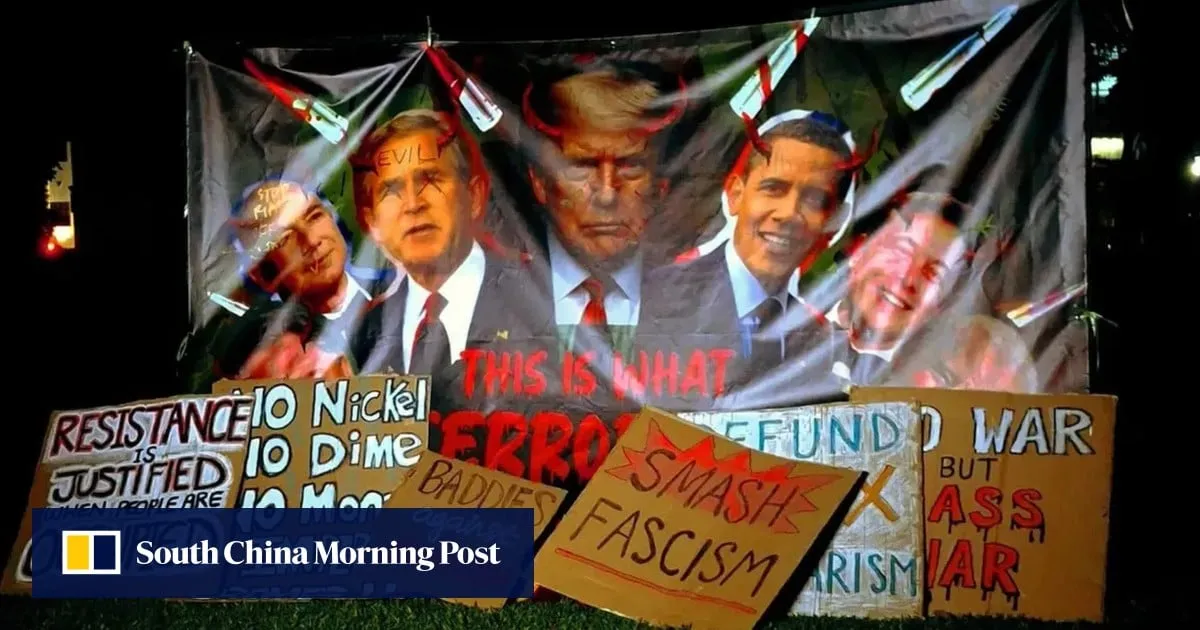
Singapore This Week in AsiaPolitics Are US-Singapore relations under pressure as public trust declines? Negative public sentiment does not immediately translate to worsening bilateral ties as the US remains an important partner, experts say Jean Iau Published: 5:00pm, 15 Apr 2026Updated: 5:54pm, 15 Apr 2026 In a rare public protest in Singapore, hundreds gathered in Hong Lim Park over the weekend to denounce the “US war machine”. They brandished placards and banners, including one with horns drawn on US presidents past and present captioned: “This is what terrorists look like.” The demonstration, which required organisers to get permission from the authorities, came as public sentiment across the region sours against Washington. Observers attribute this to the perception that the United States has become destabilising and unreliable in recent years. Brand America has taken a significant hit under Trump 2.0 Steven Okun, geopolitical analyst “Brand America has taken a significant hit under Trump 2.0,” said geopolitical analyst Steven Okun, CEO of APAC Advisors. “Tariffs, excessive immigration enforcement, diminished support for the global rules-based order and now the economic crisis stemming from the US’ unilateral attack on Iran have all worked to lessen the US’ standing in the world,” added Okun, a former chairman of the American Chamber of Commerce in Singapore. Last week, an ISEAS-Yusof Ishak Institute survey found that most Southeast Asians would choose China over the US as a strategic partner if forced to pick one. Support for China was strongest in Indonesia, Malaysia, Thailand and Singapore, while the US remained the preferred choice in the Philippines, Myanmar and Vietnam. View in AppREAD FULL ARTICLE People gather at Singapore’s Hong Lim Park on Saturday to denounce the “US war machine”. Photo: Instagram/sgacadboycott The survey also showed that American leadership under US President Donald Trump was the biggest concern among respondents, followed by global scam operations and aggressive behaviour in the South China Sea. Even before Trump returned to office, Singaporeans were already viewing China as more important than the US, said Gregory Poling, director of the Centre for Strategic and International Studies’ Southeast Asia Programme and Asia Maritime Transparency Initiative, citing public opinion numbers from other studies by Gallup and Pew. While those numbers bounced back during the Biden administration, they collapsed with Trump’s return, Poling said. “I think we will regularly get numbers from here on out showing that trust in the US is lower even than during the height of the global war on terror under [George W.] Bush,” he added. Negative public sentiment does not immediately translate into worsening bilateral ties, according to experts, and the US remains economically and geopolitically indispensable to Southeast Asia. Further Reading Most in Asean prefer China over US in survey, Trump cited as biggest concern Asian Angle | Doubts about Trump strain Southeast Asia’s US-China balancing act Singapore’s refusal to negotiate over Hormuz creates waves in Malaysia Scot Marciel, a former US diplomat and senior adviser at BowerGroupAsia, said the decline in trust was unlikely to affect US-Singapore ties dramatically, given their long history and continued close partnership. But if the decline persisted, “it likely will gradually chip away at the foundation of that relationship, weakening it over time”, he said. Singapore’s government had continued to prioritise productive diplomatic, security and economic relations with Washington, and the business community still recognised the US as the city state’s largest investor, Poling said. According to official statistics, US foreign direct investment reached S$778.6 billion (US$612 billion) at the end of 2024. Singapore’s Prime Minister Lawrence Wong talks on the phone to US President Donald Trump in November 2024. Photo: Ministry of Digital Development and Information of Singapore Even so, increasingly negative public sentiment could constrain decision-making, Poling said – particularly in a crisis, when Singaporean leaders might judge it politically risky to back Washington. “Singapore’s actions on the international stage will continue to be driven by its national interests, including supporting international law and pursuing better economic opportunities for its citizens,” Chen said. He added that the government needed to keep communicating the rationale behind its foreign policy through parliamentary speeches and other public platforms. Last week, Foreign Affairs Minister Vivian Balakrishnan told parliament that Singapore would not negotiate with Iran for safe passage through the Strait of Hormuz. Trump announces US blockade of Strait of Hormuz, warns Iranians of being ‘blown to hell’ Trump announces US blockade of Strait of Hormuz, warns Iranians of being ‘blown to hell’ Doing so would undermine fundamental principles of international law, he said, stressing that transit through international waterways was a right – not a privilege – codified in the United Nations Convention on the Law of the Sea, to which Singapore was a signatory. Balakrishnan noted that more maritime oil – crude and refined – flowed through the Straits of Malacca and Singapore than the Strait of Hormuz. He also pointed out that while the narrowest point in the Strait of Hormuz measures 21 nautical miles, the narrowest point in the Strait of Singapore is less than two nautical miles. ‘Their affair’ While Malaysian politicians criticised Singapore’s approach, Prime Minister Anwar Ibrahim said his country’s diplomatic approach was guided by its own principles and Singapore’s view was “their affair”, stressing that the two neighbours must preserve their friendship. On Monday night, Coordinating Minister for National Security K. Shanmugam said Singapore appreciated Anwar’s statement and made clear that the city state was not siding with Washington. This is not a case of Singapore siding with the US or Western countries K. Shanmugam, coordinating minister for national security “This is not a case of Singapore siding with the US or Western countries. We have said what we have said in our own strategic interest – consistent with international law. It is a core interest for Singapore.” Chen said Trump’s announcement of a blockade in the Strait of Hormuz was not a vindication of Singapore’s stance but rather a happy coincidence that spared the city state from finding itself in Washington’s crosshairs while pursuing its own interests. Apart from the strikes on Iran and Venezuela, he said other US actions and policies also gave Singapore cause for concern – such as the Section 301 tariff investigation. Last month, Singapore was one of 16 major economies named in an inquiry launched by the Office of the United States Trade Representative, which is investigating alleged excess manufacturing capacity and the importation of goods produced with forced labour. “The challenge [Singapore politicians] face is navigating these areas of tension while focusing on the health of the broader relationship and the benefits that it can bring. That is, unless the calculus that underpins the relationship changes,” Chen said. A container ship sails past oil tankers anchored in the Strait of Singapore on Tuesday. Photo: AFP Marciel said US-Singapore relations had been strong for a long time and would not deteriorate rapidly due to recent events. The two countries mark 60 years of diplomatic ties this year. “That said, Singapore has for years worried about the long-term US commitment to the region, and the Trump administration’s approach almost certainly has added to those worries,” he said. “If the current US approach continues, especially past 2028, it could well undermine Singapore’s trust sufficiently to affect the relationship.” Jean Iau FOLLOW FOLLOW Jean Iau writes for the Asia desk, covering politics, law and security-related issues in Singapore. She began her journalism career in 2019 at The Straits Times where she covered breaking news, crime and politics. She has a Masters Degree in Socio-Cultural Anthropology from Durham University. Singapore | United States | Donald Trump | Malaysia | Diplomacy | US-Asean relations | Anwar Ibrahim | Iran | US-ally trade wars | ISEAS – Yusof Ishak Institute Before you go 3 Conversations scmp poll Discover MORE stories on Singapore FOLLOW Hong Kong set to rise to No 2 global financial hub within 15 years: Paul Chan Malaysian man jailed in Singapore for raping, robbing Filipino helper Your Hong Kong Sevens weekend food guide for April 17-19 Select Voice Select Speed 0.8x 0.9x1.0x 1.1x 1.2x 1.5x 1.75x 00:0000:00 1.00x
SRCSouth China Morning Post
LANGEN
LEANCenter-Right
WORDS1 343
ENT12
WED · 2026-04-15 · 09:00 GMTBRIEF NSR-2026-0415-68720
NSR-2026-0415-68720News Report·EN·Diplomatic
Are US-Singapore relations under pressure as public trust declines?
A public protest in Singapore against the "US war machine" highlights declining public trust in the United States in the region, as reported on April 15, 2026. Experts attribute this decline to perceptions of US instability and unreliability, citing policies under a second Trump administration.
Jean IauSouth China Morning PostFiled 2026-04-15 · 09:00 GMTLean · Center-RightRead · 6 min
South China Morning PostFIG 01
Reading time
6min
Word count
1 343words
Sources cited
3cited
Entities identified
12entities
Quality score
100%
§ 01
Briefing Summary
AI-generatedNEWSAR · AI
A public protest in Singapore against the "US war machine" highlights declining public trust in the United States in the region, as reported on April 15, 2026. Experts attribute this decline to perceptions of US instability and unreliability, citing policies under a second Trump administration. A recent ISEAS-Yusof Ishak Institute survey indicated that most Southeast Asians, including those in Singapore, would prefer China over the US as a strategic partner if forced to choose. The survey identified American leadership under President Trump as a primary concern, along with global scam operations and South China Sea tensions. Despite negative sentiment, analysts suggest that the US remains an important partner for Singapore.
Confidence 0.90Sources 3Claims 5Entities 12
§ 02
Article analysis
Model · rule-basedFraming
Diplomatic
Political Strategy
Tone
Measured
AI-assessed
CalmNeutralAlarmist
Factuality
0.60 / 1.00
Mixed
LowHigh
Sources cited
3
Well sourced
FewMany
§ 03
Key claims
5 extracted01
American leadership under US President Donald Trump was the biggest concern among respondents in a survey.
factualnull
Confidence
1.00
02
Support for China was strongest in Indonesia, Malaysia, Thailand and Singapore.
factualnull
Confidence
1.00
03
An ISEAS-Yusof Ishak Institute survey found that most Southeast Asians would choose China over the US as a strategic partner if forced to pick one.
statisticnull
Confidence
1.00
04
Brand America has taken a significant hit under Trump 2.0.
quoteSteven Okun
Confidence
0.90
05
Public sentiment across the region sours against Washington due to the perception that the United States has become destabilising and unreliable.
quoteObservers
Confidence
0.80
§ 04
Full report
6 min read · 1 343 words§ 05
Entities
12 identifiedKey playerOppositionContextPositiveNeutralNegative
Organizations1
§ 06
Keywords & salience
9 termsus-singapore relations
1.00
public trust
0.80
public sentiment
0.70
us foreign policy
0.60
china
0.60
trump
0.50
southeast asia
0.50
economic crisis
0.40
geopolitics
0.40
§ 07
Topic connections
Interactive graph Network visualization showing 51 related topics
View Full Graph Person Organization Location Event|Click node to navigate|Edge numbers = shared articles