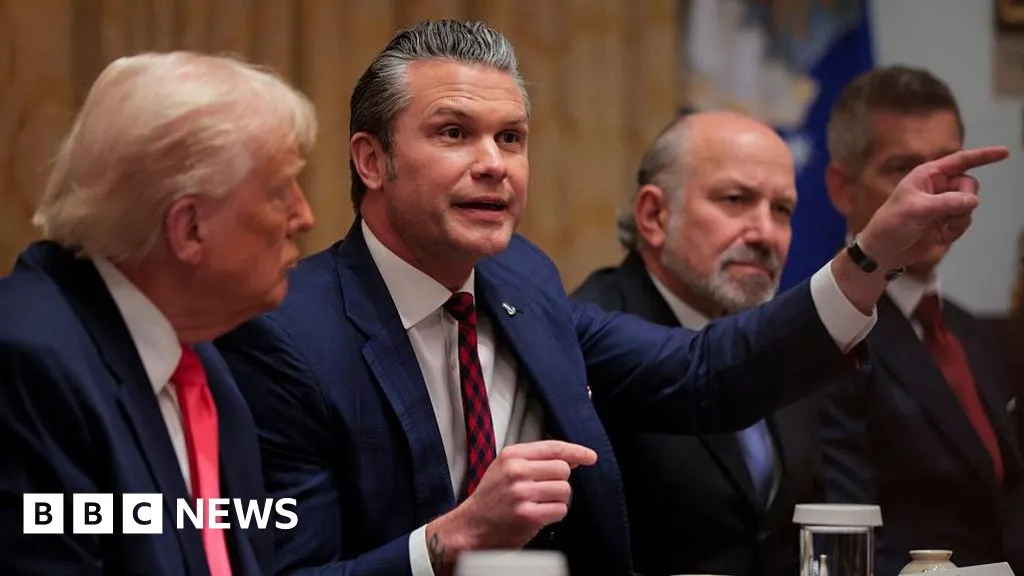
US defence secretary says he did not see survivors before follow-up strike on drug boat15 hours agoBernd Debusmann Jrat the White HouseGetty ImagesDefence secretary Pete Hegseth says that he watched the first of two strikes on the alleged drug vessel on 2 September. US Defence Secretary Pete Hegseth has said he "did not personally see survivors" before a deadly follow-up strike on an alleged drug boat in the Caribbean.An initial strike reportedly left two survivors clinging to the burning vessel, before a second strike was allegedly ordered that left them dead.The 2 September strike has prompted concerns that US forces may have violated laws governing armed conflict. During a cabinet meeting at the White House, Hegseth attributed the strike to the "fog of war" in a chaotic situation. The White House has said that a top US Navy admiral, Frank Bradley, authorised the second strike.The Washington Post first reported details about the second strike, which has led to concern from both Democratic and Republican lawmakers.In response to a reporter's question during a cabinet meeting on Tuesday, Hegseth said that he watched the first strike "live" but quickly moved on to another meeting."I did not personally see survivors," Hegseth said of the first strike. "That thing was on fire and it exploded... you can't see anything. This is called the fog of war."He added that he learned of Admiral Bradley's "correct decision" to sink the boat "a couple of hours later"."We have his back," Hegseth said of Bradley.President Trump, for his part, also defended Adm Bradley, although he distanced himself from his decision to strike the vessel a second time, saying that "we didn't know about" the follow-on strike."And I can say this: I want those boats taken out," Trump added.More than 80 people have been killed in a wave of similar strikes across the Caribbean and Eastern Pacific since early September.The Trump administration has repeatedly defended the strikes as a necessary self-defence measure to save American lives from illicit drugs.Watch: "I did not personally see survivors", Hegseth says of second deadly boat strikeOn Tuesday, Trump claimed that the strikes have led to a massive reduction in drug trafficking through maritime routes, although he did not provide evidence.US lawmakers from both sides of the political spectrum have expressed unease about the 2 September incident, with the Senate Armed Services committee vowing over the weekend to conduct "vigorous oversight" to determine what occurred.Adm Bradley - who was commander of the US military's Joint Special Operations Command at the time of the strike - is expected to appear on Capitol Hill this week. He is now overall commander of US Special Operations Command, having been promoted a month after the 2 September incident.The Geneva Convention forbids the intentional targeting of wounded combatants, saying that those participants should be apprehended and given medical aid. Several experts who spoke to the BBC expressed doubts that the reported follow-up strike could be considered legal under international law. Since the 2 September strike, the US has significantly expanded its military presence in the region, with Trump again on Tuesday vowing to "start doing those strikes on land".
SRCBBC News - World
LANGEN
LEANCenter
WORDS520
ENT4
TUE · 2025-12-02 · 20:19 GMTBRIEF NSR-2025-1202-688
NSR-2025-1202-688News Report·EN·National Security
US defence secretary says he did not see survivors before follow-up strike on drug boat
US Defence Secretary Pete Hegseth stated he did not see survivors before a second strike on a suspected drug boat in the Caribbean on September 2nd. The initial strike reportedly left two survivors, but a subsequent strike allegedly killed them, raising concerns about potential violations of laws governing armed conflict.
BBC News - WorldFiled 2025-12-02 · 20:19 GMTLean · CenterRead · 3 min
BBC News - WorldFIG 01
Reading time
3min
Word count
520words
Sources cited
6cited
Entities identified
4entities
Quality score
100%
§ 01
Briefing Summary
AI-generatedNEWSAR · AI
US Defence Secretary Pete Hegseth stated he did not see survivors before a second strike on a suspected drug boat in the Caribbean on September 2nd. The initial strike reportedly left two survivors, but a subsequent strike allegedly killed them, raising concerns about potential violations of laws governing armed conflict. Hegseth attributed the incident to the "fog of war," while the White House indicated Admiral Frank Bradley authorized the second strike. Lawmakers from both parties have expressed concern, and the Senate Armed Services Committee plans oversight. President Trump defended Bradley but distanced himself from the decision. The incident is part of a larger series of over 80 strikes in the Caribbean and Eastern Pacific since early September, which the Trump administration defends as necessary to combat drug trafficking.
Confidence 0.90Sources 6Claims 5Entities 4
§ 02
Article analysis
Model · rule-basedFraming
National Security
Legal & Judicial
Tone
Measured
AI-assessed
CalmNeutralAlarmist
Factuality
0.80 / 1.00
Factual
LowHigh
Sources cited
6
Well sourced
FewMany
§ 03
Key claims
5 extracted01
The Geneva Convention forbids the intentional targeting of wounded combatants.
factualArticle's own claim
Confidence
1.00
02
The White House has said that a top US Navy admiral, Frank Bradley, authorised the second strike.
factualThe White House
Confidence
1.00
03
US Defence Secretary Pete Hegseth has said he "did not personally see survivors" before a deadly follow-up strike.
quotePete Hegseth
Confidence
1.00
04
More than 80 people have been killed in a wave of similar strikes across the Caribbean and Eastern Pacific since early September.
statisticArticle's own claim
Confidence
0.90
05
An initial strike reportedly left two survivors clinging to the burning vessel, before a second strike was allegedly ordered.
factualArticle's own claim
Confidence
0.80
§ 04
Full report
3 min read · 520 words§ 05
Entities
4 identifiedKey playerOppositionContextPositiveNeutralNegative
People3
Locations1
§ 06
Keywords & salience
9 termsdrug boat strike
0.90
follow-up strike
0.80
survivors
0.70
laws governing armed conflict
0.60
fog of war
0.60
us defence secretary
0.50
drug trafficking
0.50
self-defence
0.40
frank bradley
0.40
§ 07
Topic connections
Interactive graph Network visualization showing 51 related topics
View Full Graph Person Organization Location Event|Click node to navigate|Edge numbers = shared articles