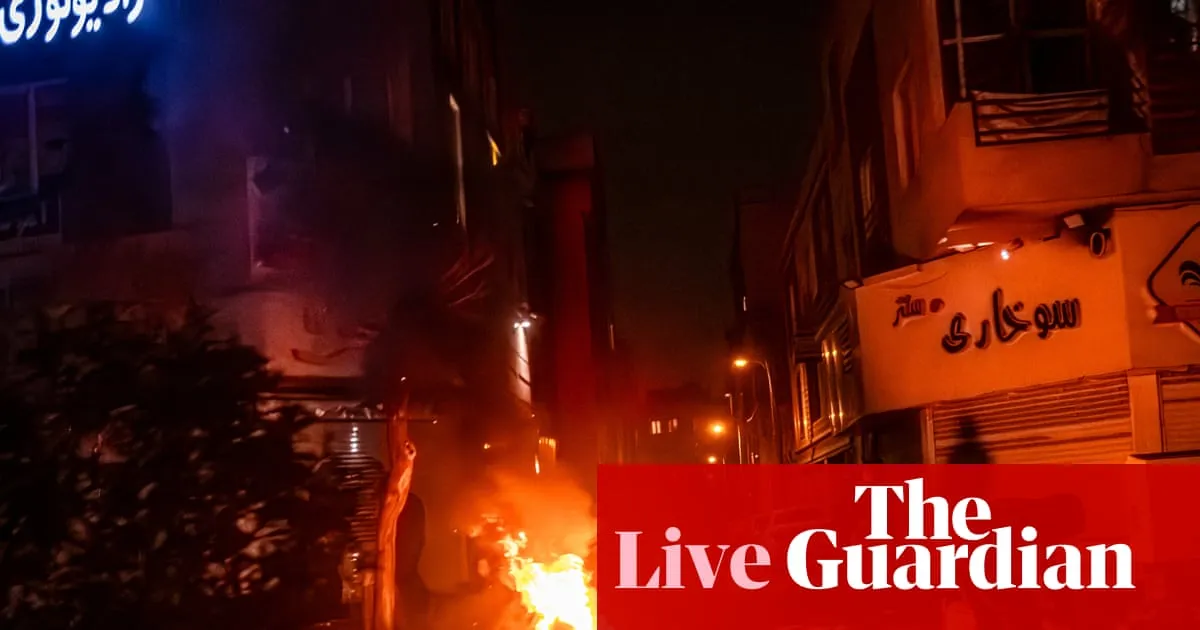
Key events4m agoProtests 'under total control', Iranian foreign minister claims14m agoOpening summaryShow key events onlyPlease turn on JavaScript to use this featureProtests 'under total control', Iranian foreign minister claimsIranian foreign minister Abbas Araqchi has claimed the protests have now “come under total control” after the violence spiked over the weekend, according to comments being carried by Al Jazeera, which we have not been able to verify the veracity of yet.Araqchi was also quoted as having said the protests “turned violent and bloody to give an excuse” for the US president, Donald Trump, to intervene.He went on to say the demonstrations – which spread to almost all provinces and dozens of cities – were “stoked and fuelled” by foreign elements and vowed that security forces will “hunt down” those responsible.Because of the internet blackout it is difficult to get a clear picture of what is going on in Iran as it is hard to obtain information from the ground.Opening summaryDonald Trump said he is considering “very strong” military action against Iran’s ruling regime amid its crackdown on protests that have shaken the country and reportedly sent the death toll soaring.But the US president also claimed on Sunday that Iran’s leader had reached out to him and proposed negotiations. “A meeting is being set up ... They want to negotiate,” Trump said, while adding that “we may have to act before a meeting”.Tehran has also ordered counter-rallies in Iran in an effort to regain the initiative, as well as warning the US earlier not to attack and vowing to hit back if it did.At least 538 people have been killed in the violence surrounding demonstrations, according to the US-based Human Rights Activists News Agency, including 490 protesters. The group reported that more than 10,600 people were arrested by Iranian authorities.Another rights monitor, the Norway-based Iran-human-rights" class="entity-link entity-organization" data-entity-id="9079" data-entity-type="organization">Iran Human Rights group, said on Sunday it had confirmed the killing of at least 192 protesters but that the actual death toll could already amount to several hundred or more. It denounced a “mass killing”.The protests – now in their second week – were initially sparked by anger over the rising cost of living and have evolved into one of the biggest challenges to the rule of supreme leader Ayatollah Ali Khamenei, 86.Protesters in Tehran, Iran, on Saturday. Photograph: Social Media/ZUMA Press Wire/ShutterstockIn other key developments: Protests have grown in recent days despite an internet blackout that has lasted more than 72 hours, according to monitor Netblocks. Activists say the shutdown is limiting the flow of information. President Masoud Pezeshkian accused the arch-foes of Iran of “trying to escalate this unrest” and bringing “terrorists from abroad into the country”, in an interview broadcast Sunday with state media. Dozens of bodies have accumulated outside a morgue south of Tehran, according to footage on a video whose location was authenticated by the Agence France-Presse news agency on Sunday. State TV has aired images of burning buildings, including a mosque, as well as funeral processions for security personnel, with authorities confirming members of the security forces have been killed. Trump said on Saturday he would “rescue” protesters if the Iranian government killed them and reiterated his threat to intervene, posting on his Truth Social platform: “Iran is looking at FREEDOM, perhaps like never before. The USA stands ready to help!!!” Flames rise from burning debris in the middle of a street in Gorgan, in Iran’s Golestan province, on Saturday amid the protests. Photograph: MEK/The Media Express/SIP/Shutterstock The Iranian government on Sunday declared three days of national mourning for “martyrs” including members of the security forces killed, state television said. Pezeshkian urged people to join a “national resistance march” of nationwide rallies on Monday to denounce the violence, which the government said had been committed by “urban terrorist criminals”, state television reported. Reza Pahlavi, who is the US-based son of Iran’s ousted shah and has played a prominent role in calling for the protests, said he was prepared to return to the country and lead a transition to a democratic government. With staff and news agencies
SRCThe Guardian - World News
LANGEN
LEANCenter-Left
WORDS675
ENT10
MON · 2026-01-12 · 07:45 GMTBRIEF NSR-2026-0112-6987
NSR-2026-0112-6987News Report·EN·Conflict
Iran crisis: Trump claims leader ‘wants to negotiate’ amid protest crackdown as he mulls US military response – latest updates
Amidst a crackdown on widespread protests in Iran, President Trump stated he is considering military action while also claiming Iranian leadership wants to negotiate. The protests, initially sparked by rising living costs, have evolved into a significant challenge to the Iranian government.
Guardian StaffThe Guardian - World NewsFiled 2026-01-12 · 07:45 GMTLean · Center-LeftRead · 3 min
The Guardian - World NewsFIG 01
Reading time
3min
Word count
675words
Sources cited
7cited
Entities identified
10entities
Quality score
100%
§ 01
Briefing Summary
AI-generatedNEWSAR · AI
Amidst a crackdown on widespread protests in Iran, President Trump stated he is considering military action while also claiming Iranian leadership wants to negotiate. The protests, initially sparked by rising living costs, have evolved into a significant challenge to the Iranian government. Iranian Foreign Minister Araqchi claims the protests are under control and blames foreign elements for fueling the unrest, accusing the US president of using the violence as an excuse to intervene. Reports from human rights organizations indicate a high death toll and thousands of arrests during the demonstrations, which have spread across numerous Iranian cities. The Iranian government has organized counter-rallies and warned the US against military intervention.
Confidence 0.90Sources 7Claims 5Entities 10
§ 02
Article analysis
Model · rule-basedFraming
Conflict
Political Strategy
Tone
Mixed Tone
AI-assessed
CalmNeutralAlarmist
Factuality
0.70 / 1.00
Factual
LowHigh
Sources cited
7
Well sourced
FewMany
§ 03
Key claims
5 extracted01
Trump said he is considering “very strong” military action against Iran.
quoteDonald Trump
Confidence
1.00
02
Dozens of bodies have accumulated outside a morgue south of Tehran.
factualAgence France-Presse
Confidence
0.90
03
Protests were initially sparked by anger over the rising cost of living.
factual
Confidence
0.90
04
Iranian foreign minister claims the protests have now “come under total control”.
quoteAbbas Araqchi
Confidence
0.90
05
At least 538 people have been killed in the violence surrounding demonstrations.
statisticUS-based Human Rights Activists News Agency
Confidence
0.80
§ 04
Full report
3 min read · 675 words§ 05
Entities
10 identifiedKey playerOppositionContextPositiveNeutralNegative
People3
Organizations3
§ 06
Keywords & salience
9 termsiran protests
1.00
us military response
0.80
negotiations
0.70
crackdown
0.70
death toll
0.60
security forces
0.50
foreign intervention
0.50
internet blackout
0.40
human rights
0.40
§ 07
Topic connections
Interactive graph Network visualization showing 51 related topics
View Full Graph Person Organization Location Event|Click node to navigate|Edge numbers = shared articles