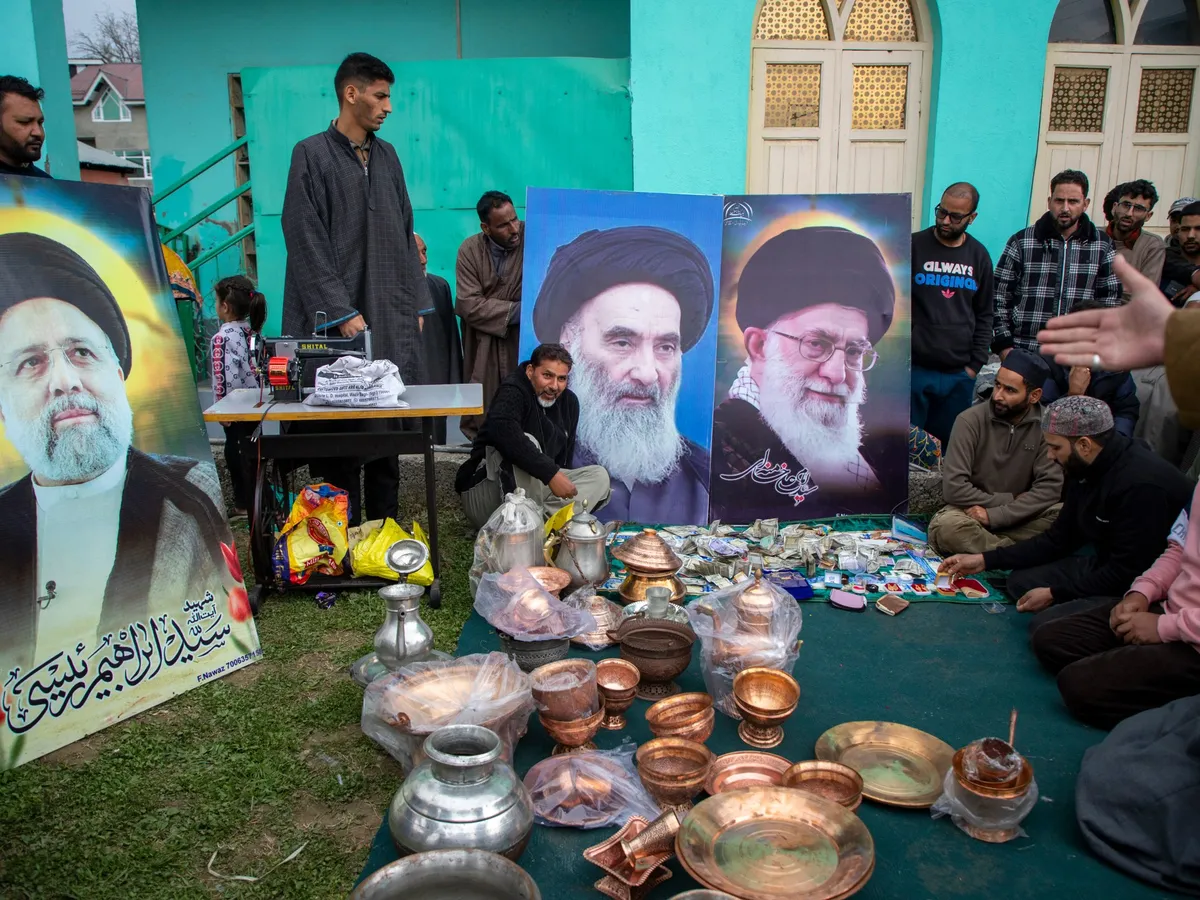
A centuries-old historical bond has come alive again amid the war on Iran, with Kashmiris sharing whatever they can.Kashmiris in a collection drive, with utensils and cash donated for the people of Iran [Junaid Bhat/Al Jazeera]Published On 16 Apr 2026Srinagar, Kashmir" class="entity-link entity-location" data-entity-id="43267" data-entity-type="location">Indian-administered Kashmir — The gold earrings were a gift from her father on her birthday just months earlier. But on March 21, as South Asia marked Eid‑ul‑Fitr, Masrat Mukhtar handed them over to an aid collection effort to help civilians in Iran trying to survive the US-Israel war on the country.She was one of many in Kashmir" class="entity-link entity-location" data-entity-id="43267" data-entity-type="location">Indian-administered Kashmir who paused their customary rituals and celebrations on the auspicious day to contribute cash, household items, and personal assets for a people more than 1,600 km (1,000 miles) away.Her cousins followed, each bringing items of personal value. Families offered copper utensils, livestock, bicycles, and portions of savings. Children broke their piggy banks, sharing savings they had carefully collected over several years. Shopkeepers and traders handed over parts of their earnings.“We give what we love. This brings us closer to them,” said Mukhtar, a 55-year-old woman from Budgam in the central part of Kashmir" class="entity-link entity-location" data-entity-id="43267" data-entity-type="location">Indian-administered Kashmir, before referring to a name by which the region has historically also been known. “This is what Little Iran does for its namesake. The bond persists through time and conflict.”That bond, rooted in more than six centuries of historical connections, has taken on a much more overt presence during the war – drawing recognition from Iranian authorities, and concerns over certain fund collection methods from Indian officials.Cash donated for Iran at a collection drive in Kashmir" class="entity-link entity-location" data-entity-id="43267" data-entity-type="location">Indian-administered Kashmir [Junaid Bhat/Al Jazeera]One daughter’s wealth, to another daughterIn Zadibal, a Shia-majority area of Srinagar – the biggest city in Kashmir" class="entity-link entity-location" data-entity-id="43267" data-entity-type="location">Indian-administered Kashmir – 73-year-old Tahera Jan watched neighbours contribute copper pots.“Kashmiris traditionally collect these utensils for their daughters’ weddings. We chose to give them instead to daughters who lost mothers and sisters in the attacks,” Jan said.Sadakat Ali Mir, a 24-year-old mini-truck driver, contributed one of the two vehicles he drives for his livelihood. Other contributors offered bicycles, scooters, and other essential items. Children, including nine-year-old Zainab Jan, handed over piggy banks.To be sure, that Shia constitute between 10 to 15 percent of Kashmir" class="entity-link entity-location" data-entity-id="43267" data-entity-type="location">Indian-administered Kashmir’s population is a factor in why the war in Iran resonates so deeply in the region. But donations for Iran have extended well beyond Shia. Several Sunni families observed simpler Eid meals, redirecting household resources towards Iranian relief. Some shopkeepers closed early, while families adjusted daily routines to contribute.Political and religious figures also participated. Budgam lawmaker Aga Syed Muntazir Mehdi donated a month’s salary to the relief effort. Imran Reza Ansari, a Shia scholar and leader of the People’s Conference party, noted public participation across communities.Similar donation campaigns in support of Iranians have also been reported from Pakistan, Iraq and other countries.But at the heart of this outpouring of support for Iran in Kashmir" class="entity-link entity-location" data-entity-id="43267" data-entity-type="location">Indian-administered Kashmir – which also witnessed large rallies after the killing of Iranian Supreme Leader Ayatollah Ali Khamenei on February 28 – are rare cultural ties that Kashmir and what was then Persia have shared for centuries.Women arrive carrying kitchenware to donate at a relief drive for Iran in Budgam, Kashmir" class="entity-link entity-location" data-entity-id="43267" data-entity-type="location">Indian-administered Kashmir, Monday, March 23, 2026 [Mukhtar Khan/ AP Photo]‘Little Iran’Sufi scholar Mir Sayyid Ali Hamadani arrived in Kashmir from Hamadan in Iran in the 14th century, introducing religious practices, art forms, and Persian literary traditions. Persian architectural influences appear in historical mosques, and the Persian language has shaped local literature.Irshad Ahmad, a scholar of Central Asian studies, said donation drives drew on this historical reservoir, with prayers, rituals, and art forms reflecting longstanding ties. Kashmir has historically been referred to as Iran-e-Sagheer, or Little Iran.The donations carry personal and cultural meaning beyond financial value, said experts. “People are not only parting with objects; they are sharing emotional continuity,” Sakina Hassan, a lecturer on humanitarian practices in New Delhi, said.More than 2,000 people have been killed in Iran during the war, which is on pause at the moment amid a fragile ceasefire brokered by Pakistan. The first round of direct talks between the United States and Iran in Islamabad last week broke down without a deal, and mediators are working on pushing the two sides towards new talks. The ceasefire is set to expire next Wednesday.A volunteer auctions a donated copper vessel to raise cash for a relief drive for Iran in Budgam, Kashmir" class="entity-link entity-location" data-entity-id="43267" data-entity-type="location">Indian-administered Kashmir, Monday, March 23, 2026 [Mukhtar Khan/AP Photo]Millions in donationsThe scope of donations from Kashmir is significant. Estimates from local authorities place the value of contributions at up to six billion rupees ($64m), including cash, gold, jewellery, household items, livestock, and vehicles.Collection points in Srinagar, Budgam, Baramulla – another major city – and the region’s northern districts were staffed by volunteers documenting donations.Small contributions, including coins, piggy banks, and utensils, make up a large portion of total aid in terms of volume. Syed Asifi, a volunteer managing central Srinagar collections, said even individuals with limited means brought what they could.Medical kits were assembled by local doctors, and supply drives were organised by students and educational institutions based on assessed needs in Iran.The Iranian embassy in New Delhi acknowledged contributions in a post on X: “We sincerely thank the kind people of Kashmir for standing with the people of Iran through their humanitarian support and heartfelt solidarity; this kindness endures.” A video shared by the embassy showed a widow donating gold she had kept as a memento of her husband, who died 28 years ago.That post was subsequently pulled down by the embassy, though the mission later posted again, thanking the people of India and Kashmir.The embassy added that Kashmir’s contributions constitute a substantial portion of donations from India, with local sources estimating the Valley’s share at more than 40 percent of the total.Jewellery donated by women for an Iran aid drive in Kashmir" class="entity-link entity-location" data-entity-id="43267" data-entity-type="location">Indian-administered Kashmir [Junaid Bhat/Al Jazeera]Security concernsBut while the majority of donations are directed towards humanitarian purposes, Indian authorities have raised concerns about potential misuse. Jammu and Kashmir Police and the State Investigative Agency (SIA) have said some funds collected through door-to-door drives by unverified individuals could be diverted to local networks of separatists and armed groups.“People depositing money directly to the Iranian embassy should not be worried,” said a senior official, speaking on condition of anonymity. “Collections by middlemen without transparent monitoring may not reach the intended recipients.”Authorities have also asked volunteers to maintain records to ensure compliance with fundraising regulations.There’s a reason for this concern, say Indian authorities.They point to the example of 2023, where funds collected in southern Kashmir – ostensibly for humanitarian purposes – were allegedly instead funnelled towards rebel groups. Organisers of the Kashmir drives for Iran maintain that all efforts are humanitarian.
SRCAl Jazeera
LANGEN
LEANCenter
WORDS1 129
ENT11
THU · 2026-04-16 · 06:56 GMTBRIEF NSR-2026-0416-69929
NSR-2026-0416-69929News Report·EN·Human Interest
Why many Kashmiris are donating gold, breaking piggy banks for Iran
Amidst a US-Israel war on Iran in April 2026, Kashmiris in Indian-administered Kashmir are donating gold, cash, and household items to aid Iranian civilians. This effort, observed during Eid-ul-Fitr, reflects a centuries-old bond between the regions.
Tauseef Ahmad,Sajid RainaAl JazeeraFiled 2026-04-16 · 06:56 GMTLean · CenterRead · 5 min
Al JazeeraFIG 01
Reading time
5min
Word count
1 129words
Sources cited
6cited
Entities identified
11entities
Quality score
100%
§ 01
Briefing Summary
AI-generatedNEWSAR · AI
Amidst a US-Israel war on Iran in April 2026, Kashmiris in Indian-administered Kashmir are donating gold, cash, and household items to aid Iranian civilians. This effort, observed during Eid-ul-Fitr, reflects a centuries-old bond between the regions. Individuals are contributing personal valuables, savings, and essential items like utensils and vehicles. Children are even breaking their piggy banks to donate their savings. The donations highlight a historical connection, with Kashmiris viewing Iran as a namesake and expressing solidarity during conflict. The aid collection has drawn recognition from Iranian authorities and scrutiny from Indian officials regarding fundraising methods.
Confidence 0.90Sources 6Claims 5Entities 11
§ 02
Article analysis
Model · rule-basedFraming
Human Interest
Political Strategy
Tone
Measured
AI-assessed
CalmNeutralAlarmist
Factuality
0.70 / 1.00
Factual
LowHigh
Sources cited
6
Well sourced
FewMany
§ 03
Key claims
5 extracted01
This is what Little Iran does for its namesake. The bond persists through time and conflict.
quoteMasrat Mukhtar
Confidence
1.00
02
Shia constitute between 10 to 15 percent of Indian-administered Kashmir’s population.
statistic
Confidence
0.90
03
Kashmiris are donating gold, cash, and other items to help civilians in Iran affected by the US-Israel war.
factual
Confidence
0.90
04
The donations are motivated by a centuries-old historical bond between Kashmir and Iran.
factual
Confidence
0.80
05
Some shopkeepers closed early, while families adjusted daily routines to contribute.
factual
Confidence
0.70
§ 04
Full report
5 min read · 1 129 words§ 05
Entities
11 identifiedKey playerOppositionContextPositiveNeutralNegative
People4
§ 06
Keywords & salience
8 termskashmir
1.00
iran
0.90
donations
0.80
aid collection
0.70
historical bond
0.60
us-israel war
0.60
indian-administered kashmir
0.50
shia
0.40
§ 07
Topic connections
Interactive graph Network visualization showing 51 related topics
View Full Graph Person Organization Location Event|Click node to navigate|Edge numbers = shared articles