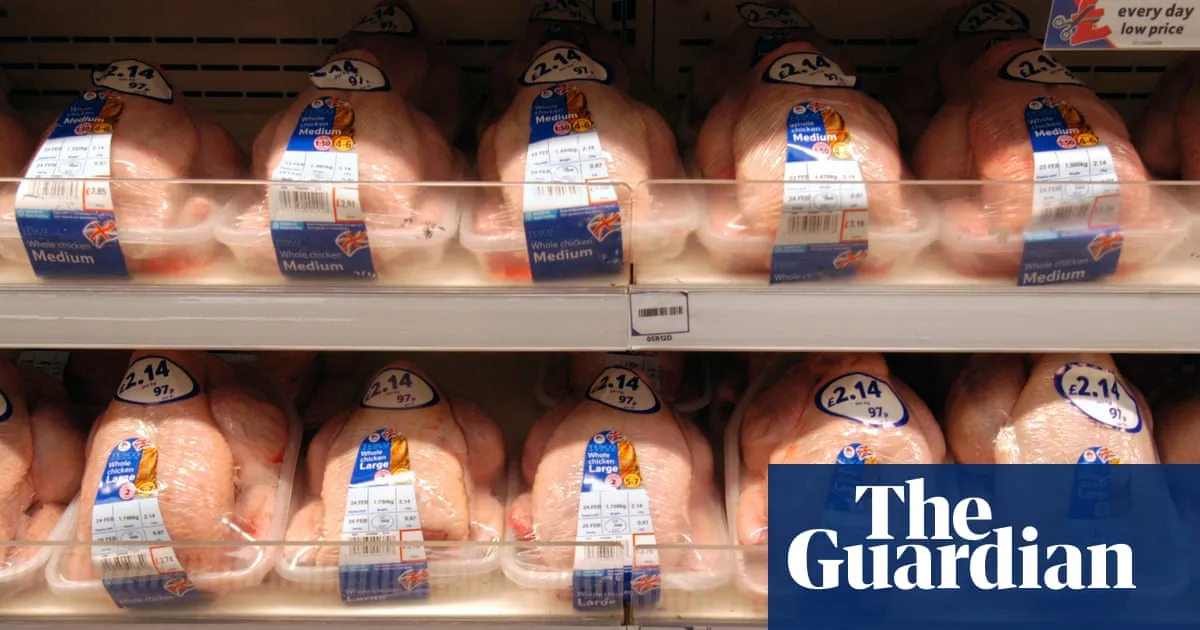
The UK could face some gaps on supermarket shelves this summer if disruption caused by the Iran war continues, with shortages of carbon dioxide potentially hitting supplies of chicken, pork and fizzy drinks.Government ministers are drawing up contingency plans for a “reasonable worst-case scenario” if the key shipping lane of the Strait of Hormuz does not reopen, disrupting supplies of the CO2 required by the food industry.Officials from departments including No 10, The Treasury and the Ministry of Defence have run a planning operation named Exercise Turnstone to rehearse various scenarios of how British industry could be affected by a long closure of the strait.The planning exercise run by the government’s Cobra emergency committee, details of which were first reported by the Times, was based on multiple disruptive events happening at once, including the strait still being closed in June, a lack of a permanent peace deal between the US and Iran, and a mechanical failure at one of the UK’s key CO2 plants.The business secretary said on Thursday that the public should be “reassured” by the fact ministers were making contingency plans for possible repercussions from the war, adding that supplies of CO2 were “not a concern” for the UK economy.Peter Kyle called the leak “unhelpful”, telling Times Radio: “The public need to be reassured that we are doing this kind of planning and we are doing this kind of scenario planning.”The boss of Tesco, Britain’s biggest retailer, said it was not aware of any problems with carbon dioxide availability across its supply chain.CO2 is a byproduct of industrial production, but is widely used across numerous industries, particularly farming, food production and hospitality.The gas is essential for the humane slaughter of livestock as it is used to stun pigs and chickens. It is also widely used in the packaging of fresh meats and fresh produce such as salad and baked goods, where it halts bacteria growth and extends shelf life.CO2 is necessary for fizzy drinks and beer, as well as being vital for cooling systems used to refrigerate products.Any shortages would come at a difficult time for breweries, which are expecting to be busy before this summer’s football World Cup, which begins on 11 June.Beyond food and hospitality, the gas is also needed for surgical procedures, MRI scans and cooling nuclear power plants.The UK is one of Europe’s largest users of CO2. In March, Kyle said the government would invest £100m to reopen the mothballed Ensus bioethanol plant on Teesside over fears that the war in Iran could trigger shortages of the gas.On Thursday he said the decision to restart the Ensus plant for three months meant “people should be reassured that we are doing this kind of action behind the scenes to keep resilience in our economy” at a time when the situation was still unfolding in the Middle East.A government spokesperson said ministers were “continuing to work closely with business groups to tackle the impacts of events in the Middle East”, adding: “Reasonable worst-case scenarios are a planning tool used by experts and are not a prediction of future events.”Ken Murphy, the Tesco chief executive, said the government was “doing the right thing in planning for a worst-case scenario” on potential interruptions to CO2 supply, and it had made a “reasonable analysis”. He welcomed the reopening of the Teesside plant.But he said Tesco had “seen nothing at this point” in terms of problems within its supply chain caused by issues with CO2 availability and that “at this point none of our suppliers have flagged any issues to us”.Murphy said that after six years of various crises – from Covid to Brexit – Tesco was confident it could head off problems with supply and was “constantly working on various scenarios internally”.He added that the biggest impact on supply chains in recent months had come from terrible weather in the south of Spain and north Africa, but that shoppers would not have noticed gaps on shelves because Tesco was able to flex its supply chain to keep goods flowing. “We are making sure we head off any issues at the pass well ahead of time,” he said.
SRCThe Guardian - World News
LANGEN
LEANCenter-Left
WORDS688
ENT10
THU · 2026-04-16 · 09:04 GMTBRIEF NSR-2026-0416-69938
NSR-2026-0416-69938News Report·EN·Economic Impact
UK could face gaps on supermarket shelves by summer if Iran war continues
The UK government is preparing for potential supermarket shortages this summer due to the ongoing Iran war, which could disrupt carbon dioxide (CO2) supplies. Exercise Turnstone, led by the Cobra emergency committee, is planning for a "worst-case scenario" involving the continued closure of the Strait of Hormuz, a lack of US-Iran peace, and UK CO2 plant failures.
Joanna Partridge, Alexandra Toppingand Sarah ButlerThe Guardian - World NewsFiled 2026-04-16 · 09:04 GMTLean · Center-LeftRead · 3 min
The Guardian - World NewsFIG 01
Reading time
3min
Word count
688words
Sources cited
4cited
Entities identified
10entities
Quality score
100%
§ 01
Briefing Summary
AI-generatedNEWSAR · AI
The UK government is preparing for potential supermarket shortages this summer due to the ongoing Iran war, which could disrupt carbon dioxide (CO2) supplies. Exercise Turnstone, led by the Cobra emergency committee, is planning for a "worst-case scenario" involving the continued closure of the Strait of Hormuz, a lack of US-Iran peace, and UK CO2 plant failures. CO2 is crucial for food production, including livestock slaughter, packaging, and the production of fizzy drinks. Shortages could impact supplies of chicken, pork, and carbonated beverages, potentially affecting breweries before the summer World Cup. While a Tesco representative is unaware of any CO2 problems, the government aims to reassure the public that contingency plans are in place.
Confidence 0.90Sources 4Claims 5Entities 10
§ 02
Article analysis
Model · rule-basedFraming
Economic Impact
National Security
Tone
Mixed Tone
AI-assessed
CalmNeutralAlarmist
Factuality
0.70 / 1.00
Factual
LowHigh
Sources cited
4
Well sourced
FewMany
§ 03
Key claims
5 extracted01
The government would invest £100m to reopen the mothballed Ensus bioethanol plant on Teesside.
factual
Confidence
1.00
02
The planning exercise was based on multiple disruptive events happening at once, including the strait still being closed in June.
factual
Confidence
1.00
03
Government ministers are drawing up contingency plans for a “reasonable worst-case scenario” if the key shipping lane of the strait of Hormuz does not reopen.
factual
Confidence
1.00
04
Supplies of CO2 were “not a concern” for the UK economy.
quotebusiness secretary
Confidence
0.80
05
The UK could face some gaps on supermarket shelves this summer if disruption caused by the Iran war continues.
prediction
Confidence
0.70
§ 04
Full report
3 min read · 688 words§ 05
Entities
10 identifiedKey playerOppositionContextPositiveNeutralNegative
Locations4
§ 06
Keywords & salience
10 termscarbon dioxide
0.90
food shortages
0.90
iran war
0.80
strait of hormuz
0.70
supply chain
0.70
contingency plans
0.70
food production
0.60
supermarket shelves
0.60
uk economy
0.50
fizzy drinks
0.40
§ 07
Topic connections
Interactive graph No topic relationship data available yet. This graph will appear once topic relationships have been computed.