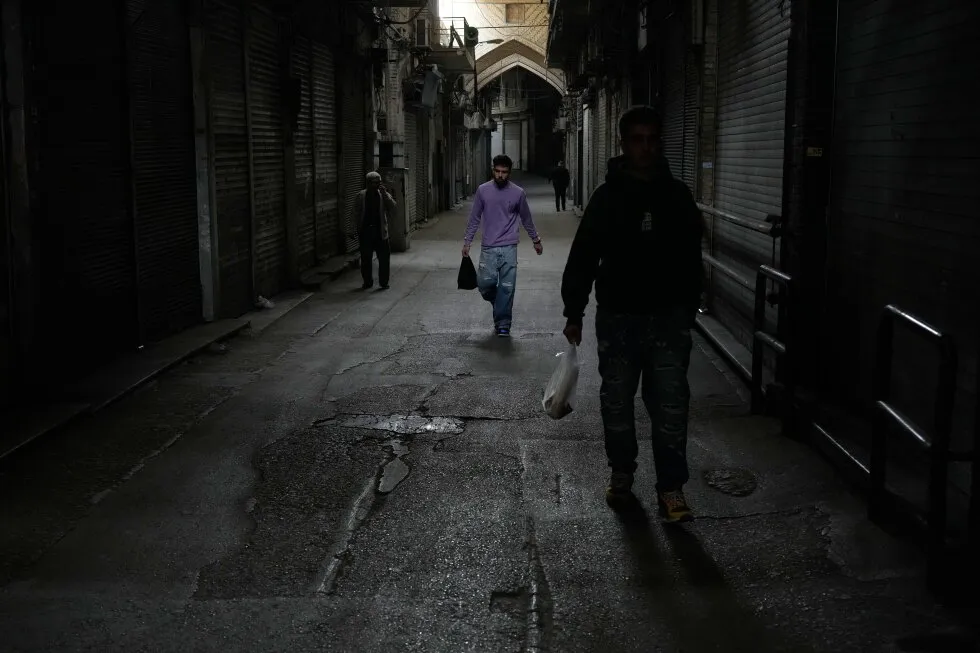
People walk past closed shops at the nearly empty traditional main bazaar during Iranian New Year, or Nowruz, holidays in Tehran, Iran, Sunday, March 29, 2026. (AP Photo/Vahid Salemi, File) 2026-04-18T05:09:06Z Tehran, Iran (AP) — Mahnaz Ataei, a finance manager in Tehran, brings her 7-year-old to the office and oversees his online classes while trying to do her job. Schools have been closed across Iran since the United States and Israel launched the war on Feb. 28, with no word on when in-person instruction will resume. The fear of airstrikes has lifted since a fragile ceasefire went into effect, but life has not returned to normal. As with the COVID closures six years ago, it’s especially difficult for working parents with small children. “My productivity drops when I have to pay attention to both my child and my work at the same time,” Ataei said. “The hardest part is trying to create balance between work and online classes, and always stressing over whether he is really learning his lessons properly.” The war killed at last 3,000 people in Iran, including more than 165 people killed in a strike on an elementary school . The ceasefire is set to expire early next week, with the U.S. and Iran still divided on key issues like Iran’s enriched uranium . A U.S. naval blockade could further damage Iran’s already cratered economy. Safer but not easier Many parents fled Tehran with their children after the airstrikes began. But the relative safety came at the cost of disrupted routines, crowded living arrangements and financial stress. Now they are struggling to resume normal life with no idea what comes next. “I feel like I’m suspended — neither in the air nor on the ground,” said Roya Amiri, a housewife who recently returned to Tehran after fleeing with her two sons, ages 10 and 18, days after the start of the war. The family joined hundreds of thousands of Iranians who fled the capital and other cities for safety in rural areas or the relatively unscathed north. They stayed with relatives, with 15 people living under one roof. Tensions flared among the children as they packed into close quarters and their routines — and sleep — were disrupted. Her 10-year-old son has a respiratory illness, and they struggled to find his medication. (
SRCAssociated Press (AP)
LANGEN
LEANCenter
WORDS386
ENT7
SAT · 2026-04-18 · 06:23 GMTBRIEF NSR-2026-0418-70478
NSR-2026-0418-70478News Report·EN·Human Interest
Families in Iran struggle with school closures even as the airstrikes have stopped
Following a ceasefire after a war between the U.S., Israel, and Iran that began on February 28th and killed at least 3,000 in Iran, Iranian families are struggling with ongoing school closures. Despite the cessation of airstrikes, schools remain closed, disrupting routines and creating challenges for working parents who must juggle work and childcare.
Associated Press (AP)Filed 2026-04-18 · 06:23 GMTLean · CenterRead · 2 min
Associated Press (AP)FIG 01
Reading time
2min
Word count
386words
Sources cited
2cited
Entities identified
7entities
Quality score
100%
§ 01
Briefing Summary
AI-generatedNEWSAR · AI
Following a ceasefire after a war between the U.S., Israel, and Iran that began on February 28th and killed at least 3,000 in Iran, Iranian families are struggling with ongoing school closures. Despite the cessation of airstrikes, schools remain closed, disrupting routines and creating challenges for working parents who must juggle work and childcare. Many families fled Tehran and other cities during the conflict, seeking safety in rural areas, which led to overcrowded living situations and financial strain. Now, even with the ceasefire, families face uncertainty as they try to resume normal life while the U.S. and Iran remain divided on key issues and a potential U.S. naval blockade threatens Iran's economy. The ceasefire is set to expire early next week.
Confidence 0.90Sources 2Claims 5Entities 7
§ 02
Article analysis
Model · rule-basedFraming
Human Interest
Economic Impact
Tone
Measured
AI-assessed
CalmNeutralAlarmist
Factuality
0.70 / 1.00
Factual
LowHigh
Sources cited
2
Limited
FewMany
§ 03
Key claims
5 extracted01
They stayed with relatives, with 15 people living under one roof.
factual
Confidence
1.00
02
The ceasefire is set to expire early next week, with the U.S. and Iran still divided on key issues like Iran’s enriched uranium
factual
Confidence
1.00
03
“My productivity drops when I have to pay attention to both my child and my work at the same time,”
quoteMahnaz Ataei
Confidence
1.00
04
The war killed at last 3,000 people in Iran, including more than 165 people killed in a strike on an elementary school.
statistic
Confidence
1.00
05
Schools have been closed across Iran since the United States and Israel launched the war on Feb. 28.
factual
Confidence
1.00
§ 04
Full report
2 min read · 386 words§ 05
Entities
7 identifiedKey playerOppositionContextPositiveNeutralNegative
Locations4
Events1
§ 06
Keywords & salience
9 termsschool closures
0.90
iran
0.80
airstrikes
0.70
working parents
0.70
ceasefire
0.60
online classes
0.60
fragile ceasefire
0.50
economic impact
0.50
disrupted routines
0.40
§ 07
Topic connections
Interactive graph Network visualization showing 51 related topics
View Full Graph Person Organization Location Event|Click node to navigate|Edge numbers = shared articles