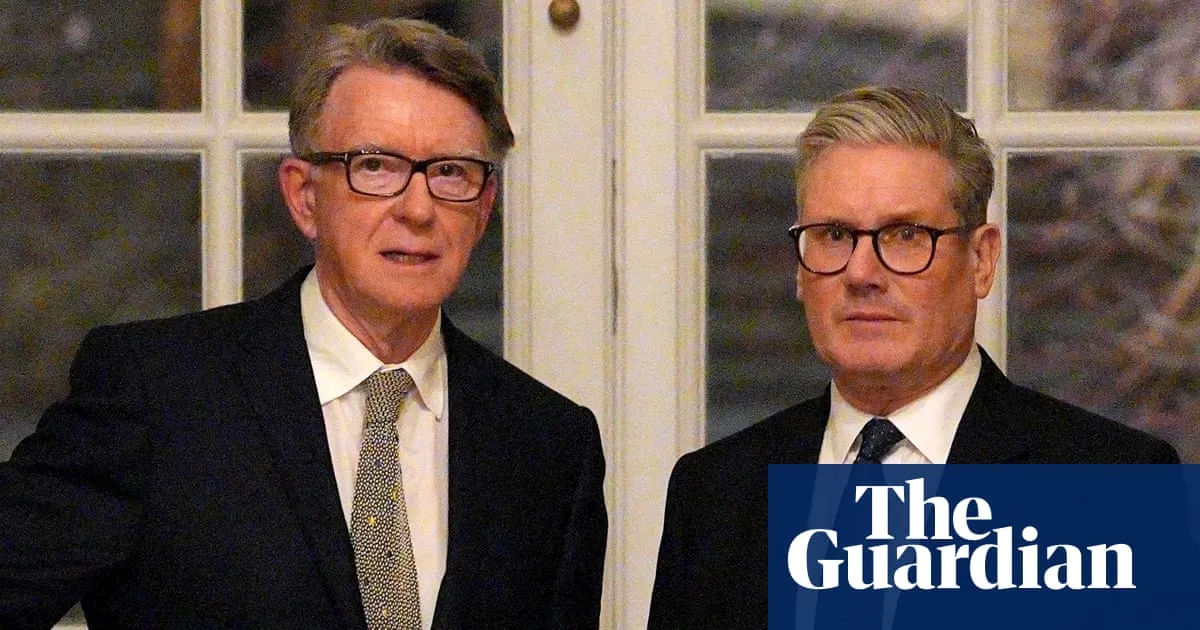
Did Keir Starmer really not know that Peter Mandelson had failed vetting? Photograph: Carl Court/PA View image in fullscreen Did Keir Starmer really not know that Peter Mandelson had failed vetting? Photograph: Carl Court/PA Monday briefing: How is it possible the prime minister didn’t know about Mandelson’s vetting failure? In today’s newsletter: As questions mount over transparency and accountability in the ambassadorial appointment process, the political fallout continues to spread across Keir Starmer’s government Good morning. Today the prime minister will face parliament in the wake of the Guardian’s exclusive revelation that during the process of appointing Peter Mandelson as ambassador to the US, the former New Labour “prince of darkness” failed UK security vetting – something Keir Starmer says he was not told about. On Friday, Starmer said he was “absolutely furious” and described the situation as “totally unacceptable”. But the episode has once again raised questions about his political judgment, with opposition parties – and some of his own MPs – calling for his resignation. The story has ramifications beyond the immediate fallout for Starmer. For today’s newsletter I spoke to the Guardian’s head of investigations, Paul Lewis, about what the story tell us about how power operates inside government – and who is really in charge. First, the headlines. Iran | Tehran is not planning to take part in new talks with the US in Islamabad, Iranian state media reported, as its military accused America of violating a fragile ceasefire by attacking a cargo ship. US news | At least eight children were killed and two adults wounded in a mass shooting in Shreveport, Louisiana. Police said the suspect, who died after a police pursuit, killed seven of his own children and wounded their mother, as well as killing another child. UK politics | Keir Starmer will deliver a high-stakes statement to MPs on Monday setting out how Peter Mandelson was able to take up his role as UK ambassador without the Foreign Office revealing it had overruled the decision to fail his vetting. Protest | Seven people from an activist group calling for higher taxes on the super-rich have been arrested by police on suspicion of conspiracy to steal after a plot to steal from high-end stores was uncovered. Crime | A woman has been arrested on suspicion of attempted murder after a car hit pedestrians in central London in the early hours of yesterday morning. A woman in her 30s was in hospital in a critical condition and a man in his 50s suffered life-changing injuries. In depth: ‘It needed to be in the public domain’ View image in fullscreen Peter Mandelson resigned from the Labour party over his links to Jeffrey Epstein. Photograph: US Department of Justice/AFP/Getty Images Peter Mandelson was appointed the UK’s ambassador to Washington in February 2025. He was sacked in September 2025 after documents released in the US revealed the extent of his ties with convicted sex offender Jeffrey Epstein, which the Foreign Office said were “materially different from that known at the time of his appointment”. But “who knew what, and when” about his relationship with Epstein has never been satisfactorily explained despite the release of documents to parliament about the appointment process. Then it appeared there might be another dimension – that Mandelson had failed security vetting but had been given the role anyway. “The moment we got a sense this story might be true,” Paul tells me, “my colleagues Henry Dyer, Pippa Crerar and I worked relentlessly to stand it up.” If, after his appointment as US ambassador, Peter Mandelson failed his UK security vetting – and then that decision was overruled by officials at the Foreign Office – unbeknownst, allegedly, to the prime minister or other members of the cabinet, Paul knew it needed to be in the public domain. Once it was, he predicted there would be very significant ramifications: for Keir Starmer, for Olly Robbins, and for the wider intelligence and security establishment – all of which is just starting to pan out. After Labour’s July 2024 election victory, Mandelson quickly re-emerged as an influential figure around the new government, advising ministers and building ties in No 10 before being announced as the next US ambassador. It now appears that in January 2025 he failed developed vetting clearance – a rare outcome – only for the decision to be internally overruled by the Foreign Office, allowing him to take up the post. On 2 September last year, the closeness of Mandelson’s relationship to Epstein was laid bare in the first tranche of files released in the US. On 10 September Starmer said in parliament he had “confidence in him”, and on 11 September a Downing Street spokesperson told the media that Foreign Office vetting had been done “normal way”. Later that day Starmer fired Mandelson. In February, Starmer said that Mandelson had passed vetting, with Morgan McSweeney then resigning as Starmer’s chief of staff, saying he took full responsibility for advising Starmer to appoint Mandelson. In March, document released to parliament stated that national security adviser, Jonathan Powell, had doubts about Mandelson’s appointment, describing it as “weirdly rushed”, but crucially the documents do not disclose that Mandelson failed security vetting. “If you believe Downing Street, no politician was told – not David Lammy as foreign secretary, and not the prime minister. That’s extraordinary.” Paul is not alone in thinking this is extraordinary. Others have gone further. Veteran Labour MP Jon Trickett said: “It simply doesn’t sound credible,” and Conservative leader Kemi Badenoch described the idea as “completely preposterous” and said there was “deliberate dishonesty”. Paul tells me that as much as this is clearly a very significant political story, what really fascinates him is “the wider question of where power resides in the British state”. “It’s a massive Westminster story,” he says. “About Starmer’s candour in parliament and in public, his judgment in appointing Mandelson, and the resignation of the Foreign Office permanent secretary, Olly Robbins. “But what this episode seems to reveal is the really significant, and potentially unchecked, power of senior civil servants and officials.” According to multiple sources, Mandelson was initially denied clearance in late January 2025, but Starmer had by then announced he would be making Mandelson the UK’s chief diplomat in Washington, potentially posing a dilemma for officials at the Foreign Office. Paul points out it very much reminds him of the television sitcom Yes, Minister with its wily senior Whitehall mandarins manoeuvring politicians, running the show behind the scenes by seemingly pressing ahead with a plan without consulting ministers about an important change of circumstances. As revealed on Friday, Starmer was apparently left in the dark about sensitive information relating to Mandelson’s security vetting by two other top civil servants besides Robbins, including the recently appointed cabinet secretary, Antonia Romeo – who has known since March. Mandelson’s role would have been one of the most sensitive in government. “Think about the implications,” Paul says. “The UK’s most senior diplomat in Washington, dealing with intelligence from GCHQ and the NSA, handling top-secret material, was allowed into that role despite failing a vetting process that even relatively junior civil servants have to pass. “That’s a hugely consequential decision, apparently taken without ministers being informed.” A second strand of the story raises even more profound constitutional questions. In February, parliament passed a “humble address” requiring the government to release all papers relating to Mandelson’s appointment. While sensitive material can be withheld from publication, it must still be shared with the intelligence and security committee. But the Guardian found that “officials were considering not even disclosing those vetting documents to that committee. In other words, potentially resisting a direct parliamentary order.” That, Paul says, raises a fundamental question: “Who ultimately holds power: parliament, or the national security establishment?” “These kinds of journalistic investigations are difficult,” Paul says. “They involve national security, they’re complex, and they deal with material that is, by nature, highly secret. “And this was a story where it became clear quite early on that there were people in government who really did not want it to come out.” It is exactly this kind of difficult, vitally important journalism that the Guardian can only carry out because of the unique way we are funded by you, our readers. What happens politically now is not clear. Starmer’s leadership has looked fragile for some time, and Labour is braced for a difficult set of elections in May. But that alone may not be enough to trigger a move against him. The three most frequently mentioned potential successors – Wes Streeting, Angela Rayner and Andy Burnham – each face obstacles. Streeting has drawn criticism over perceived manoeuvring, Rayner remains under scrutiny over her tax matters and a perception she is not up to big international issues, and Burnham is still outside parliament. Starmer may take heart from some backbench MPs going in to bat for him. Southport’s Patrick Hurley called it a “fuss over nothing”, saying: “By an order of magnitude, the bigger problem for us is the shock from the Iran war, the ongoing challenge on prices of consumer goods, and the very long shadow of Liz Truss’s mini-budget. Everything else is a sideshow.” The Guardian has learned that Adrian Fulford, who led the Southport inquiry, is expected to review Mandelson’s vetting process and the wider system. The recently departed Foreign Office permanent secretary, Robbins, has been invited to give evidence to the Commons foreign affairs select committee on Tuesday, and Pippa Crerar has written that he is “understood to be extremely angry at what he believes to be his unfair treatment by the prime minister”. And before that, Starmer faces the House of Commons today. The Mandelson affair has already claimed multiple senior figures. Whether it ultimately claims the prime minister remains to be seen. What else we’ve been reading View image in fullscreen A health check on a hazel dormouse. Photograph: David Levene/The Guardian London Zoo celebrates its 200th anniversary this year, and the Guardian’s photographer David Levene has been given a behind-the-scenes access to its veterinary team. Patrick Elena Saavedra Buckley relays her experience of taking part in a mission to live on Mars with the caveat that it is taking place at a purpose-built camp in Utah. Martin I was gripped by this essay by American writer Siri Hustvedt about the death of her husband, Paul Auster. Patrick They used to warn us about the dangers of the internet, but increasingly people are finding it is their parents being radicalised by social media. Simon Usborne investigates. Martin Another birthday. This time, Michael Rosen is turning 80. The much-loved children’s author reflects on the death of his son, antisemitism and surviving Covid. Patrick Sport View image in fullscreen Erling Haaland celebrates his goal. Photograph: Tom Jenkins/The Guardian Football | Manchester City took one step close to an unlikely comeback in the Premier League title race thanks to a winner from Erling Haaland, pictured above, against Arsenal at the Etihad. The 2-1 win puts them three points behind with a game in hand. Tennis | Emma Raducanu has withdrawn from the Madrid Open due to a viral illness. She has been out of action since March. Snooker | Mark Allen revealed how a burger and a few drinks fuelled his surge into the second round of the World Snooker Championship after he defeated Zhang Anda 10-6 at the Crucible. “Commons showdown for Starmer over Mandelson vetting scandal” – that’s the lead story in the Guardian at the start of the week. “Mandelson had top level of security clearance” reports the Times while the Telegraph says “Starmer knew about Mandelson red flags”. The i paper runs with “Starmer faces showdown in Commons – and fights for his future”. “Day Starmer has to stand up and take the blame” is the Mail’s verdict. The Mirror has a puff piece by comparison – “Heroes of the deep” – as it joins the PM on a tour of a British nuclear sub. The Express’s preferred angle of attack is a Tory claim that “Crime costs UK taxpayers £90m a day under Labour”. The Metro’s splash is “Britain boots out grieving jet crash dad”. Top story in the Financial Times is “Iran war will squeeze US voters long after conflict ends, economists warn”. Today in Focus View image in fullscreen Kezia Dugdale, the former leader of Scottish Labour, at Stonewall HQ in Edinburgh. Photograph: Murdo MacLeod/The Guardian Stonewall’s new chair on trans rights, JK Rowling and the future of the LGBTQ+ movement An exclusive interview with Kezia Dugdale on the charity’s mistakes and the future of the LGBTQ+ movement. With reporting by Libby Brooks Cartoon of the day | Tom Gauld View image in fullscreen Illustration: Tom Gauld The Upside A bit of good news to remind you that the world’s not all bad View image in fullscreen Amanda Barry at Port Lockroy. Photograph: UKAHT Amanda Barry’s father, George, died when she was nine. She discovered his Antarctic journals and photos in her mother’s loft, sparking a lifelong desire in her to visit Port Lockroy, where he had served as base leader in 1948. After a career in PR, she returned to study environmental science and worked on building experience in museums and as a guide. In her 60s, she was selected as museum manager for the UK Antarctic Heritage Trust. Amanda reached the tiny island and stood where her father once stood. The experience offered her the closest sense of reunion she believes she will ever have. “The first time I walked in, I saw his picture on the wall,” she says. “I cried, of course. It was such a magical thing.” And finally, the Guardian’s puzzles are here to keep you entertained throughout the day. Until tomorrow. Explore more on these topics Keir Starmer First Edition newsletter Labour Peter Mandelson newsletters Share Reuse this content
SRCThe Guardian - World News
LANGEN
LeanCenter-Left
WORDS2,312
ENT7
MON · 2026-04-20 · 06:01 GMTBRIEF NSR-2026-0420-70861
NSR-2026-0420-70861News Report·EN·Political Strategy
Monday briefing: How is it possible the prime minister didn’t know about Mandelson’s vetting failure?
The UK Prime Minister will face parliamentary scrutiny over his knowledge of Peter Mandelson's failed security vetting before being appointed as US ambassador. The Guardian reported that Mandelson, a former New Labour leader, was deemed unfit for the role due to his past associations with organized crime figures but was still given the position without the Foreign Office revealing this information to Keir Starmer.
Martin BelamThe Guardian - World NewsFiled 2026-04-20 · 06:01 GMTLean · Center-LeftRead · 10 min
The Guardian - World NewsFIG 01
Reading time
10min
Word count
2,312words
Sources cited
3cited
Entities identified
7entities
NEWSAR · AI
The UK Prime Minister will face parliamentary scrutiny over his knowledge of Peter Mandelson's failed security vetting before being appointed as US ambassador. The Guardian reported that Mandelson, a former New Labour leader, was deemed unfit for the role due to his past associations with organized crime figures but was still given the position without the Foreign Office revealing this information to Keir Starmer. Starmer has described the situation as "totally unacceptable" and "absolutely furious". The episode raises questions about transparency and accountability in the ambassadorial appointment process, particularly within the Prime Minister's office. Mandelson's vetting failure occurred during his appointment process, but it is unclear when or if this information was shared with Starmer.
Confidence 0.90Sources 3Claims 3Entities 7
Framing
Political Strategy
Tone
Measured
AI-assessed
CalmNeutralAlarmist
Factuality
0.80 / 1.00
Factual
LowHigh
Sources cited
3
Well sourced
FewMany
01
At least eight children were killed and two adults wounded in a mass shooting in Shreveport, Louisiana.
factualPolice
Confidence
1.00
02
Peter Mandelson was appointed as the UK ambassador to Washington despite failing UK security vetting.
statisticThe Guardian's head of investigations, Paul Lewis
Confidence
1.00
03
Keir Starmer was not informed about Peter Mandelson's failed UK security vetting.
factualKeir Starmer
Confidence
1.00
§ 04
Full report
10 min read · 2,312 wordsKey playerOppositionContextPositiveNeutralNegative
keir starmer
0.90
security vetting
0.80
vetting failure
0.80
peter mandelson
0.80
government accountability
0.70
transparency and accountability
0.70
uk politics
0.60
§ 07
Connections
Who appears together in the newsIn this articleWider coverageLine weight = articles in common
Laying out network…
Strongest ties articles in common
- 12,267
- 2,643
- 2,172
- 1,171
- 706
- 693
Recurring context not named in this article
- PDonald Trumplinks 7
- LWashingtonlinks 6
- LIsraellinks 6
- OEuropean Unionlinks 6
- LRussialinks 6
- LFrancelinks 6
- LChinalinks 6
- LUkrainelinks 6