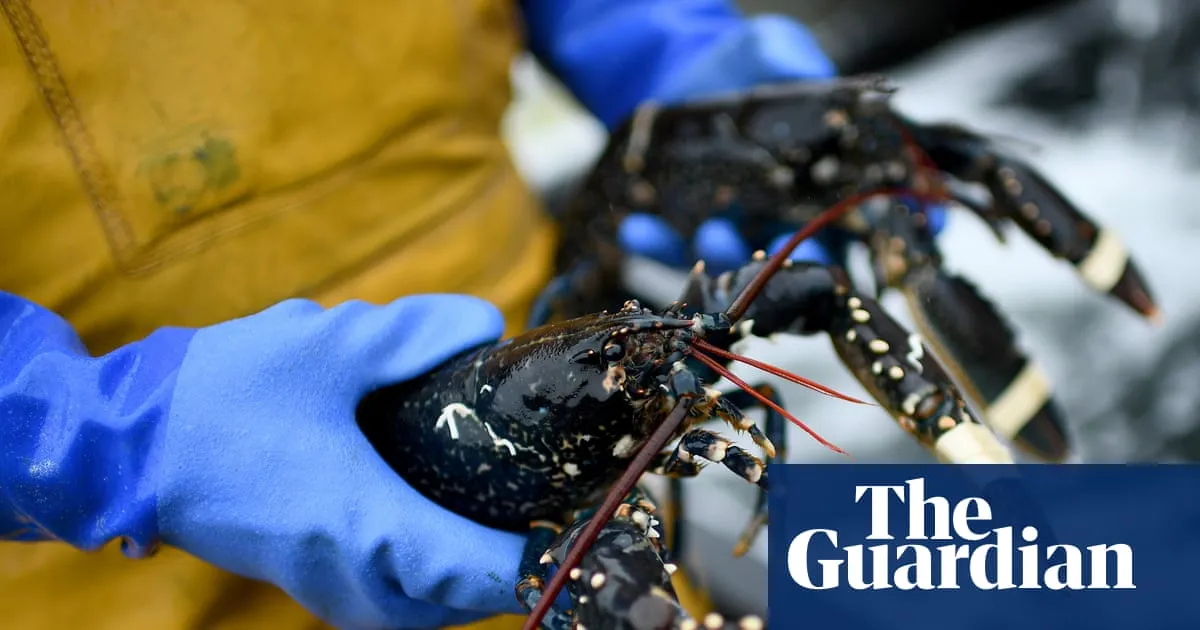
A new agriculture agreement with the EU would not wipe out all Brexit paperwork but may greatly increase sales of Scottish langoustines and oysters, the House of Lords has heard.The UK and EU are close to finalising a sanitary and phytosanitary (SPS) agreement to reduce Brexit trade barriers, and while it will have “modest” impact on the UK economy the agreement will be significant, peers on the European affairs committee were told on Tuesday.It would spell the end of physical checks on farm produce and the end of the need for veterinary certificates, which cost £200 each.It could also remove the need to label food as “Not for EU”, which has been “a significant problem” for wholesalers and distributors, said William Bain, head of trade policy at the British Chambers of Commerce.Bain, who is Scottish, said it could reopen the door for exports of Scottish langoustines and molluscs. Before Brexit, they would be fished and diners in Paris could be eating them within a day. Many exports stopped because border checks reduced the seafood’s shelf life.However, an SPS deal would not be erase all paperwork, with British exporters still having to fill out customs, VAT, and safety and security declarations.Labour’s plan to reduce trade barriers for food exporters would mean applying all future EU rules and regulations in relation to farm produce under what is known as “dynamic alignment”.Under negotiation is an agreement to accept the 76 laws that have either been passed in Brussels or from which the UK has already diverged in the farm food area.On Tuesday, peers were told that the UK could have pursued an alternative path such as the “mutual recognition” of food standards that supports trade between New Zealand and the UK.That would have removed the need for dynamic alignment with the EU, said Shanker Singham, chair of the Growth Commission and a past adviser to some MPs on alternative arrangements for Brexit in Northern Ireland.He said the UK had significant commercial heft in talks, with about 23% of the EU’s global exports of agrifood going to the UK – with “much less” going the other way.This is partly because the EU implemented all Brexit rules in Dover and beyond from day one, with up to 20,000 British businesses stopping exports to the bloc as a result. The UK, however, never applied the border controls in the same way, eventually opting for random inspections on fresh food.Singham said the trade imbalance gave Keir Starmer a huge buyer’s advantage in talks. “The interesting thing here is that the UK government hasn’t really used the leverage it has,” he said.He suggested the UK could pursue an alternative system where both sides would “mutually recognise” their standards, as New Zealand and Australia do, rather than dynamically align with the EU.“If you don’t ask, you don’t get,” he told peers. “One has to be very, very careful when one is giving away one’s own regulatory authority in any area.Sam Lowe, head of trade and market access practice at Flint Global, said the advantage of dynamic alignment was that “physical inspections would pretty much disappear”, something a New Zealand-Australian style mutual recognition deal would not afford.“What we’re actually asking for is the EU to recognise our dynamic alignment, and in doing so, treat our exporters better,” he said. The EU exporters have an advantage because the UK recognises their rules. “So what we are actually doing is asking them to give us something back on that,” he added.
SRCThe Guardian - World News
LANGEN
LEANCenter-Left
WORDS579
TUE · 2026-04-21 · 15:44 GMTBRIEF NSR-2026-0421-71255
NSR-2026-0421-71255News Report·EN·Human Interest
UK and EU close in on agricultural deal to reduce Brexit barriers
The UK and EU are nearing an agreement on sanitary and phytosanitary (SPS) measures to reduce agricultural trade barriers created by Brexit. The agreement aims to eliminate physical checks on farm produce and veterinary certificates, potentially boosting exports of Scottish seafood like langoustines and oysters.
Lisa O’CarrollThe Guardian - World NewsFiled 2026-04-21 · 15:44 GMTLean · Center-LeftRead · 3 min
The Guardian - World NewsFIG 01
Reading time
3min
Word count
579words
Sources cited
0cited
Entities identified
0entities
Quality score
75%
§ 01
Briefing Summary
AI-generatedNEWSAR · AI
The UK and EU are nearing an agreement on sanitary and phytosanitary (SPS) measures to reduce agricultural trade barriers created by Brexit. The agreement aims to eliminate physical checks on farm produce and veterinary certificates, potentially boosting exports of Scottish seafood like langoustines and oysters. While not erasing all paperwork, such as customs and VAT declarations, it would remove the need for "Not for EU" labeling. Experts suggest alternative approaches, like mutual recognition of food standards, could have been pursued. The UK's significant import volume of EU agrifood provides leverage in negotiations, especially given the disproportionate impact of Brexit trade rules on British businesses.
Confidence 0.90
§ 04
Full report
3 min read · 579 words§ 06
Keywords & salience
10 termsbrexit
0.90
trade barriers
0.80
agriculture agreement
0.80
uk
0.70
sps agreement
0.70
eu
0.70
food exports
0.60
trade policy
0.50
dynamic alignment
0.50
food standards
0.40
§ 07
Topic connections
Interactive graph Network visualization showing 33 related topics
View Full Graph Person Organization Location Event|Click node to navigate|Edge numbers = shared articles