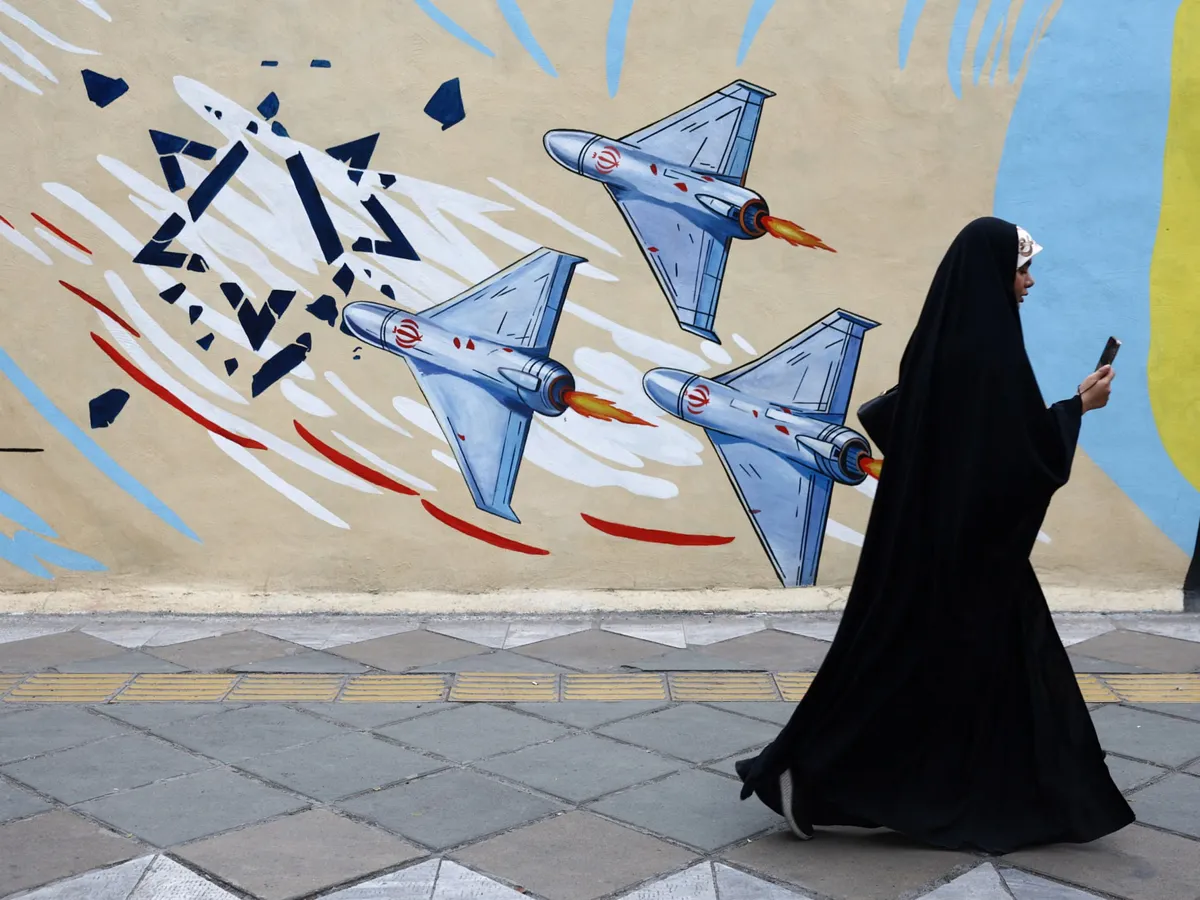
EXPLAINERBetween an expiring ceasefire and a possible deal lies a range of ways in which the war could proceed, analysts say.A woman walks past an anti-Israel mural on a street in Tehran on April 20, 2026, two days before a US-Iran ceasefire is due to expire [Majid Asgaripour/West Asia News Agency via Reuters]Published On 21 Apr 2026Vice President JD Vance is scheduled to lead a team of United States negotiators in Islamabad on Tuesday for talks with Iran aimed at ending their war, even though Tehran is yet to confirm its participation in this latest round of negotiations.Meanwhile, a fragile two-week ceasefire is poised to expire on Wednesday with no clarity on whether it will be extended amid a spike in tensions over the past two days.The first round of US-Iran talks in Islamabad on April 11 ended without a breakthrough. Since then, the US has imposed a naval blockade on all Iran-linked ships trying to pass through the Strait of Hormuz. Iran has fired at ships trying to transit through the vital shipping route. And early on Monday, the US shot at and then seized an Iranian vessel trying to pass through the narrow waterway.Tehran called the ship’s seizure “piracy” and has threatened retribution. It has refused to join talks under the shadow of threats. Trump has revived his warning that he would order the US military to blow up all bridges and power plants in Iran if it does not accept a deal on US terms.Amid this uncertainty over the future of the talks and the truce, we break down the latest from both sides and four potential scenarios that could play out in the next few days:People in Tehran take part in an anti-US and anti-Israel rally on April 19, 2026 [Majid Asgaripour/West Asia News Agency via Reuters]What’s the latest from both sides?Both the US and Iran have been exchanging threats as the ceasefire is due to expire in the coming hours.The two-week ceasefire, announced by US President Donald Trump on April 7, should expire at 8pm Washington, DC, time on Tuesday (midnight GMT, 3:30am in Tehran and 5am in Islamabad on Wednesday). However, Trump has in recent comments indicated that he has already moved the deadline back by a day.While Islamabad continues with its preparations to host multiday talks, there has been no confirmation yet from Iranian officials about whether they will attend.The US president said he feels confident Iran will negotiate or it will “see problems like they’ve never seen before”.Trump confirmed in a Truth Social post that the US delegation is planning to visit Islamabad on Tuesday. While accusing Iran of violating the ceasefire by firing at vessels in the Strait of Hormuz, Trump added: “We’re offering a very fair and reasonable DEAL, and I hope they take it because, if they don’t, the United States is going to knock out every single Power Plant, and every single Bridge, in Iran. NO MORE MR. NICE GUY!”Meanwhile, Iran maintained there will be no negotiations under the shadow of threats.Mohammad Reza Mohseni Sani, who sits on the Iranian parliament’s National Security Commission, cast further doubt on the prospects of talks with the US.He said in comments carried by Iran’s Mehr news agency that “negotiations are not acceptable” in “the current situation” accusing the US of being “overly demanding” and pursuing ulterior objectives for domestic benefit.“Given the current conditions, recent aggressions and the history we have with the United States in previous negotiations, the next round of talks is, God willing, off the table,” he said.Ali Vaez, the Iran project director for the International Crisis Group think tank, told Al Jazeera that the key hurdle before any second round of talks was “whether the US is willing to ease pressure enough to make diplomacy credible and whether Iran is willing to curb its leverage enough to keep talks alive”.US Vice President JD Vance, centre, walks with Pakistani Chief of Defence Forces Asim Munir, left, and Pakistani Foreign Minister Mohammad Ishaq Dar after arriving for talks with Iranian officials in Islamabad, Pakistan, on April 11, 2026 [Jacquelyn Martin/AP]Scenario 1: Talks happen and achieve a temporary dealPakistan has been aiming to get the US and Iran to agree to multiple days of negotiations, sources close to the mediation efforts told Al Jazeera.For the US, Vance is expected to be joined by Trump’s envoy and fellow real estate developer Steve Witkoff and Trump’s son-in-law Jared Kushner, the same team that participated in the first round of talks. If the Iranians come, the parliament’s speaker, Mohammad Bagher Ghalibaf, is again expected to lead their delegation, which will also include Foreign Minister Abbas Araghchi.Mediators in Islamabad are aiming to reach a “memorandum of understanding” between the US and Iran to buy time to achieve a final deal and extend the ceasefire.“Success would not be a final deal. It would be an interim understanding that extends talks, stabilises the ceasefire and creates a framework for trading nuclear steps for sanctions relief,” Vaez said.However, glaring differences exist in the demands and expectations from both sides, including over Tehran’s nuclear programme, control of the Strait of Hormuz, sanctions on Iran and its frozen assets.“If the two sides do not change their stances, there cannot be a deal in Islamabad,” said Aniseh Bassiri Tabrizi, an associate fellow in the Middle East and North Africa Programme at the Chatham House think tank.Iranian parliament Speaker Mohammad Bagher Ghalibaf meets with Pakistan’s military chief Asim Munir in Tehran on April 16, 2026 [Handout/Iranian parliament speaker’s office/West Asia News Agency via Reuters]Scenario 2: Talks end without a breakthrough but with a ceasefire extensionFor there to be any meaningful progress in the talks, “there needs to be compromises on both sides because at the moment there is too much of a gap to reach an agreement,” Tabrizi told Al Jazeera.“Unless that changes, it’s unlikely that we will see a deal,” she said.Trump has doubled down in recent days on his insistence that Iran stop all uranium enrichment and hand over its current stockpile of enriched uranium. Iran has rejected those demands.“The US is not learning its lessons from experience,” Iranian Ministry of Foreign Affairs spokesman Esmaeil Baghaei said on Monday. “And this will never lead to good results.”Still, Tabrizi said, even in the absence of a breakthrough in a second round of talks, the two sides may agree to “some sort of temporary extension of the ceasefire”, which would give diplomacy another chance.Ships and tankers sit outside the Strait of Hormuz off the coast of Musandam, Oman, on April 18, 2026 [Reuters]Scenario 3: No talks but the ceasefire is extendedTrump told Bloomberg News on Monday that he considers the ceasefire over “Wednesday evening Washington time” and said it was “highly unlikely” that he would extend it if no deal is reached.Still, a last-minute post on his Truth Social platform extending the ceasefire would not necessarily be surprising, analysts said – even if Iran refuses to show up to the talks in Islamabad.“It [would be] a fragile pause, not a durable ceasefire,” Vaez said. “As long as maritime pressure and mutual accusations continue, the risk of miscalculation remains very high.”“Without a diplomatic framework, it would be buying time, not building stability,” he added.Tabrizi agreed. Already, though, the war has fundamentally changed the US-Iran equation, she said.“President Trump is arguing that regime change has happened because the figures that they are dealing with are different,” Tabrizi said. “Iran probably doesn’t seem to see the US as an existential threat like before the fighting started.”Scenario 4: Talks fail, and the ceasefire expiresTrump’s repeated threats to restart the bombing of Iran in the absence of a deal also open up a fourth scenario: If Iranian negotiators do not travel to Islamabad for the talks, that threat will be tested.
SRCAl Jazeera
LANGEN
LEANCenter
WORDS1 294
ENT6
TUE · 2026-04-21 · 12:22 GMTBRIEF NSR-2026-0421-71278
NSR-2026-0421-71278News Report·EN·National Security
Iran-US war: Four scenarios for what’s next as talks stumble
Amidst rising tensions and an expiring ceasefire, US-Iran talks aimed at ending their ongoing war face uncertainty. Scheduled to be held in Islamabad, the talks, led by US Vice President JD Vance, are jeopardized by Iran's refusal to confirm participation.
Yashraj SharmaAl JazeeraFiled 2026-04-21 · 12:22 GMTLean · CenterRead · 6 min
Al JazeeraFIG 01
Reading time
6min
Word count
1 294words
Sources cited
4cited
Entities identified
6entities
Quality score
100%
§ 01
Briefing Summary
AI-generatedNEWSAR · AI
Amidst rising tensions and an expiring ceasefire, US-Iran talks aimed at ending their ongoing war face uncertainty. Scheduled to be held in Islamabad, the talks, led by US Vice President JD Vance, are jeopardized by Iran's refusal to confirm participation. The two-week ceasefire, set to expire on April 22nd, 2026, is threatened by recent escalations, including a US naval blockade and the seizure of an Iranian vessel in the Strait of Hormuz. Iran has condemned the seizure as "piracy" and threatened retaliation, while the US has warned of further military action if a deal is not reached. The article outlines four potential scenarios for the coming days, as both sides exchange threats and the future of negotiations remains unclear.
Confidence 0.90Sources 4Claims 5Entities 6
§ 02
Article analysis
Model · rule-basedFraming
National Security
Tone
Measured
AI-assessed
CalmNeutralAlarmist
Factuality
0.70 / 1.00
Factual
LowHigh
Sources cited
4
Well sourced
FewMany
§ 03
Key claims
5 extracted01
The US delegation is planning to visit Islamabad on Tuesday for talks with Iran aimed at ending their war.
factualUS administration
Confidence
1.00
02
The two-week ceasefire, announced by US President Donald Trump on April 7, should expire at 8pm Washington, DC time on Tuesday.
factualDonald Trump (US President)
Confidence
1.00
03
Trump has revived his warning that he would order the US military to blow up all bridges and power plants in Iran if it does not accept a deal on US terms.
quoteDonald Trump (US President)
Confidence
1.00
04
Iran has fired at ships trying to transit through the vital shipping route, calling it 'piracy'.
quoteIranian officials
Confidence
1.00
05
The US has imposed a naval blockade on all Iran-linked ships trying to pass through the Strait of Hormuz.
factualUS administration
Confidence
1.00
§ 04
Full report
6 min read · 1 294 words§ 05
Entities
6 identifiedKey playerOppositionContextPositiveNeutralNegative
Organizations1
§ 06
Keywords & salience
8 termsiran-us war
1.00
ceasefire
0.90
negotiations
0.80
talks
0.70
strait of hormuz
0.60
us military
0.50
naval blockade
0.50
islamabad
0.40
§ 07
Topic connections
Interactive graph Network visualization showing 51 related topics
View Full Graph Person Organization Location Event|Click node to navigate|Edge numbers = shared articles