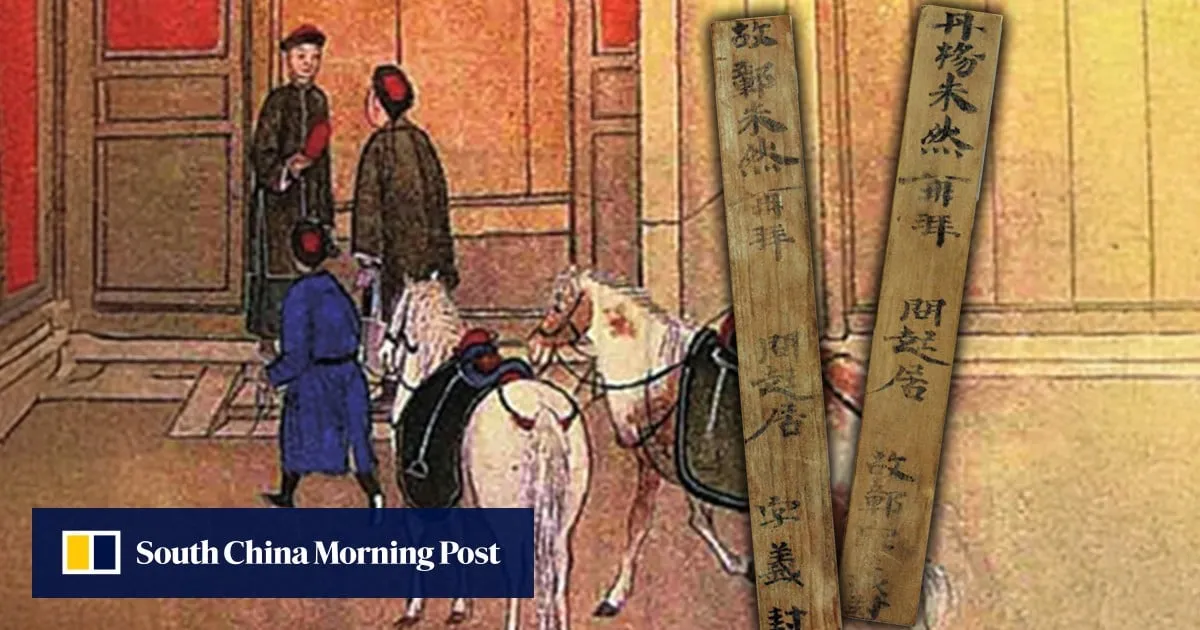
While people in modern times send new year greetings easily on social network apps, in ancient times it was a much more complicated ritual.In China, the origin of delivering new year greeting cards can be traced back to the Han dynasty (206 BC-AD 220).During that time, people began making name cards, writing their name, age, hometown, official position, personal statement on long bamboo or wood sticks.These sticks were called ming ci. The character ming means “name”, and ci is literally translated as “prick”. The same term is still used to refer to “name card” in today’s Japan.A Chinese New Year greeting card made of bamboo from ancient times, above. Photo: QQ.comThe number of ming ci a person received during the Han dynasty was a symbol of that person’s social status. Some would even put a red bag outside their gate to receive the sticks, seeing it as the same as “receiving blessings”.It is widely understood that the name cards began to be used in new year greetings during the Tang Dynasty (618-907), for two reasons.The first reason was the Chinese New Year, or Spring Festival, was first recognised as a national holiday during that time.The second was the popularity of the paper medium. People no longer needed to carry bamboo and wooden sticks around.As methods of sending developed over time, paper greetings, like the one above, became popular. Photo: QQ.comIt was also during the Tang Dynasty that networking with teachers using name cards went viral among students, to have a chance to be recommended for the imperial examination.During the Song dynasty (960-1279), new year greeting cards prevailed, especially in the prosperous capital city, Bianliang.Unlike today’s new year greetings that can be easily sent to hundreds just by tapping some buttons on the screen, it was a much more difficult task to greet hundreds in person at that time.The above painting depicts a servant delivering a red-coloured so-called flying letter. Photo: QQ.comSo some resourceful people thought of the method of letting their servants delivering new year greeting papers to those that were more remote, only visiting those important in person.Further ReadingThe new year greetings delivered by the servants were poetically named “flying letters”.Even the “flying letters” had hierarchy.For more important people the servants would bring a box that contained gifts apart from the greeting card, and hand it to the gatekeeper. For the rest they simply put the card into the red bag.The content of the ancient new year greeting cards was simple and generic.For example, a documented new year greeting by the Northern Song dynasty poet Qin Guan only had 17 characters, and only two were the greeting message that said “Happy New Year”.A man holds a modern-day 3D gift card with a horse on a red background. Photo: ShutterstockSending flying letters was so popular during the Song dynasty, that it even inspired impostors.According to Guixin Zashi, a collection of anecdotes written by Zhou Mi during the Southern Song dynasty, Zhou’s uncle wanted to send new year greeting cards but did not have a servant, so he got a visiting servant drunk and replaced his master’s cards with his own.as printing techniques advanced, people also became dissatisfied with blank paper.During the Ming dynasty (1368-1644), new year greetings were written on paper printed with plum blossom patterns, which represent the literati’s noble and elegant characters.
SRCSouth China Morning Post
LANGEN
LEANCenter-Right
WORDS554
ENT6
WED · 2026-04-22 · 01:00 GMTBRIEF NSR-2026-0422-71400
NSR-2026-0422-71400News Report·EN·Human Interest
Chinese New Year bamboo greeting cards date back over 2,000 years to Han dynasty
The practice of sending New Year's greetings in China dates back to the Han dynasty (206 BC-AD 220), when people used bamboo or wood sticks called "ming ci" as name cards, symbolizing social status. During the Tang dynasty (618-907), the Spring Festival became a national holiday and paper became popular, leading to the use of paper greeting cards.
Fran LuSouth China Morning PostFiled 2026-04-22 · 01:00 GMTLean · Center-RightRead · 3 min
South China Morning PostFIG 01
Reading time
3min
Word count
554words
Sources cited
1cited
Entities identified
6entities
Quality score
100%
§ 01
Briefing Summary
AI-generatedNEWSAR · AI
The practice of sending New Year's greetings in China dates back to the Han dynasty (206 BC-AD 220), when people used bamboo or wood sticks called "ming ci" as name cards, symbolizing social status. During the Tang dynasty (618-907), the Spring Festival became a national holiday and paper became popular, leading to the use of paper greeting cards. Students also used name cards to network with teachers for imperial examination recommendations. By the Song dynasty (960-1279), sending New Year's greeting cards became prevalent, especially in the capital. Servants delivered these greetings, known as "flying letters," with varying levels of formality depending on the recipient's importance.
Confidence 0.90Sources 1Claims 5Entities 6
§ 02
Article analysis
Model · rule-basedFraming
Human Interest
Tone
Measured
AI-assessed
CalmNeutralAlarmist
Factuality
0.80 / 1.00
Factual
LowHigh
Sources cited
1
Limited
FewMany
§ 03
Key claims
5 extracted01
During the Song dynasty (960-1279), new year greeting cards prevailed, especially in the prosperous capital city, Bianliang.
factualnull
Confidence
1.00
02
The Chinese New Year, or Spring Festival, was first recognised as a national holiday during the Tang dynasty (618-907).
factualnull
Confidence
1.00
03
During the Han dynasty, people wrote their name, age, hometown, official position, personal statement on long bamboo or wood sticks called ming ci.
factualnull
Confidence
1.00
04
The origin of delivering new year greeting cards in China can be traced back to the Han dynasty (206 BC-AD 220).
factualnull
Confidence
1.00
05
According to Guixin Zashi, sending flying letters was so popular during the Song dynasty, that it even inspired impostors.
factualZhou Mi
Confidence
0.90
§ 04
Full report
3 min read · 554 words§ 05
Entities
6 identifiedKey playerOppositionContextPositiveNeutralNegative
Organizations1
§ 06
Keywords & salience
10 termschinese new year
1.00
greeting cards
0.90
han dynasty
0.80
bamboo sticks
0.70
ming ci
0.70
tang dynasty
0.60
flying letters
0.50
social status
0.50
spring festival
0.40
song dynasty
0.40
§ 07
Topic connections
Interactive graph Network visualization showing 51 related topics
View Full Graph Person Organization Location Event|Click node to navigate|Edge numbers = shared articles