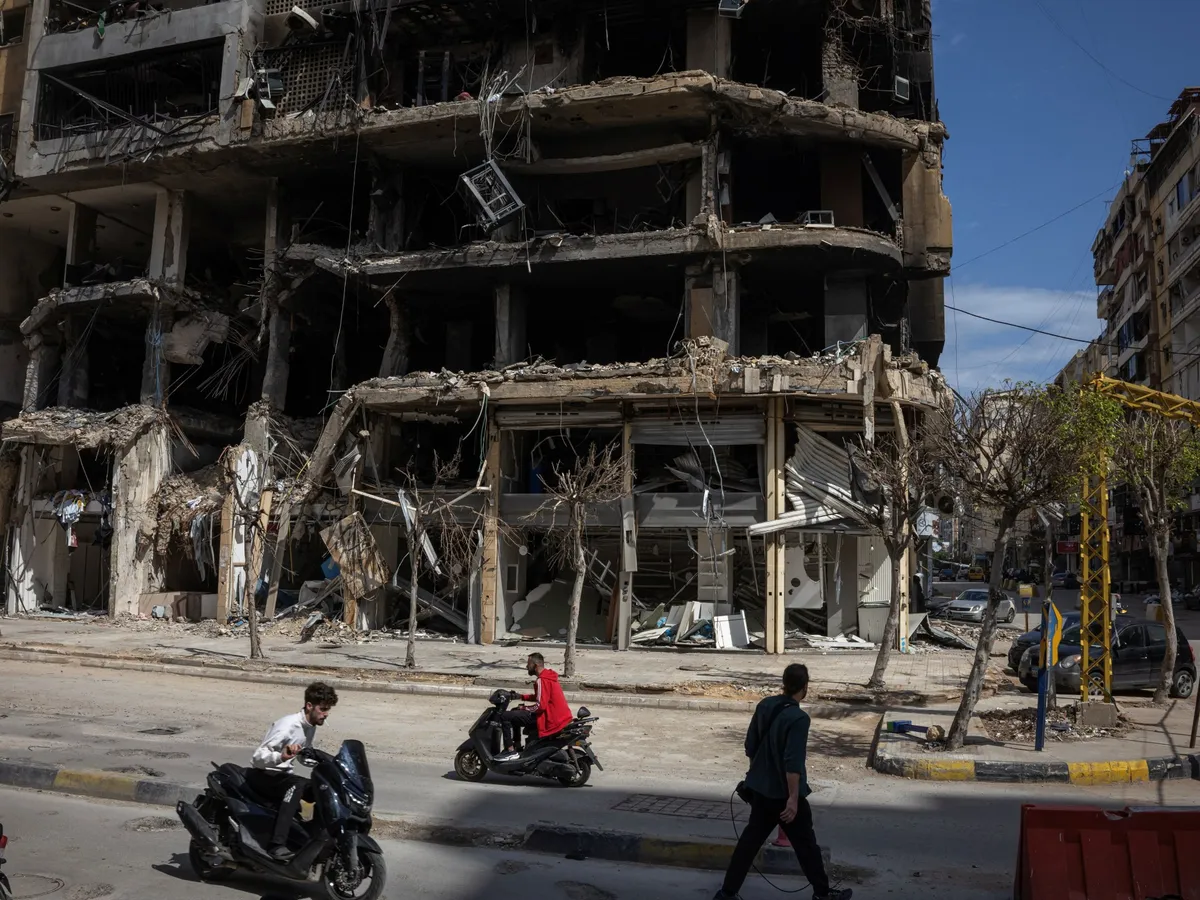
Raids on a truck and a motorcycle in the town of Yohmor al-Shaqif kill four people, state media report.People pass damaged buildings in Beirut amid a 10-day ceasefire between Lebanon and Israel [Marko Djurica/Reuters]Published On 25 Apr 2026Israeli attacks have killed at least four people in southern Lebanon’s Nabatieh district, the state news agency reports, as Israel continues to pummel the country in defiance of a three-week extension of a ceasefire with Hezbollah.In a statement on Saturday, Lebanon Ministry of Public Health’s emergency operations centre said two Israeli raids on a truck and a motorcycle in the town of Yohmor al-Shaqif killed four people, the Lebanese National News Agency reported.Recommended Stories list of 4 itemslist 1 of 4Israel continues attacks on Lebanon despite extension of ceasefirelist 2 of 4Israeli attacks on Lebanon may violate international law, UN warnslist 3 of 4Reality check: Israeli ambitions confront US dictates in Iran and Lebanonlist 4 of 4Mixed views in Lebanon ahead of controversial talks with Israelend of listAl Jazeera’s Heidi Pett, reporting from the city of Tyre, said the attacks were carried out north of the Litani River, below which Israel has unilaterally declared to be operating.Meanwhile, in the city of Bint Jbeil, also in southern Lebanon, Israeli soldiers reportedly blew up buildings on Saturday morning.Al Jazeera correspondents on the ground separately reported bombings in the city of Khiam, including on residential blocks.Israel’s ongoing spree is “part of a continued pattern of Israeli military activity, despite what is ostensibly a ceasefire”, Pett said, adding that the “rumble and thud of explosions” could be heard across southern swaths of the country.“That is Israel demolishing houses and buildings,” she said.Lebanon’s Ministry of Public Health said that Israeli attacks since March 2 have killed 2,496 people and wounded 7,719.The attacks are the latest to rock southern Lebanon since United States President Donald Trump announced the ceasefire extension on Thursday. Within hours, the Israeli military claimed it had “eliminated” six Hezbollah fighters in an exchange of fire near Bint Jbeil.Hezbollah lawmaker Ali Fayyad said the ceasefire was “meaningless in light of Israel’s insistence on hostile acts, including assassinations, shelling, and gunfire”.He added that Israeli attacks meant Hezbollah retains the “right to retaliate”.Israeli Prime Minister Benjamin Netanyahu said Israel was “maintaining full freedom of action against any threat” and claimed Hezbollah was “trying to sabotage” the pause.Analysts say the ceasefire arrangement has failed to halt hostilities and may never have been intended to do so.Ali Rizk, a security affairs analyst in Beirut, told Al Jazeera: “We have to remember that this was a ceasefire between the Lebanese state and the Israeli state.”“We’ve had Hezbollah parliamentarians say that this ceasefire doesn’t concern them,” he added.Rizk said the process initiated by Washington has been viewed with scepticism in Lebanon.“It’s been seen as an attempt to take aim at Hezbollah, first and foremost, more than actually being about real peace or real calm,” he said.He went further, arguing the truce lacked substance from the outset.“I think that the ceasefire basically never existed to begin with. It was an arrangement reached between Israeli officials to allow for these negotiations, and the number one of these negotiations is to dismantle Hezbollah,” he said.Israel has also warned residents not to approach areas near the Litani River, where its forces remain deployed, reinforcing its continued military presence on Lebanese territory.Before Trump’s ceasefire announcement, a poll by the Israel Democracy Institute suggested that Jewish Israeli respondents overwhelmingly supported continuing the conflict, even if it led to friction with the US.The Lebanese leadership has rejected the possibility of Lebanon being used as a “bargaining chip” amid potential US-Israel negotiations with Iran, Pett said.Lebanese civilians, meanwhile, are facing the fallout.Huda Kamal Mansour, from Aitaroun village in southern Lebanon, has been living with her nine-year-old son in an empty stadium in Beirut along with other displaced families for the past 45 days.She told Al Jazeera she ran for her life when the Israeli army started bombarding her neighbourhood.“There was zero distance between us and the Israeli army when they attacked southern Lebanon. All I could hear was the sound of explosions hitting villages. We were told to evacuate from the village, then the tanks surrounded us,” she recalled.“Israel didn’t leave one house standing there.”
SRCAl Jazeera
LANGEN
LEANCenter
WORDS705
ENT11
SAT · 2026-04-25 · 13:25 GMTBRIEF NSR-2026-0425-71510
NSR-2026-0425-71510News Report·EN·Conflict
Israeli attacks kill four in southern Lebanon
Israeli attacks in southern Lebanon have resulted in the deaths of at least four people. State media reported that two separate raids on a truck and a motorcycle in Yohmor al-Shaqif on Saturday killed the individuals.
Al Jazeera StaffAl JazeeraFiled 2026-04-25 · 13:25 GMTLean · CenterRead · 3 min
Al JazeeraFIG 01
Reading time
3min
Word count
705words
Sources cited
6cited
Entities identified
11entities
Quality score
100%
§ 01
Briefing Summary
AI-generatedNEWSAR · AI
Israeli attacks in southern Lebanon have resulted in the deaths of at least four people. State media reported that two separate raids on a truck and a motorcycle in Yohmor al-Shaqif on Saturday killed the individuals. These attacks occurred north of the Litani River, an area Israel has designated for its operations. The Lebanese Ministry of Public Health stated that Israeli attacks since March 2 have caused significant casualties. These incidents follow an extension of a ceasefire, which Hezbollah lawmaker Ali Fayyad deemed "meaningless" due to Israel's continued hostile actions.
Confidence 0.90Sources 6Claims 5Entities 11
§ 02
Article analysis
Model · rule-basedFraming
Conflict
Human Rights
Tone
Mixed Tone
AI-assessed
CalmNeutralAlarmist
Factuality
0.70 / 1.00
Factual
LowHigh
Sources cited
6
Well sourced
FewMany
§ 03
Key claims
5 extracted01
Israel was “maintaining full freedom of action against any threat” and claimed Hezbollah was “trying to sabotage” the pause.
quoteIsraeli Prime Minister Benjamin Netanyahu
Confidence
1.00
02
The ceasefire was “meaningless in light of Israel’s insistence on hostile acts, including assassinations, shelling, and gunfire”.
quoteHezbollah lawmaker Ali Fayyad
Confidence
1.00
03
Israeli attacks since March 2 have killed 2,496 people and wounded 7,719.
statisticLebanon’s Ministry of Public Health
Confidence
0.90
04
Two Israeli raids on a truck and a motorcycle in the town of Yohmor al-Shaqif killed four people.
factualLebanon Ministry of Public Health
Confidence
0.90
05
Israeli attacks have killed at least four people in southern Lebanon’s Nabatieh district.
factualLebanese National News Agency
Confidence
0.90
§ 04
Full report
3 min read · 705 words§ 05
Entities
11 identifiedKey playerOppositionContextPositiveNeutralNegative
People3
Organizations1
§ 06
Keywords & salience
8 termsisraeli attacks
1.00
southern lebanon
0.90
ceasefire
0.80
hezbollah
0.70
military activity
0.60
civilian casualties
0.50
international law
0.40
yohmor al-shaqif
0.40
§ 07
Topic connections
Interactive graph Network visualization showing 51 related topics
View Full Graph Person Organization Location Event|Click node to navigate|Edge numbers = shared articles