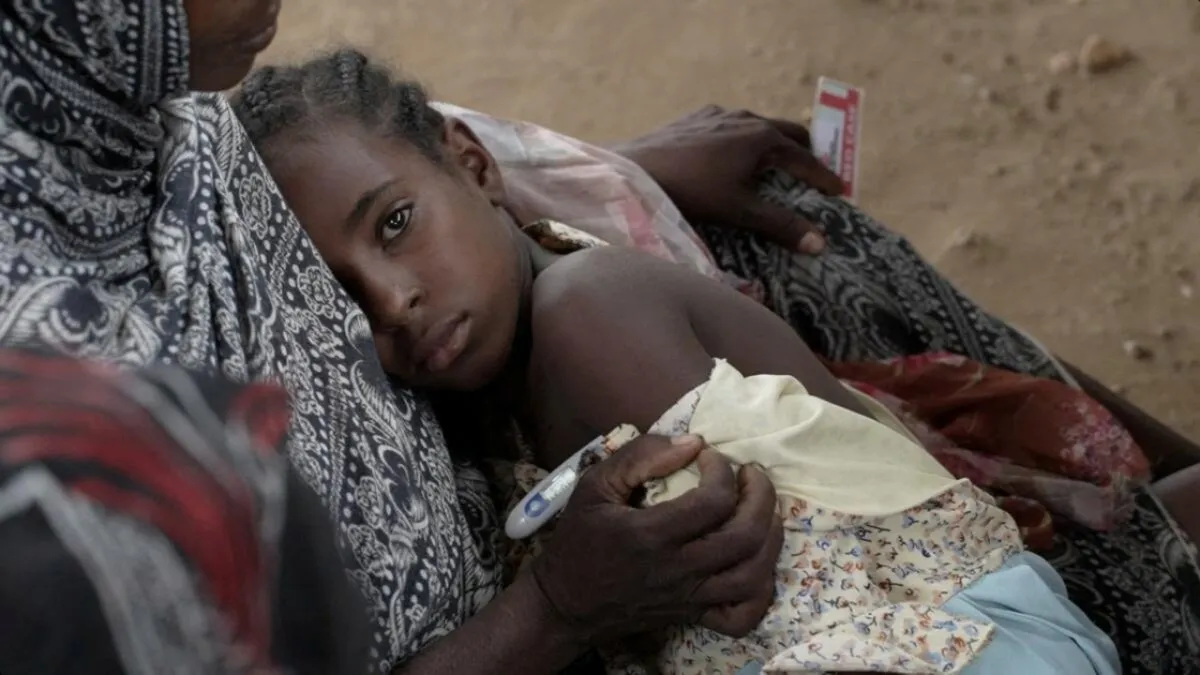
Measles kills 70 in East Darfur’s Labado in a few weeks as healthcare collapse leaves families without medicines.A measles outbreak has struck several Labado districts since March [File: UNHCR/Reuters]Published On 27 Apr 2026East Darfur, Sudan — Hawa Adam did not expect a childhood illness to kill her son. Ali was two years old when he fell sick on February 25 in Labado, in Sudan’s East Darfur state. He died two days later.“I thought it was one of the ordinary childhood diseases,” the 37-year-old told Al Jazeera. “I never imagined I would lose my child to this epidemic.”Recommended Stories list of 4 itemslist 1 of 4Guterres urges end to arms flow as Sudan war enters fourth yearlist 2 of 4After three years of war, Sudan army and RSF locked in military impasselist 3 of 4Who is keeping the fight alive in Sudan’s war?list 4 of 4Sudan’s Prime Minister: This is the path out of the horrors of warend of listHawa attributes his death to the absence of basic medical care – no vaccination, no qualified doctors.“Most doctors”, she says, “left the area after the war broke out, forcing those with means to seek treatment abroad, in South Sudan or Uganda.”A measles outbreak has struck several Labado districts since March, killing approximately 70 people and infecting about 1,000 others across 12 residential neighbourhoods, in a population of roughly 12,000, which includes displaced people who arrived during the war, according to Mohamed Abdel Aziz, 32, coordinator of the Labado crisis unit, a community-run group.Those numbers were disputed by East Darfur’s health director, Dr Jabir al-Nadeef, who confirmed to Al Jazeera that measles has struck four districts of the state, but only reported 300 cases and 26 deaths, figures that diverge substantially from those documented by the Labado emergency room.“Vaccines only arrived on April 11 from Chad via UNICEF [United Nations Children’s Fund ], after a prolonged period with no supply, and a vaccination campaign is scheduled to run from April 18 to 24 across the state,” he said.Measles is one of the world’s most contagious diseases, spread by contact with infected nasal or throat secretions or breathing in air that was breathed out by someone with measles, according to the World Health Organization (WHO). Outbreaks can result in severe complications and deaths, especially among young, malnourished children.There is no specific treatment for measles, which is a viral disease. Dr al-Nadeef said all areas of East Darfur have been supplied with vitamin A for both prevention and treatment of complications. Patients who reach a health facility are isolated until recovery, but families are responsible for purchasing any medicines needed to treat complications.Discovered by accidentThe first measles cases in Darfur in the current outbreak were recorded in January, according to UNICEF. It is unfolding against the backdrop of a near-total collapse of public health infrastructure across Darfur, where war has gutted facilities, halted routine vaccination and driven out medical personnel.“We discovered the outbreak by accident,” Abdel Aziz, the coordinator, told Al Jazeera.The teams had been conducting home visits to follow up on a training workshop for women on fire-prevention. During those visits, the teams began to see the scale of the outbreak, with almost half of the homes visited having measles cases.The documented death toll, according to Abdel Aziz, now stands at 70. Total infections are estimated at approximately 1,000.Three families, three childrenIn the al-Nil neighbourhood, Ismail Issa, 38, lost his two-year-old daughter Makarem on March 11. His brother Ahmed lost an 18-month-old son, Issa, on March 25.Then Hasan, the three-year-old son of Ismail’s sister Medeeha, died on March 23. All three families live in adjoining homes in the same neighbourhood, and the infection passed between them.“We tried to cure them with simple remedies like trying to lower temperatures with water compresses and using handmade potions from local plants to help with itching, but we couldn’t afford medicines, and sometimes we couldn’t find them,” Ismail told Al Jazeera.Abdel Aziz traced much of the death toll directly to a supply failure. Medicines ran out at the government health centre on February 23. Drugs remain available at private pharmacies, but most residents cannot afford them.Intravenous fluids cost 8,000 Sudanese pounds ($20.50); antibiotics used to treat complications range from 10,000 to 15,000 pounds ($25.60 to $38.40), Abdel Aziz said. A local organisation provided a limited medicine supply, but it was exhausted within two days.Long journey for treatmentAsmaa Jalaluddin, 28, lives in the Dar al-Naim West neighbourhood of Labado with her three children, the eldest of whom is eight. Her three-year-old daughter, Mashaer Rajab al-Sheikh, fell ill on April 5 with fever, diarrhoea and persistent vomiting. She stopped eating and kept her eyes shut for four days.On April 8, Asmaa took her to the Labado health centre, where she was told her daughter had measles. With no medicines available, she was directed to travel to Shuairiya, 40 kilometres north. There, on April 10, Mashaer received fever reducers and vitamins and slowly began to open her eyes again. She was discharged two days later.Asmaa’s five-year-old daughter, Abrar, also fell ill in March and recovered at Labado hospital. But Asmaa is clear about what is driving the spread: “Families in Labado are suffering from the disease because vaccination has stopped at health facilities”.Local doctors are now calling for intervention from international health organisations, noting that diseases that had been eliminated are returning.UNICEF spokesperson for Sudan, Eva Hinds, told Al Jazeera that “measles cases continue to be reported across Darfur, with insecurity, displacement, damaged health facilities, and prolonged disruption to routine immunisation all constraining the response”.“Measles vaccination coverage has fallen to 46 percent, while routine immunisation – measured by the first dose of the diphtheria, tetanus, and pertussis vaccinen- dropped to just 48 percent in 2024, threatening decades of progress in child health,” she added.UNICEF says that a measles-rubella vaccine catch-up campaign has been completed across all localities in Central Darfur and West Darfur, as well as parts of North and South Darfur, reaching approximately 2.1 million children aged nine to 14. Vaccination in remaining areas, including East Darfur, is scheduled for mid to end of April, aiming to reach close to 750,000 children across all nine of the state’s localities.For the families of Labado, the calendar offers little comfort.In the al-Nil neighbourhood, three siblings buried their children within days of one another over the Eid holiday. In Dar al-Naim West, a mother counts the days until her daughter’s 14-day isolation ends. In the Safaa neighbourhood, Hawa Adam has already buried hers.“They could have still been alive,” Hawa Adam said. “Those without money die in Darfur.”This article was published in collaboration with Egab.
SRCAl Jazeera
LANGEN
LEANCenter
WORDS1 101
ENT7
MON · 2026-04-27 · 08:04 GMTBRIEF NSR-2026-0427-71907
NSR-2026-0427-71907News Report·EN·Human Interest
War and neglect fuel deadly measles epidemic in Sudan’s Darfur
A deadly measles epidemic is ravaging Labado districts in East Darfur, Sudan, claiming approximately 70 lives and infecting around 1,000 people in recent weeks. The outbreak, which began in March, is exacerbated by a collapse in healthcare services, including a severe lack of medicines and the departure of medical professionals following the ongoing conflict.
By Eisa DafallahAl JazeeraFiled 2026-04-27 · 08:04 GMTLean · CenterRead · 5 min
Al JazeeraFIG 01
Reading time
5min
Word count
1 101words
Sources cited
0cited
Entities identified
7entities
Quality score
100%
§ 01
Briefing Summary
AI-generatedNEWSAR · AI
A deadly measles epidemic is ravaging Labado districts in East Darfur, Sudan, claiming approximately 70 lives and infecting around 1,000 people in recent weeks. The outbreak, which began in March, is exacerbated by a collapse in healthcare services, including a severe lack of medicines and the departure of medical professionals following the ongoing conflict. Families are struggling to access basic care, with many unable to vaccinate their children. While local crisis units report higher figures, the state health director confirmed measles in four districts, with significantly lower reported cases and deaths. Vaccines from UNICEF only arrived on April 11, with a vaccination campaign scheduled for later in April. The epidemic highlights the devastating impact of war and neglect on public health in the region.
Confidence 0.90Entities 7
§ 04
Full report
5 min read · 1 101 words§ 05
Entities
7 identifiedKey playerOppositionContextPositiveNeutralNegative
Organizations1
§ 06
Keywords & salience
8 termsmeasles epidemic
1.00
healthcare collapse
0.90
sudan war
0.80
darfur
0.70
vaccination
0.60
childhood illness
0.50
displaced people
0.40
unicef
0.40
§ 07
Topic connections
Interactive graph No topic relationship data available yet. This graph will appear once topic relationships have been computed.