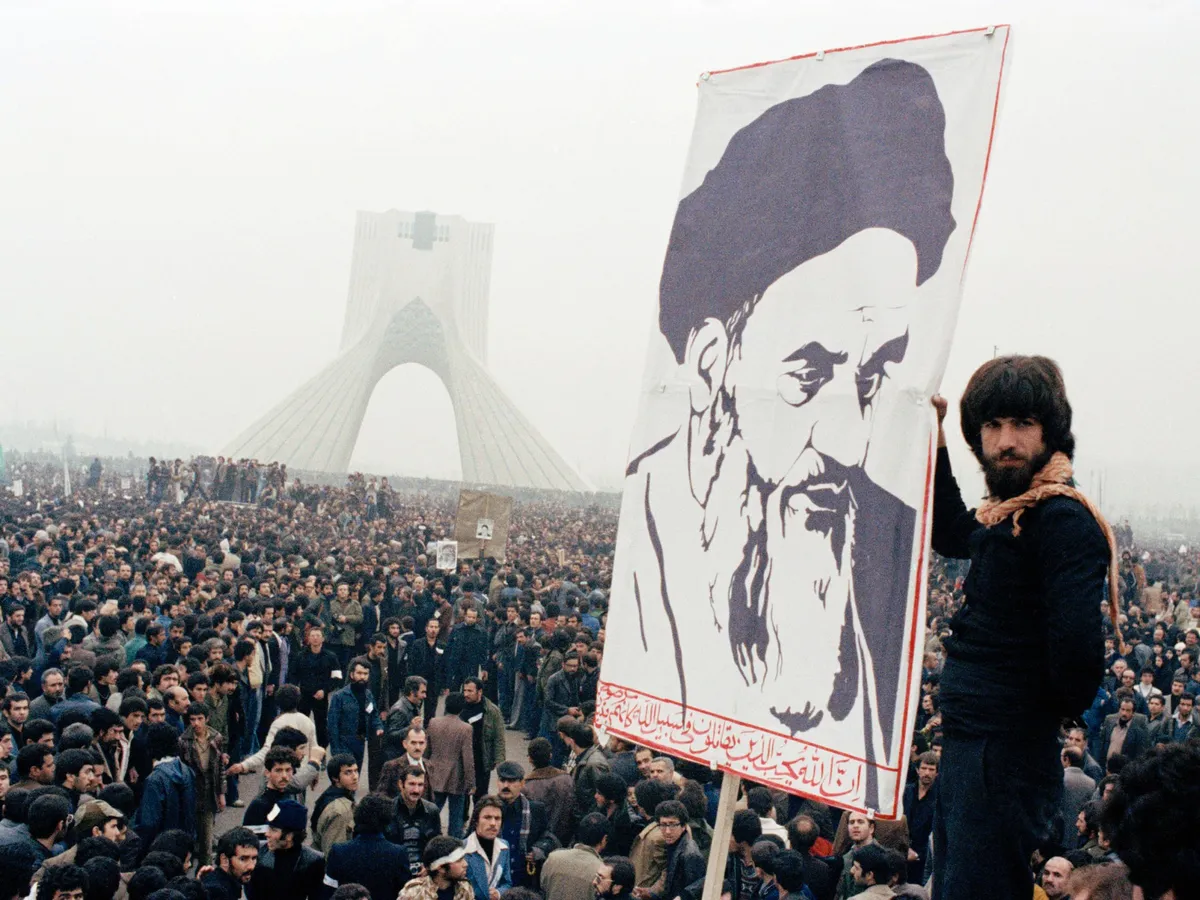
EXPLAINERFrom a hostage crisis, a years-long war, and a nuclear dispute, Iran's struggles remain pivotal to its identity.Iranian protesters demonstrate against Shah Mohammad Reza Pahlavi in Tehran, Iran, October 9, 1978 [AP Photo]Published On 13 Jan 2026The protests in Iran are grabbing headlines, with the government and the opposition accusing each other of escalating violence. The government also says that foreign interference is behind the protests.It is the latest round of demonstrations against Iran’s governing system since the 1979 revolution that toppled the shah and ushered in an Islamic Republic.Recommended Stories list of 3 itemslist 1 of 3Displaced citizens without a vote Myanmar’s electionlist 2 of 3AFCON 2025 organisers investigate clashes at Nigeria, Morocco gameslist 3 of 3Myanmar Rohingya genocide case begins at International Courtend of listBut the country has also faced other crises, including earthquakes, war, sanctions, nuclear tensions, regional interventions and political drama.Here is a timeline of some of the major events from the last five decades.1979February: Ayatollah Ruhollah Khomeini returns after 14 years of exile in Iraq and France.April: After a referendum, Iran is declared an Islamic republicNovember: The United States imposes its first sanctions on Iran, justified by the seizure of American hostages held at the US Embassy in Tehran. The US had supported the the overthrown shah, or monarch, Mohammad Reza Pahlavi, and, earlier, helped depose the democratically elected prime minister, Mohammad Mosaddegh, in a 1953 coup, also supported by US and UK intelligence agencies.1980September: Iraq invades Iran. Estimates put the war’s death toll at approximately 500,000, with Iran suffering the heavier losses. The war was defined by large-scale trenches, machineguns and bayonet uses, similar to World War I. However, Iraq also used chemical weapons against Iranians and Iraqi Kurds.1981January: All remaining US hostages are released, ending the Iranian hostage crisis.June: A bombing at the Islamic Republican Party headquarters in Tehran kills dozens of senior officials, including the head of the judiciary, Mohammad Beheshti, regarded as the second-most important person in Iran after Khomeini.August: President Mohammad-Ali Rajai and Prime Minister Mohammad Javad Bahonar are assassinated in a bombing attack on a meeting in Tehran. Authorities blame the leftist revolutionary-minded opposition Mojahedin-e Khalq (MEK) group, which had faced a crackdown the previous year.1982June: Israel invades Lebanon. Iran starts funding what will become the Lebanese resistance movement, Hezbollah.1988July: The USS Vincennes, a US Navy guided missile cruiser, shoots down a civilian Iran Air Airbus plane over the Gulf, killing all 290 people on board.August: A ceasefire begins between Iran and Iraq after United Nations-brokered negotiations.1989June: Supreme Leader Ayatollah Ruhollah Khomeini dies on June 3.His successor, Ayatollah Ali Khamenei, is chosen by the Assembly of Experts the next day.1990June: Iran is hit by a major earthquake. About 40,000 people are killed.1995March and May: The US imposes oil and trade sanctions on Iran. It accuses Iran of sponsoring “terrorism” and seeking nuclear arms.1998September: The Taliban admits that eight Iranian diplomats and a journalist had been killed in Afghanistan the previous month, during the group’s takeover of the northern city of Mazar-i-Sharif. Iran deploys thousands of troops to its shared border with Afghanistan in response.2002January: US President George W Bush names Iran part of the “axis of evil”, alongside North Korea and Iraq, saying the countries are supporters of “terrorism”.2003March: The US invades Iraq. Iran begins financing and supporting Shia militias and political groups on the ground. Its influence over such groups is still prevalent today.November: Iran announces it will suspend its uranium enrichment programme and allow more thorough UN inspections of its nuclear sites. The International Atomic Energy Agency (IAEA) says there is no evidence of a nuclear weapons programme. This openness is a change after Iranian officials had blocked or impeded past inspections.December: The Bam earthquake in southern Iran kills up to 40,000 people2006December: the UN Security Council (UNSC) imposes sanctions on Iran’s trade in sensitive nuclear materials and technology, after Iran failed to suspend its nuclear programme in exchange for diplomatic and economic incentives from Germany and the five permanent UNSC members – France, China, Russia, the UK, and the US.2007October: The US adds additional, increasingly tough sanctions on Iran2010June: The UNSC imposes a fourth round of sanctions on Iran over its nuclear programme. The sanctions include an expanded arms embargo and stricter financial regulations.September: Iran accuses Israel and the US of infecting its nuclear power plant systems after discovering malware on systems used by staff in the nuclear sector.2011March: The regime of President Bashar al-Assad in Syria, an Iranian ally, brutally represses a popular uprising that started in March on the back of the Arab Spring protests. Later in the year, the Iranian Revolutionary Guard Corps (IRGC) sends Iranian and foreign militias to support al-Assad.2012January: The European Union begins boycotting Iranian oil exports.September: The IAEA claims it is obstructed from inspecting Iran’s Parchin military site and that Iran has increased the amount of nuclear centrifuges enriching uranium, raising fears that the country is getting closer to obtaining a nuclear weapon.October: The Iranian rial falls to a record low against the US dollar, losing 80 percent of its value since 2011, largely due to international sanctions.2015July: Iran comes to an agreement with the administration of US President Barack Obama, as well as the UK, France, Russia, China and the EU, to limit its nuclear programme in return for sanctions relief. The Joint Comprehensive Plan of Action (JCPOA) is widely referred to as the nuclear deal, and the agreement leads to celebrations from Iranians, hoping for an end to the country’s isolation.2018May: Obama’s successor, President Donald Trump, withdraws the US from the nuclear deal, arguing that the JCPOA is too lenient on Iran and should be replaced by a “better deal”.2020January: Qassem Soleimani, the leader of the IRGC’s Quds Force, is assassinated by a US drone strike in Baghdad.2024April: Israel bombs Iran’s embassy in Damascus, killing seven people, including two IRGC generals.May: Iranian President Ebrahim Raisi dies in a helicopter crash in the country’s East Azerbaijan province.July: Hamas chief Ismael Haniyeh is assassinated in Tehran, with Israel widely regarded as being behind the attack.2025June: Israel attacks Iran, starting a 12-day war between the two sides that kills at least 610 Iranians and 28 Israelis.
SRCAl Jazeera
LANGEN
LEANCenter
WORDS1 026
ENT9
TUE · 2026-01-13 · 07:06 GMTBRIEF NSR-2026-0113-7194
NSR-2026-0113-7194News Report·EN·Conflict
Iran since 1979: A timeline of crises
Since the 1979 revolution that established the Islamic Republic, Iran has faced numerous internal and external crises. In 1979, Ayatollah Khomeini returned from exile, and the US imposed sanctions following the hostage crisis at the US embassy.
Al JazeeraFiled 2026-01-13 · 07:06 GMTLean · CenterRead · 5 min
Al JazeeraFIG 01
Reading time
5min
Word count
1 026words
Sources cited
0cited
Entities identified
9entities
Quality score
100%
§ 01
Briefing Summary
AI-generatedNEWSAR · AI
Since the 1979 revolution that established the Islamic Republic, Iran has faced numerous internal and external crises. In 1979, Ayatollah Khomeini returned from exile, and the US imposed sanctions following the hostage crisis at the US embassy. The Iran-Iraq War, beginning in 1980, resulted in an estimated 500,000 deaths and saw the use of chemical weapons. In 1981, US hostages were released, but bombings targeted government officials, including President Rajai and Prime Minister Bahonar. These events, along with ongoing nuclear tensions, regional interventions, and political instability, have shaped Iran's identity over the past five decades. Recent protests highlight the ongoing challenges facing the country's governing system.
Confidence 0.90Claims 5Entities 9
§ 02
Article analysis
Model · rule-basedFraming
Conflict
Political Strategy
Tone
Measured
AI-assessed
CalmNeutralAlarmist
Factuality
0.90 / 1.00
Factual
LowHigh
Sources cited
0
No named sources
FewMany
§ 03
Key claims
5 extracted01
Ayatollah Ruhollah Khomeini returns after 14 years of exile in Iraq and France.
factual
Confidence
1.00
02
All remaining US hostages are released in January 1981, ending the Iranian hostage crisis.
factual
Confidence
1.00
03
Iraq invades Iran in September 1980.
factual
Confidence
1.00
04
The United States imposes its first sanctions on Iran, justified by the seizure of American hostages held at the US Embassy in Tehran.
factual
Confidence
1.00
05
Estimates put the Iran-Iraq war’s death toll at approximately 500,000, with Iran suffering the heavier losses.
statistic
Confidence
0.90
§ 04
Full report
5 min read · 1 026 words§ 05
Entities
9 identifiedKey playerOppositionContextPositiveNeutralNegative
People3
Organizations1
§ 06
Keywords & salience
10 termsiran
1.00
1979 revolution
0.90
islamic republic
0.80
hostage crisis
0.70
protests
0.70
iran-iraq war
0.60
sanctions
0.60
ayatollah khomeini
0.50
nuclear tensions
0.50
political drama
0.40
§ 07
Topic connections
Interactive graph Network visualization showing 51 related topics
View Full Graph Person Organization Location Event|Click node to navigate|Edge numbers = shared articles