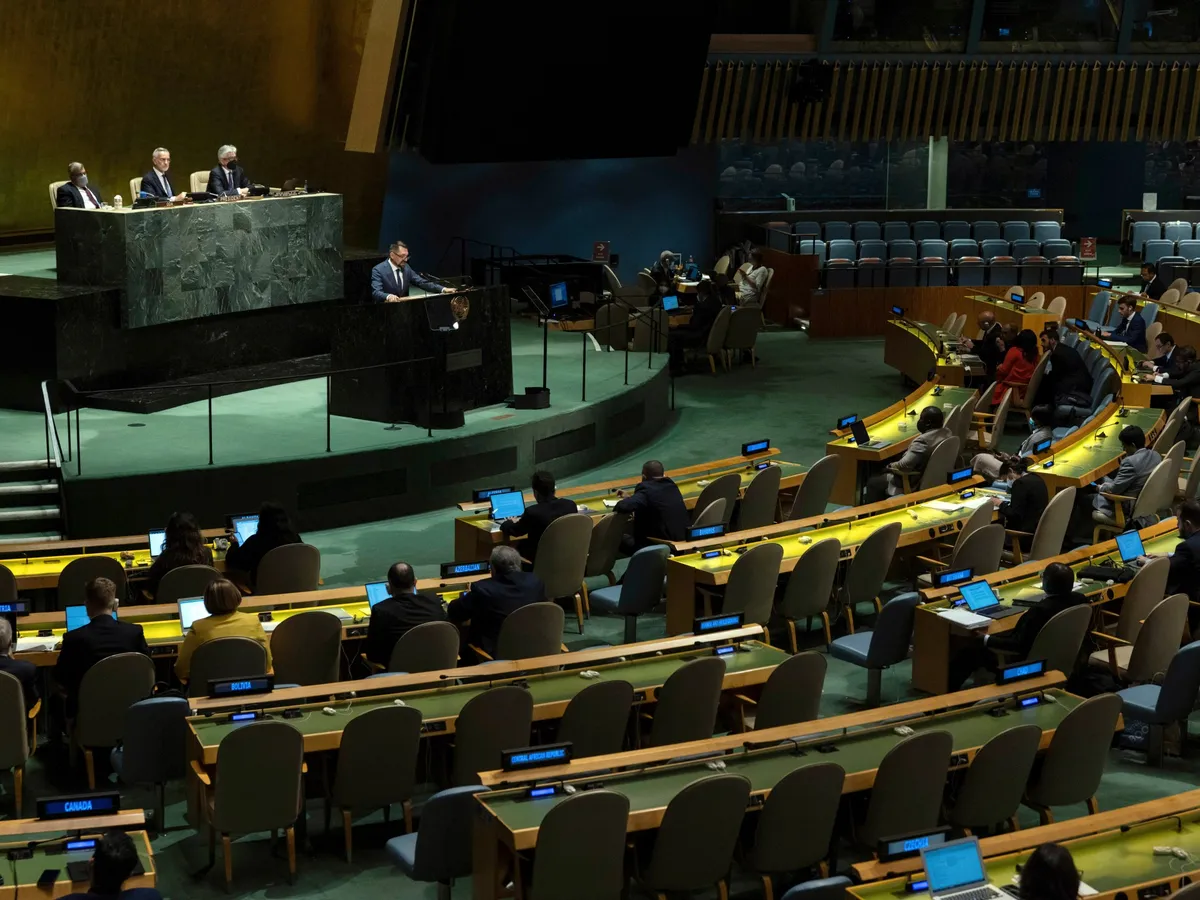
Analysts say a review conference is unlikely to halt nuclear powers from continuing to flout the treaty’s rules.The 2022 nuclear Non-Proliferation Treaty review conference was held in the UN General Assembly [File: Yuki Iwamura/AP]Published On 27 Apr 2026The Treaty on the Non-Proliferation of Nuclear Weapons (NPT), the cornerstone of global efforts to prevent the spread of nuclear weapons, has opened its five-year review conference in New York under the shadow of a fragile ceasefire between the United States and Iran.At the centre of the discussions will be Iran’s enriched uranium stockpile: how much remains, where it is located and what will ultimately happen to it.Recommended Stories list of 4 itemslist 1 of 4What is uranium enrichment and how quickly could Iran build a nuclear bomb?list 2 of 4US-Iran conflict: What’s the latest as the Islamabad talks stall?list 3 of 4The war on Iran is eroding nuclear non-proliferationlist 4 of 4Russia attacks Odesa, claims Ukraine hit Zaporizhzhia nuclear plantend of listOn February 27, Omani Foreign Minister, Badr Albusaidi, who was mediating talks between Washington and Tehran, said Iran had agreed to “zero accumulation”, “zero stockpiling” and full verification of its existing stockpile by the International Atomic Energy Agency (IAEA).Iran’s existing stockpile, the Omani minister said, would be downblended to natural uranium levels and converted into fuel.However, hours later, the US and Israeli strikes began.The NPT, alongside the 2015 Iran nuclear deal, which Washington abandoned in 2018, was designed precisely to prevent such a scenario. One of the justifications that the US and Israel have used to wage war on Iran – that Tehran must not be allowed to continue with a nuclear programme – has drawn accusations of hypocrisy, given Israel is the only country in the Middle East with nuclear weapons. Israel has never officially acknowledged it has nuclear weapons and is not a signatory to the NPT.To many experts, the NPT’s very survival as a credible mechanism to prevent the spread of nuclear weapons is now at stake.The grand bargain is ‘fundamentally broken’The NPT rests on a basic exchange: States without nuclear weapons agree not to acquire them while those that possess them commit to eventual disarmament.In return, all signatories retain the right to peaceful nuclear technology under international supervision.Opened for signature in 1968 with Ireland as the first signatory, the NPT entered into force in 1970. It is the most widely adhered-to arms control agreement with 191 member states.Five countries are formally recognised as nuclear-weapon states: the US, Russia, China, the United Kingdom and France, all of which are permanent members of the United Nations Security Council. Every other signatory is legally bound not to develop or acquire nuclear arms.The treaty is built on three pillars: nonproliferation, disarmament and the peaceful use of nuclear energy. It is monitored by the IAEA.The third pillar has largely held. The second has not.“The NPT’s grand bargain has fundamentally broken down because all nuclear-weapon states are modernising their arsenals at an alarming rate, especially China,” Sahar Khan, a Washington, DC-based independent analyst and nonresident fellow at the Institute for Global Affairs, told Al Jazeera.Hossein Mousavian, who worked on Iran’s nuclear diplomacy team in negotiations with the European Union and the IAEA, argued that the treaty’s credibility has also been damaged by what many states see as inconsistent enforcement of its principles.“The record of the nuclear Non-Proliferation Treaty has come under serious strain,” he said. “Nuclear-weapon states have fallen short of their disarmament commitments while continuing to modernise their arsenals, and some have developed strategic partnerships with nuclear-armed states outside the treaty.”He added that attacks on nuclear facilities under IAEA safeguards have not been met with “clear and consistent responses” from either the UN Security Council or the IAEA, raising broader concerns among nonnuclear states about fairness and equal treatment under the treaty.“The result is a growing perception that the NPT is shifting from a rules-based regime toward a more politicised instrument shaped by power dynamics rather than uniform application of its principles,” he said.The 2000 NPT review conference was the last major moment of consensus before the 2003-2011 Iraq War, which undermined faith in the international arms control system and saw relations between nuclear and nonnuclear states deteriorate sharply, Rebecca Johnson, the director of the Acronym Institute for Disarmament Diplomacy, told Al Jazeera.“The possession of nuclear weapons creates a sense of impunity,” she said, arguing that nuclear-armed states increasingly use their arsenals not simply as deterrents but also as geopolitical shields that embolden conventional military action.She also argued that frustration with the NPT process helped drive support for the Treaty on the Prohibition of Nuclear Weapons, adopted in 2017, which offers an alternative path towards disarmament outside the control of the nuclear powers.Who has signed the NPT and who hasn’t?Four UN member states have never signed the treaty: India, Pakistan, Israel and South Sudan.India and Pakistan tested nuclear weapons in 1998. Israel maintains a policy of deliberate opacity, neither confirming nor denying it possesses nuclear arms, although it is widely believed to have at least 90 warheads.North Korea joined the treaty in 1985, was later found to be noncompliant with its safeguards obligations and withdrew in 2003.It has since conducted multiple nuclear tests.Analysts said this means the treaty’s architecture has an inherent structural imbalance. States that tested nuclear weapons before January 1, 1967, are permanently recognised as nuclear powers while all others must forgo nuclear weapons indefinitely.Iran chose to remain within the framework. It joined the NPT in 1974 and, despite repeated crises, has never withdrawn from it. That status underpins Tehran’s claim to the same rights as any other signatory. Those include the right to uranium enrichment to levels justified for a civilian nuclear programme.Israel’s position complicates that argument.“The one thing that no one is talking about is how Israel is not a member of the NPT, yet has nuclear weapons, and has been able to bomb a signatory of the NPT that does not have nuclear weapons,” Khan told Al Jazeera. “This war has set a dangerous precedent – that if you have nuclear weapons, you can attack a state you believe has the intention to develop them.”Iran and the NPTAfter Iran joined the NPT, its nuclear programme drew limited scrutiny for decades.That changed in 2002 when a dissident group revealed undeclared uranium-enrichment facilities at the Natanz Nuclear Facility and a heavy-water reactor in Arak.“What got Iran into trouble”, Khan said, “was two things: developing secret underground nuclear facilities – as an NPT signatory, Iran is obligated to declare them and allow IAEA inspections – and President [Mahmoud] Ahmadinejad’s decision to restart uranium enrichment at an accelerated pace.” Ahmadinejad was Iran’s president from 2005 to 2013.The 2015 Iran nuclear deal – called the Joint Comprehensive Plan of Action (JCPOA) and agreed between Iran and the five permanent UN Security Council members plus Germany – imposed the most extensive restrictions ever placed on a nonnuclear-weapon state.Iran cut its enriched uranium stockpile by 98 percent to 300kg (660lb), capped enrichment at 3.67 percent, reduced its centrifuges by two-thirds and accepted one of the most intrusive inspection regimes implemented by the IAEA. In return, nuclear-related sanctions against it were lifted.“The point of the JCPOA was not to stop Iran from enriching uranium, because as a signatory [of the NPT] it is allowed to, but to place the programme under constant monitoring and inspections,” Khan said. “By allowing Iran to enrich and develop its own centrifuges, the JCPOA provided a route for building trust.”
SRCAl Jazeera
LANGEN
LEANCenter
WORDS1 240
ENT5
MON · 2026-04-27 · 14:43 GMTBRIEF NSR-2026-0427-72024
NSR-2026-0427-72024News Report·EN·National Security
NPT summit: Can nuclear pact survive US-Israel war on Iran?
The 2026 Nuclear Non-Proliferation Treaty (NPT) review conference is underway in New York amidst a fragile ceasefire between the US and Iran. Discussions are centered on Iran's enriched uranium stockpile, following an agreement for "zero accumulation" and IAEA verification, which was reportedly undermined by subsequent US and Israeli strikes.
Nils Adler,Abid HussainAl JazeeraFiled 2026-04-27 · 14:43 GMTLean · CenterRead · 5 min
Al JazeeraFIG 01
Reading time
5min
Word count
1 240words
Sources cited
6cited
Entities identified
5entities
Quality score
100%
§ 01
Briefing Summary
AI-generatedNEWSAR · AI
The 2026 Nuclear Non-Proliferation Treaty (NPT) review conference is underway in New York amidst a fragile ceasefire between the US and Iran. Discussions are centered on Iran's enriched uranium stockpile, following an agreement for "zero accumulation" and IAEA verification, which was reportedly undermined by subsequent US and Israeli strikes. Analysts question the NPT's credibility, arguing that nuclear powers continue to disregard its rules. The treaty's core principle involves non-nuclear states forgoing weapons in exchange for disarmament commitments from nuclear states and access to peaceful nuclear technology. The conflict and Israel's undeclared nuclear arsenal, while not an NPT signatory, raise accusations of hypocrisy and challenge the treaty's effectiveness in preventing nuclear proliferation.
Confidence 0.90Sources 6Claims 3Entities 5
§ 02
Article analysis
Model · rule-basedFraming
National Security
Tone
Measured
AI-assessed
CalmNeutralAlarmist
Factuality
0.80 / 1.00
Factual
LowHigh
Sources cited
6
Well sourced
FewMany
§ 03
Key claims
3 extracted01
Israel has never officially acknowledged it has nuclear weapons and is not a signatory to the NPT.
factualArticle text
Confidence
1.00
02
The US and Israeli strikes began hours after Iran agreed to these terms.
factual
Confidence
1.00
03
Iran agreed to 'zero accumulation', 'zero stockpiling' and full verification of its existing stockpile by the International Atomic Energy Agency (IAEA).
factualOmani Foreign Minister Badr Albusaidi
Confidence
0.90
§ 04
Full report
5 min read · 1 240 words§ 05
Entities
5 identifiedKey playerOppositionContextPositiveNeutralNegative
§ 06
Keywords & salience
9 termsiran nuclear program
1.00
nuclear non-proliferation treaty
1.00
us-iran conflict
0.90
nuclear weapons
0.80
uranium enrichment
0.70
iaea
0.60
israel nuclear weapons
0.50
npt review conference
0.50
nuclear disarmament
0.40
§ 07
Topic connections
Interactive graph No topic relationship data available yet. This graph will appear once topic relationships have been computed.