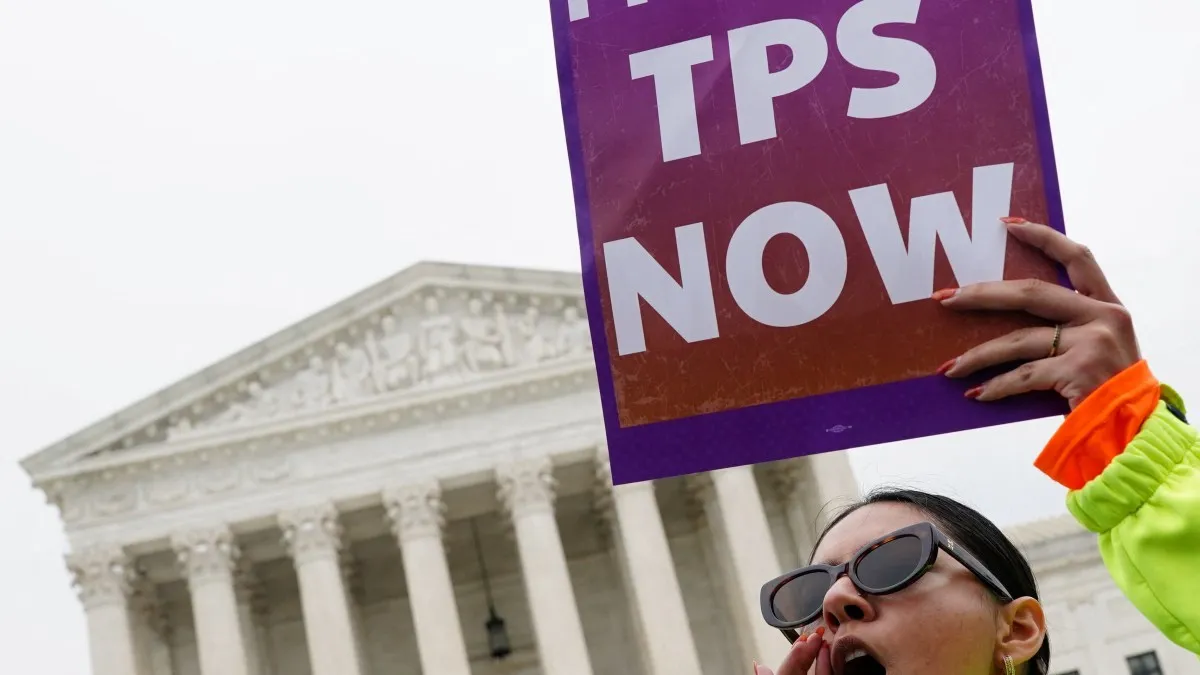
Court to decide whether Trump may terminate temporary protected status in case that could determine whether 1.3 million people may remain in US.A woman takes part in a demonstration by immigrant rights activists outside the US Supreme Court in Washington, DC, on April 29, 2026 [Nathan Howard/Reuters]Published On 29 Apr 2026Washington, DC – The United States Supreme Court has begun to hear a case on whether the administration of President Donald Trump may strip the temporary legal status of hundreds of thousands of Haitians and Syrians living in the country.The hearing on Wednesday at the country’s highest court specifically concerns whether Trump may end “temporary protected status” (TPS) for citizens of the two countries, which is granted when it is deemed unsafe for individuals to return to their home countries.Recommended Stories list of 3 itemslist 1 of 3ICE, Ilhan Omar and Somalis: Unpacking Trump’s obsession with Minnesotalist 2 of 3US ends temporary protected status for Yemeni refugees, asylum seekerslist 3 of 3Yemeni Americans feel ‘betrayed’ as Trump revokes immigration protectionsend of listBut the court’s eventual decision could have wide-ranging implications beyond the 350,000 Haitians and 6,100 Syrians living in the US under TPS. It could throw into jeopardy the future of about 1.3 million people from 17 countries currently living in the US on the status, opening the door to rendering them undocumented during the Trump administration’s mass deportation drive.Last year, then-Homeland Security Secretary Kristi Noem rescinded TPS for Haiti and Syria, saying it had been “abused and exploited” and conditions in the countries had improved since the status was first approved.Noem maintained that recent TPS extensions for Haiti, which was first granted the status in 2010, and Syria, which was granted the status in 2012, were not “justified or necessary”.Critics have pointed to ongoing political, humanitarian and security crises in Haiti and persistent instability in Syria, which has faced Israeli incursions and spurts of violence after emerging from more than a decade of war.Class action lawsuits filed by Haitians and Syrians charge that the department did not follow proper procedures in terminating their status. The administration has maintained that the law that created TPS does not allow for review of its decision by the courts.The Haitian lawsuit goes further, accusing the Trump administration of being motivated, in part, by racism. Trump particularly singled out Haitians living in the US during his 2024 election campaign, deploying several racist tropes, including that Haitians living in Springfield, Ohio, were “eating pets”.In February, US District Judge Ana Reyes ruled that the administration’s actions were likely motivated, in part, by “racial animus” in violation of the US Constitution’s equal rights protections.Reyes said it was likely that Noem made the decision to terminate TPS “because of hostility to nonwhite immigrants”. A Department of Homeland Security (DHS) spokesperson decried the ruling as “lawless activism”.In a rare rebuke to Trump, the US House of Representatives in April passed a bill to extend TPS for Haitians through 2029 with 10 Republicans joining Democrats in support of the legislation. The Senate has not yet voted on the bill.Since Trump began his second term in January 2025, the DHS has also moved to end TPS for Venezuela, Nepal, Nicaragua, Honduras, Afghanistan, Cameroon, South Sudan, Myanmar, Ethiopia, Somalia and Yemen although the efforts have mostly been stayed by lower courts.In October, the Supreme Court issued an unsigned order allowing the Trump administration’s cancellation of TPS for Venezuela to stand while legal challenges make their way through lower courts. The status is due to end on October 2.Before Wednesday’s hearing, Cecilia Gonzalez, a TPS recipient and cofounder of the Venezuelan American Caucus, said the implications of the Supreme Court’s ruling would be vast, deciding “whether immigrant families who have followed the law and built their lives in this country can have their protections stripped away overnight for political purposes”.“As a Venezuelan, I learned early on that when things get difficult, there are two options: fleeing or fighting,” she said in a statement.“I already fled once, so now I choose to fight, not only for Venezuelans, but for every immigrant community that deserves dignity, stability, and permanent solutions.”
SRCAl Jazeera
LANGEN
LEANCenter
WORDS685
WED · 2026-04-29 · 15:18 GMTBRIEF NSR-2026-0429-72409
NSR-2026-0429-72409News Report·EN·Legal & Judicial
US Supreme Court hears Haiti, Syria TPS case with wide-ranging implications
The US Supreme Court is hearing a case that will determine if President Trump's administration can terminate Temporary Protected Status (TPS) for hundreds of thousands of Haitians and Syrians. This status is granted to individuals from countries deemed unsafe for return.
Joseph StepanskyAl JazeeraFiled 2026-04-29 · 15:18 GMTLean · CenterRead · 3 min
Al JazeeraFIG 01
Reading time
3min
Word count
685words
Sources cited
4cited
Entities identified
0entities
Quality score
75%
§ 01
Briefing Summary
AI-generatedNEWSAR · AI
The US Supreme Court is hearing a case that will determine if President Trump's administration can terminate Temporary Protected Status (TPS) for hundreds of thousands of Haitians and Syrians. This status is granted to individuals from countries deemed unsafe for return. The decision could impact approximately 1.3 million people from 17 countries currently holding TPS, potentially rendering them undocumented and subject to deportation. The Trump administration argued that TPS for Haiti and Syria was no longer justified, citing improved conditions, while critics point to ongoing crises in those nations. Lawsuits filed by TPS holders allege improper procedures were followed in terminating their status and, in the case of Haitians, suggest racial motivation.
Confidence 0.90Sources 4Claims 5
§ 02
Article analysis
Model · rule-basedFraming
Legal & Judicial
Social Justice
Tone
Mixed Tone
AI-assessed
CalmNeutralAlarmist
Factuality
0.75 / 1.00
Factual
LowHigh
Sources cited
4
Well sourced
FewMany
§ 03
Key claims
5 extracted01
The Trump administration maintains that the law that created TPS does not allow for judicial review of its termination decisions.
factualTrump administration
Confidence
1.00
02
Homeland Security Secretary Kristi Noem rescinded TPS for Haiti and Syria, claiming the status had been 'abused and exploited' and conditions in those countries had improved.
quoteKristi Noem
Confidence
1.00
03
The US Supreme Court is hearing a case on whether the Trump administration may end Temporary Protected Status (TPS) for citizens of Haiti and Syria.
factual
Confidence
1.00
04
US District Judge Ana Reyes ruled that the administration’s actions were likely motivated, in part, by 'racial animus' in violation of the US Constitution.
factualAna Reyes
Confidence
0.90
05
The court's decision could impact the legal status of approximately 1.3 million people from 17 countries currently living in the US under TPS.
prediction
Confidence
0.80
§ 04
Full report
3 min read · 685 words§ 06
Keywords & salience
8 termstemporary protected status
1.00
us supreme court
0.90
trump administration
0.80
haiti
0.70
syria
0.70
immigration
0.60
deportation
0.50
legal status
0.40
§ 07
Topic connections
Interactive graph Network visualization showing 6 related topics
View Full Graph Person Organization Location Event|Click node to navigate|Edge numbers = shared articles