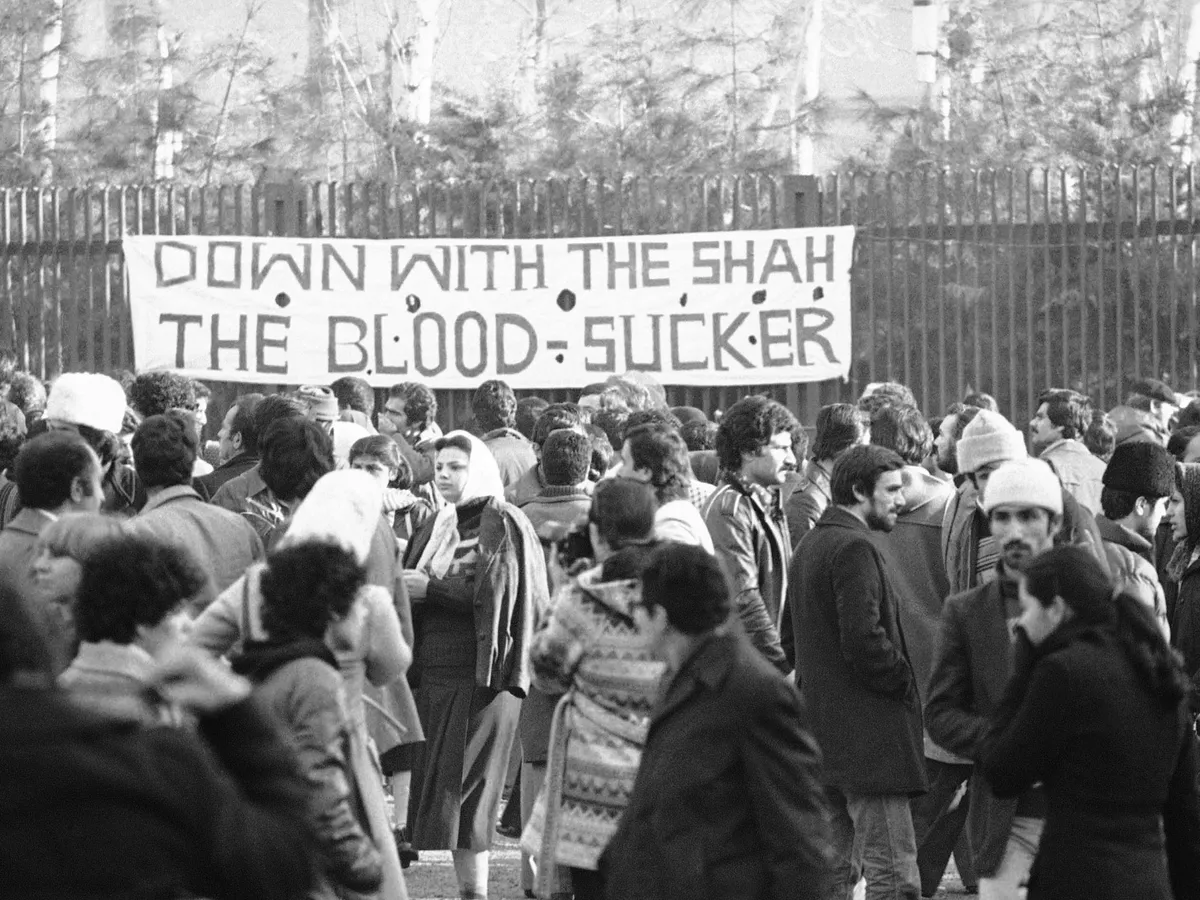
The nature of power in Tehran today is very different from what it was in the 1970s.Saeid Golkar is assistant professor at the Department of Political Science at the University of Tennessee, Chattanooga.Published On 13 Jan 2026A banner denouncing Shah Mohammad Reza Pahlavi is put up at the entrance of Tehran University on January 13, 1979, a month before the monarchy fell [Bernhard Frye/AP]Iran is living through one of the most dangerous moments in its post-revolutionary history. Nationwide protests have become sustained rather than episodic. As a new wave of unrest has spread across the country, violence has intensified. The true death toll cannot be verified yet.These events have revived a familiar question: Is Iran heading towards another 1979?The temptation to rely on this analogy is understandable. Images of mass mobilisation and rapidly recurring protests evoke memories of the final months of the shah’s rule. Yet the comparison is ultimately misleading.The success of the 1979 revolution cannot be explained solely by mass mobilisation. Instead, it was the convergence of coordinated opposition under Ayatollah Ruhollah Khomeini and, more decisively, the ruling elites’ inability to effectively repress dissent that ensured its triumph.Mohammad Reza Shah had cancer, was heavily medicated and was visibly indecisive. His leadership faltered during crises. He left the country twice amid political upheaval, first in 1953 after being challenged by Prime Minister Mohammad Mosaddegh and again in January 1979 as protests spread nationwide.Equally important, the shah’s repressive apparatus was fragmented and socially heterogeneous. Apart from SAVAK, the shah’s central intelligence organisation, the police and gendarmerie were tasked with maintaining social order while the Iranian Army focused on territorial defence rather than political repression.These institutions lacked systematic ideological vetting and drew personnel from diverse social and ideological backgrounds. When the shah left the country, some segments of the police stopped their repressive tactics and cooperated with protesters to maintain public order while senior military commanders hesitated, prioritised self-preservation and ultimately abandoned the monarchy.The situation today is fundamentally different. Unlike the shah, Ayatollah Ali Khamenei’s leadership is not marked by hesitation or indecision during crises.Since assuming the position of supreme leader in 1989, Khamenei has overseen a profound transformation of the Islamic Republic into what I describe as a theocratic security state that relies more on repression rather than societal consent. As the supreme leader, he presides over a highly institutionalised, cohesive, ideologically committed and deeply invested coercive apparatus. This structural reality, rather than popular sentiment alone, defines the limits of revolutionary change in Iran today.The Islamic Republic’s coercive power is not concentrated in a single institution. Instead, it is distributed across overlapping organisations with redundant chains of command. These forces are concentrated within the Islamic Revolutionary Guard Corps, the Basij, the police, the intelligence services and the social networks attached to them.Iran’s coercive institutions are dominated by the regime’s hardcore supporters. Their loyalty is not merely transactional. It is ideological, institutional and generational. Ideological vetting and patronage ensure that their loyalty is not only enforced but actively cultivated.Their social mobility, economic security and sense of identity are tied to the survival of the regime and Khamenei’s leadership. For them, regime collapse is not a political transition; it is an existential threat. In moments of crisis, these loyalists act preemptively to prevent the diffusion of protest and frame unrest as foreign-backed sedition, lowering internal barriers to violence.Consequently, even protests that are larger and more widespread geographically than those in 1979 would not fundamentally challenge the regime. Instead, they would lead to stricter repression. This highlights a key lesson: Protests by themselves do not cause revolutions.Revolutions occur when mass unrest intersects with elite paralysis or defection. That happened in 1979, but it has not happened now.What could alter this equilibrium is not protest alone but a direct shock to the regime’s leadership structure. External intervention, particularly by the United States, would likely aim to disrupt elite coordination by targeting senior political and security figures with strikes.Such an approach would only generate a genuine regime crisis if it removed Khamenei himself. Power in the Islamic Republic has been heavily centralised within the office of the supreme leader and his inner circle. His sudden absence could trigger elite confrontation over succession and weaken cohesion at the top.But intervention could also reinforce loyalist unity. If Khamenei survived, core supporters within the Islamic Revolutionary Guard Corps, the Basij and the intelligence services would almost certainly close ranks, as they have done during previous external confrontations. Under those conditions, elite defection would remain unlikely.Even in the event of regime collapse, Iran would not face the institutional vacuum seen in some post-intervention states. The country’s modern bureaucracy, which has maintained continuity since the early 20th century, would likely continue functioning in the short term. Administrative breakdown would be constrained by state capacity, social organisation and national identity.Some warn that the fall of the Islamic Republic would inevitably lead to a prolonged insurgency. That risk cannot be dismissed. However, unlike the cases of Iraq or Afghanistan, in Iran, there would not be external state actors willing and able to finance, organise and sustain armed radical movements. Iranian society has also shown deep resistance to religious extremism and political radicalism. It is possible that instability following a regime collapse could be contained.The real danger, then, is not that Iran is on the verge of repeating 1979 but that persistent reliance on that analogy blinds policymakers to how the Islamic Republic functions today. Misreading the nature of power in Iran does not increase the chances of peaceful change. It increases the likelihood that Iranians themselves will bear the cost of repression, escalation and prolonged uncertainty.The views expressed in this article are the author’s own and do not necessarily reflect Al Jazeera’s editorial stance.
SRCAl Jazeera
LANGEN
LEANCenter
WORDS952
ENT10
TUE · 2026-01-13 · 14:28 GMTBRIEF NSR-2026-0113-7249
NSR-2026-0113-7249Analysis·EN·Political Strategy
Why Iran is not repeating 1979
Recent protests in Iran have sparked comparisons to the 1979 revolution, but the current situation differs significantly. While mass mobilization is evident, the key difference lies in the nature of the ruling power.
Saeid GolkarAl JazeeraFiled 2026-01-13 · 14:28 GMTLean · CenterRead · 4 min
Al JazeeraFIG 01
Reading time
4min
Word count
952words
Sources cited
1cited
Entities identified
10entities
Quality score
100%
§ 01
Briefing Summary
AI-generatedNEWSAR · AI
Recent protests in Iran have sparked comparisons to the 1979 revolution, but the current situation differs significantly. While mass mobilization is evident, the key difference lies in the nature of the ruling power. Unlike the Shah, who was indecisive and oversaw a fragmented and socially diverse repressive apparatus, Ayatollah Ali Khamenei's leadership is firm and decisive. The Shah's police and military lacked systematic ideological vetting, leading to hesitation and defection during the revolution. Today, Iran's leadership is more unified and determined to suppress dissent, making a repeat of 1979 unlikely despite widespread unrest. The article analyzes the factors that contributed to the success of the 1979 revolution and contrasts them with the current political landscape in Iran.
Confidence 0.90Sources 1Claims 5Entities 10
§ 02
Article analysis
Model · rule-basedFraming
Political Strategy
Conflict
Tone
Measured
AI-assessed
CalmNeutralAlarmist
Factuality
0.60 / 1.00
Mixed
LowHigh
Sources cited
1
Limited
FewMany
§ 03
Key claims
5 extracted01
Mohammad Reza Shah had cancer, was heavily medicated and was visibly indecisive.
factualnull
Confidence
0.90
02
Nationwide protests have become sustained rather than episodic.
factualnull
Confidence
0.90
03
Ayatollah Ali Khamenei’s leadership is not marked by hesitation or indecision during crises.
factualnull
Confidence
0.80
04
The success of the 1979 revolution cannot be explained solely by mass mobilisation.
factualnull
Confidence
0.80
05
Khamenei has overseen a profound transformation of the Islamic Republic into a theocratic security state.
factualSaeid Golkar
Confidence
0.70
§ 04
Full report
4 min read · 952 words§ 05
Entities
10 identifiedKey playerOppositionContextPositiveNeutralNegative
People5
Organizations2
§ 06
Keywords & salience
9 termsiran
1.00
1979 revolution
0.90
protests
0.80
political repression
0.70
ayatollah ali khamenei
0.60
shah mohammad reza pahlavi
0.60
leadership
0.50
ruling elites
0.50
mass mobilization
0.50
§ 07
Topic connections
Interactive graph Network visualization showing 51 related topics
View Full Graph Person Organization Location Event|Click node to navigate|Edge numbers = shared articles