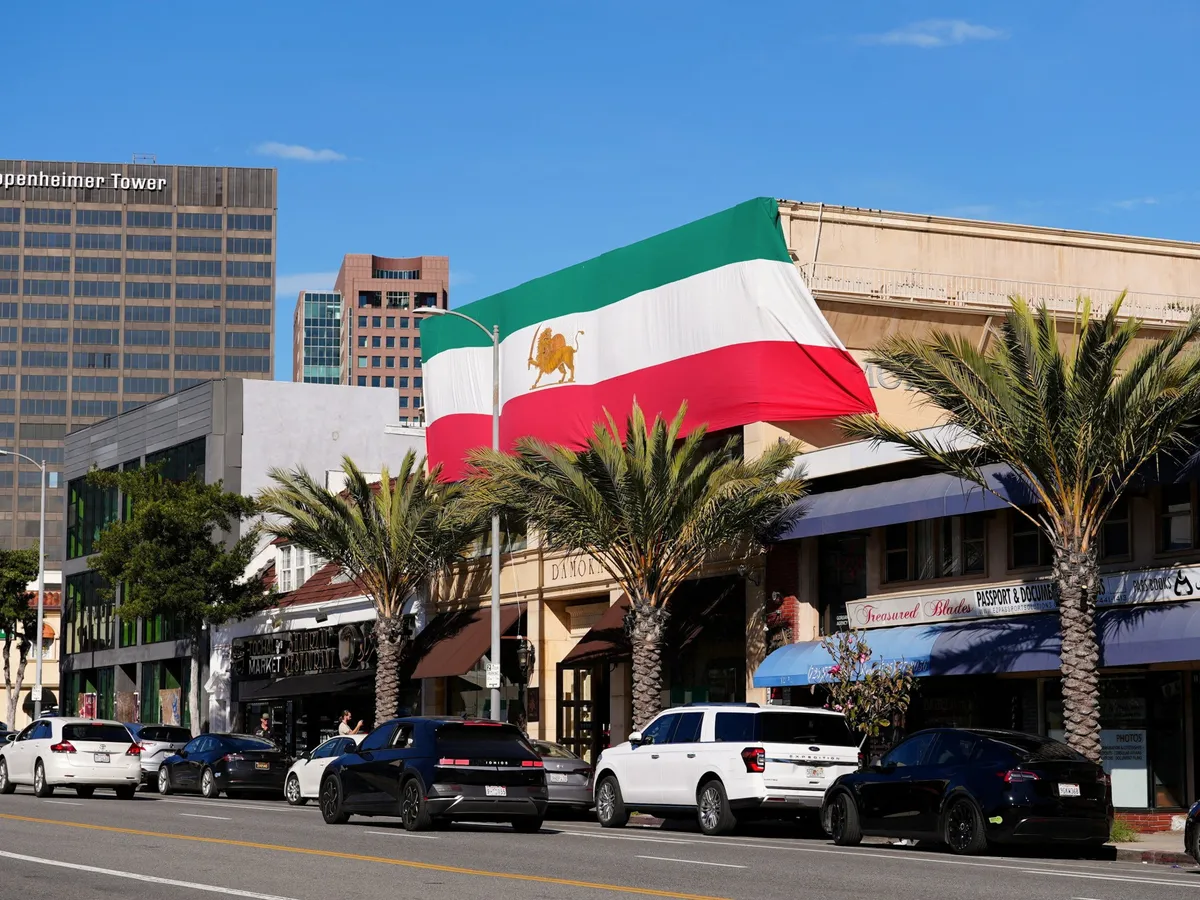
EXPLAINERUS sanctions have damaged Iran's economy, which was the reason the protests broke out in the first place.A large Lion and Sun pre-Iranian revolution national flag is displayed on a building along Westwood Boulevard in Los Angeles, California, US, January 12, 2026 [Arafat Barbakh/Reuters]Published On 13 Jan 2026As demonstrators flood Iranian streets in ongoing protests which started late last month, United States President Donald Trump has threatened military intervention, arguing that he wants to “help” protesters.He wrote in a post on his Truth Social platform on Saturday: “Iran is looking at FREEDOM, perhaps like never before. The USA stands ready to help!!!” He has since echoed those sentiments in other public statements.But ignored in his claims of wanting to help Iranians is a fact: decades of US-led sanctions against Iran, including ones that were toughened under Trump, have played a central role in the country’s economic crises that were the primary trigger for the current spate of protests.We unpack the impact of US sanctions on Iran and whether its track record in the country has been one of helping people.What is going on in Iran?The protests in Iran started from Tehran’s Grand Bazaar on December 28, 2025, after the rial plunged to a record low against the US dollar. Shopkeepers shuttered their businesses to rally against rising prices in Iran.The protests have since spread to other provinces and have snowballed into a broader challenge to the country’s leadership.On Monday, the rial was trading at more than 1.4 million to the US dollar, a sharp decline from about 700,000 in January 2025 and approximately 900,000 in mid-2025.The plummeting currency has triggered steep inflation, with food prices 72 percent higher than last year on average.What are the US sanctions against Iran?Iran is one of the most heavily sanctioned countries in the world.In 1979, Ayatollah Ruhollah Khomeini returned to Iran after 14 years of exile in Iraq and France. Following a referendum, Iran was declared an Islamic republic.The US first imposed sanctions on Iran in November 1979, after Iranian students stormed its embassy in Tehran and took Americans hostage.The 1979 Islamic revolution overthrew the shah, or monarch, Mohammad Reza Pahlavi, whose forces notoriously used repression and torture to keep him in power, without a democratic mandate.The US, which backed Pahlavi, had also helped topple Iran’s democratically elected prime minister, Mohammad Mosaddegh, in 1953 in a coup supported by US and British intelligence agencies.Also in 1979, Washington halted oil imports from Iran and froze $12bn in Iranian assets. Iranian products were banned from import into the US apart from small gifts, informational material, foodstuffs and some carpets.In 1995, then-President Bill Clinton issued executive orders preventing US companies from investing in Iranian oil and gas and trading with Iran. He banned US trade with Iran and investment in the country. A year later, the US Congress passed a law requiring that the US government impose sanctions on foreign firms investing more than $20m a year in Iran’s energy sector.In December 2006, the United Nations Security Council imposed sanctions on Iran’s trade in nuclear-energy-related materials and technology and froze the assets of individuals and companies involved in activities pertaining to it.The sanctions were mainly an effort to curtail Iran’s growing nuclear capacity, but while programmes to enrich uranium were stopped in 2002, they restarted in late 2005. In subsequent years, the UN toughened the sanctions and imposed more sanctions on Iran. The European Union also followed suit.In 2015, Iran signed a nuclear deal – the Joint Comprehensive Plan of Action (JCPOA) – with the US, EU, China, France, Germany, Russia and the United Kingdom.The deal banned uranium enrichment at Iran’s Fordow nuclear facility and allowed only peaceful development of nuclear technology for energy production in return for the complete lifting of sanctions.Iran agreed to refrain from any uranium enrichment and research into it at Fordow for 15 years. It also agreed not to keep any nuclear material there but instead to “convert the Fordow facility into a nuclear, physics and technology centre”.However, in 2018, during his first term, Trump announced the US withdrawal from the nuclear treaty and reimposed all sanctions on Iran that were lifted under the treaty.In 2019, the Trump administration designated Iran’s Islamic Revolutionary Guard Corps (IRGC) a Foreign Terrorist Organization. Additionally, he imposed sanctions targeting petrochemicals, metals (steel, aluminium, copper) and senior Iranian officials. The intensifying sanctions were part of Trump’s maximum pressure campaign against Iran.On January 3, 2020, the US assassinated Qassem Soleimani, the head of the IRGC’s elite Quds Force, in a drone strike in Baghdad, Iraq. The US also imposed additional sanctions on Iran.The Biden administration, in power from 2021 to 2025, kept in place most US sanctions against Iran.In September 2025, the UN sanctions were reimposed on Iran over its nuclear programme when the UNSC voted against permanently lifting economic sanctions on Iran.How have these sanctions impacted Iran?Incomes: Iran’s gross domestic product (GDP) per capita fell from more than $8,000 in 2012 to about $6,000 by 2017, and to a little above $5,000 in 2024, according to World Bank data.The sharpest declines coincided with the reimposition and tightening of US sanctions under Trump’s campaign from 2018 onwards, which squeezed oil exports and access to global finance.Oil exports and revenue: Iran’s oil exports fell by 60-80 percent after US sanctions were reimposed, stripping the government of tens of billions of dollars in annual revenue.Iran was exporting about 2.2 million barrels per day (mbpd) of crude oil in 2011. The exports fell sharply after 2018, to an all-time low of just more than 400,000bpd in 2020.Exports have gradually risen to about 1.5mbpd in 2025, but remain below their pre‑2018 levels.Currency crash: The Iranian rial has collapsed in value. In the mid‑2010s, a dollar bought only a few tens of thousands of rials on the open market. However, by 2025, it bought several hundred thousand. Now, it can buy more than 1 million rials.A devalued currency can help a country in promoting its exports, but sanctions have long blocked a bulk of Iran’s exports. Meanwhile, the currency crisis has made imports costlier, contributed to increased inflation, and reduced investor confidence.The sanctions have also crippled Iran’s access to dollars from financial markets, making it harder for it to participate in international trade.Aviation: One of the most visible victims of the sanctions on Iran has been its aviation sector. After the initial sanctions in 1979, the government was unable to import new planes. Iran suffered from a spike in deadly aircraft accidents through the 1980s, 90s and the early 2000s.Between 1979 and 2023, plane crashes killed more than 2,000 people in the country, according to the Geneva-based Bureau of Aircraft Accident Archives (B3A).Corruption: The sanctions on Iran spurred a “sanctions economy”, or the particular way its elite have profited from them and reshaped the country’s economy around sanctions.Sanctions create opportunities for corruption, forcing trade and finance into grey and black channels. For instance, oil has to be sold through intermediaries, such as front companies or shadow fleets. Imports and exports pass through informal channels. Public information about trade deals is sparse.
SRCAl Jazeera
LANGEN
LEANCenter
WORDS1 178
ENT10
TUE · 2026-01-13 · 12:31 GMTBRIEF NSR-2026-0113-7259
NSR-2026-0113-7259Analysis·EN·Economic Impact
How US sanctions crippled lives of Iranians Trump says he wants to ‘help’
Amidst ongoing protests in Iran triggered by economic hardship, US President Trump has expressed a desire to "help" the Iranian people. However, the article highlights that decades of US-led sanctions, particularly those strengthened under Trump, have significantly damaged Iran's economy, contributing to the very conditions fueling the protests.
Sarah ShamimAl JazeeraFiled 2026-01-13 · 12:31 GMTLean · CenterRead · 5 min
Al JazeeraFIG 01
Reading time
5min
Word count
1 178words
Sources cited
0cited
Entities identified
10entities
Quality score
100%
§ 01
Briefing Summary
AI-generatedNEWSAR · AI
Amidst ongoing protests in Iran triggered by economic hardship, US President Trump has expressed a desire to "help" the Iranian people. However, the article highlights that decades of US-led sanctions, particularly those strengthened under Trump, have significantly damaged Iran's economy, contributing to the very conditions fueling the protests. The protests began in Tehran in late December 2025 due to the plunging value of the Iranian rial and rising prices. The rial has continued to decline, leading to steep inflation, with food prices rising dramatically. The US first imposed sanctions on Iran in 1979 following the Islamic Revolution and the hostage crisis at the US embassy.
Confidence 0.90Claims 5Entities 10
§ 02
Article analysis
Model · rule-basedFraming
Economic Impact
Political Strategy
Tone
Measured
AI-assessed
CalmNeutralAlarmist
Factuality
0.70 / 1.00
Factual
LowHigh
Sources cited
0
No named sources
FewMany
§ 03
Key claims
5 extracted01
The US first imposed sanctions on Iran in November 1979 after the embassy hostage crisis.
factualnull
Confidence
1.00
02
Food prices are 72 percent higher than last year on average in Iran.
statisticnull
Confidence
1.00
03
The rial was trading at more than 1.4 million to the US dollar on Monday.
statisticnull
Confidence
1.00
04
In 1953, the US helped topple Iran’s democratically elected prime minister.
factualnull
Confidence
0.90
05
US sanctions have damaged Iran's economy, which was the reason the protests broke out.
factualnull
Confidence
0.80
§ 04
Full report
5 min read · 1 178 words§ 05
Entities
10 identifiedKey playerOppositionContextPositiveNeutralNegative
People4
Organizations1
§ 06
Keywords & salience
8 termsus sanctions
1.00
iran
0.90
protests
0.80
economic crisis
0.80
iranian rial
0.60
inflation
0.60
donald trump
0.50
islamic revolution
0.40
§ 07
Topic connections
Interactive graph Network visualization showing 51 related topics
View Full Graph Person Organization Location Event|Click node to navigate|Edge numbers = shared articles