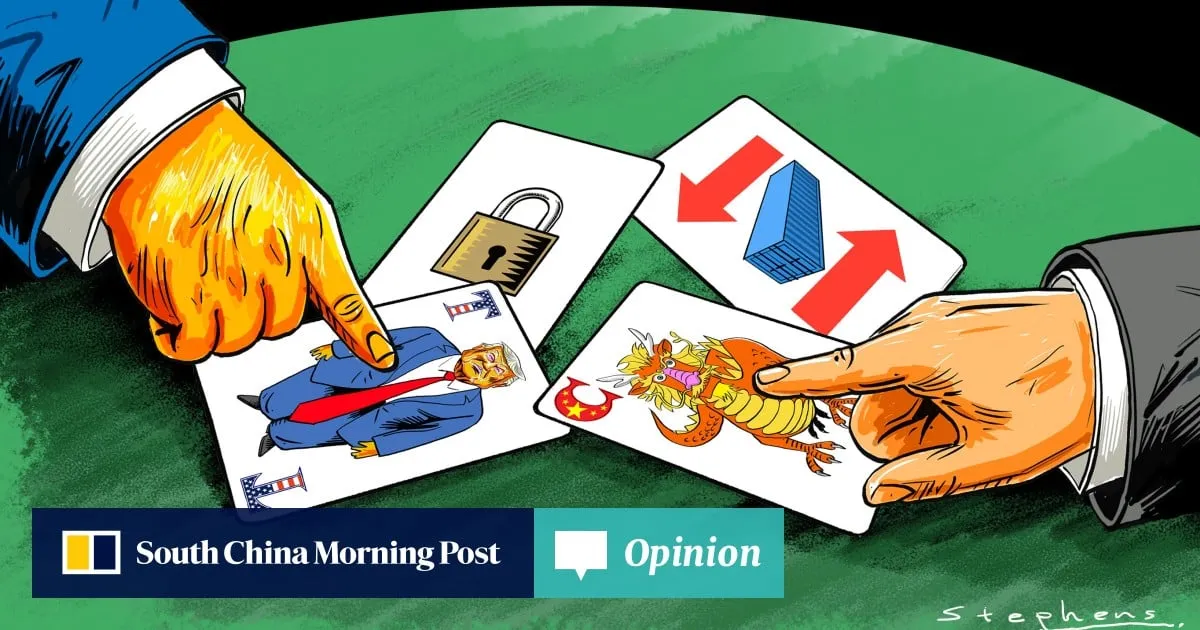
Beijing’s decision last Monday to block Meta’s US$2 billion acquisition of the Chinese-founded AI start-up Manus came as little surprise. The central government had already flagged its investigation and barred the company’s two founders from leaving the country.At first glance, the intervention appears disruptive to Chinese firms seeking foreign capital and US companies eyeing investments in China. However, a deeper look reveals this as emblematic of a new normal in China-US business ties, especially in the high-stakes hi-tech sector, where the two powers are locked in intensifying strategic competition. National security and technological self-reliance now routinely supersede commercial deals.To appreciate the dynamics, reverse the roles. Imagine a high-flying US AI start-up being acquired by a Chinese tech giant such as Tencent. Washington would almost certainly invoke national security reviews and probably block the deal. Beijing’s actions on Manus mirror this logic. In an era of decoupling pressures and export controls, both sides prioritise retaining critical capabilities over open-market principles.This episode also serves as an intriguing footnote to the coming summit between President Xi Jinping and US President Donald Trump, scheduled for May 14-15 in Beijing, the first US presidential visit to China in nearly a decade. Originally planned for late March, the trip was postponed amid the US-Israeli war against Iran.Concerns linger about further delays if nuclear talks falter and US military actions resume, but the summit is likely to proceed. Another postponement would complicate scheduling, and both leaders have strong incentives to stabilise ties amid global volatility.Beijing perceives that it has a stronger negotiating position. The US remains preoccupied with the Middle East, while Trump faces looming midterm elections and seeks tangible “wins”. These could include major Chinese purchases of US agricultural products and Boeing aircraft.Freshly harvested soybeans are loaded into a truck to be taken to a grain elevator at the Fultz family farm in Tracy, Minnesota, on October 7, 2025. Photo: TNSWithin this context, Beijing’s stance on Manus signals resolve ahead of the talks. Last month, China introduced new regulations to investigate and penalise foreign companies that cease using Chinese suppliers, aiming to deter decoupling. Meanwhile, the US has ramped up pressure in the lead-up to the meeting, halting certain chip equipment shipments to Hua Hong Semiconductor and warning financial institutions over dealings with Chinese refineries processing Iranian oil.In the short term, China has the advantage. Its confidence draws from its handling of Trump’s second term since early 2025. After Trump launched a global tariff war in April last year, China became the only major country to stand up to the US, eventually forcing him to blink first.From a Chinese perspective, the October summit between Xi and Trump in Busan, South Korea, marked the first time China was recognised as a genuine peer to the US in the international system. Trump then revived the term “G2” to describe the meeting with Xi. The coming Beijing summit will reinforce this narrative for both domestic and international audiences.It could also mark the beginning of a new period of prolonged stability in bilateral ties, at least for this year. This would help relieve external pressure on China as the country embarks on its new five-year plan. Chinese leaders will soon begin preliminary deliberations on a new leadership line-up ahead of the Communist Party’s 21st Congress late next year.‘We have a deal’: Trump claims breakthrough after ‘12 out of 10’ talks with Xi Jinping‘We have a deal’: Trump claims breakthrough after ‘12 out of 10’ talks with Xi JinpingXi is expected to make a reciprocal visit to the US later this year, possibly in September, to be followed by further meetings on the fringes of the Asia-Pacific Economic Cooperation forum summit in Shenzhen in November and the Group of 20 summit in Miami in December. In that sense, both sides have a strong incentive to ensure the coming summit gets off to a good start.Further ReadingOn Thursday night, Vice-Premier He Lifeng, China’s top official in charge of China-US economic and trade talks, held an “in-depth” and “constructive” video call with US Treasury Secretary Scott Bessent and US Trade Representative Jamieson Greer. According to Xinhua, the two sides exchanged views on “properly addressing respective concerns in the economic and trade sector and advancing pragmatic cooperation”. This call clearly forms part of efforts to flesh out trade and investment deals for announcement at the summit.SCMP Plus is a new premium news platform that gives you an all-inclusive edge to stay ahead on China news. To access our exclusive content you’ll need to subscribe.Already a subscriber?LOG INGreer has previously mentioned discussions on creating a “US-China Board of Trade”, apparently aimed at addressing the trade imbalance, something the Trump administration is keen to resolve through increased imports of American goods. Whether the summit will also lead to the formation of a “US-China Board of Investment”, which would facilitate Chinese investment in non-sensitive sectors in the US, remains to be seen. In return, China is likely to press Washington to relax restrictions on technological exports.Around the same time, Foreign Minister Wang Yi held a phone call with his US counterpart Marco Rubio. Wang called for both sides to make proper arrangements for the coming summit and highlighted the Taiwan question, which “concerns China’s core national interests and constitutes the biggest risk factor in China-US relations”.There have been suggestions that Xi could push Trump to adjust Washington’s long-standing language on Taiwan, shifting from not supporting Taiwan’s independence to actively opposing it. For outsiders, the difference might seem abstract, but for Beijing it would represent a major rhetorical victory and intensified pressure on the island. Whether China can offer sufficient incentives to appeal to Trump’s transactional approach remains to be seen.It would be too optimistic to expect any breakthrough from the summit later this month. The bargaining is likely to continue throughout the year. Nevertheless, any deal that helps stabilise trade and investment flows between the world’s two largest economies should be seen as a win for both sides and for global economic stability.
SRCSouth China Morning Post
LANGEN
LEANCenter-Right
WORDS996
ENT11
SUN · 2026-05-03 · 21:30 GMTBRIEF NSR-2026-0503-73487
NSR-2026-0503-73487Analysis·EN·Political Strategy
China’s Manus block a show of strength ahead of Xi-Trump summit
China's blocking of Meta's $2 billion acquisition of AI startup Manus, a move that surprised few, demonstrates a shift in business relations between China and the US. This decision, occurring ahead of President Xi Jinping's summit with President Donald Trump, highlights the increasing prioritization of national security and technological self-reliance over commercial deals in the high-tech sector.
Wang XiangweiSouth China Morning PostFiled 2026-05-03 · 21:30 GMTLean · Center-RightRead · 4 min
South China Morning PostFIG 01
Reading time
4min
Word count
996words
Sources cited
0cited
Entities identified
11entities
Quality score
100%
§ 01
Briefing Summary
AI-generatedNEWSAR · AI
China's blocking of Meta's $2 billion acquisition of AI startup Manus, a move that surprised few, demonstrates a shift in business relations between China and the US. This decision, occurring ahead of President Xi Jinping's summit with President Donald Trump, highlights the increasing prioritization of national security and technological self-reliance over commercial deals in the high-tech sector. The action mirrors potential US responses to similar acquisitions, reflecting a global trend of decoupling pressures and export controls. Beijing's stance on Manus signals its resolve in negotiations, as China seeks to retain critical capabilities and the US faces domestic political pressures and seeks tangible economic agreements. The summit, scheduled for May 14-15 in Beijing, is expected to proceed despite potential global volatility.
Confidence 0.90Claims 5Entities 11
§ 02
Article analysis
Model · rule-basedFraming
Political Strategy
Technology
Tone
Mixed Tone
AI-assessed
CalmNeutralAlarmist
Factuality
0.60 / 1.00
Mixed
LowHigh
Sources cited
0
No named sources
FewMany
§ 03
Key claims
5 extracted01
China blocked Meta's US$2 billion acquisition of AI start-up Manus.
factual
Confidence
1.00
02
National security and technological self-reliance now routinely supersede commercial deals in China-US business ties.
factual
Confidence
0.90
03
Both China and the US prioritize retaining critical capabilities over open-market principles in an era of decoupling pressures.
factual
Confidence
0.85
04
Beijing's decision on Manus signals resolve ahead of the Xi-Trump talks.
factual
Confidence
0.80
05
China perceives it has a stronger negotiating position ahead of the summit.
factual
Confidence
0.70
§ 04
Full report
4 min read · 996 words§ 05
Entities
11 identifiedKey playerOppositionContextPositiveNeutralNegative
§ 06
Keywords & salience
10 termschina-us relations
1.00
strategic competition
0.90
national security
0.90
technological self-reliance
0.80
ai start-up
0.70
decoupling
0.70
xi-trump summit
0.60
export controls
0.50
foreign investment
0.40
commercial deals
0.40
§ 07
Topic connections
Interactive graph Network visualization showing 51 related topics
View Full Graph Person Organization Location Event|Click node to navigate|Edge numbers = shared articles