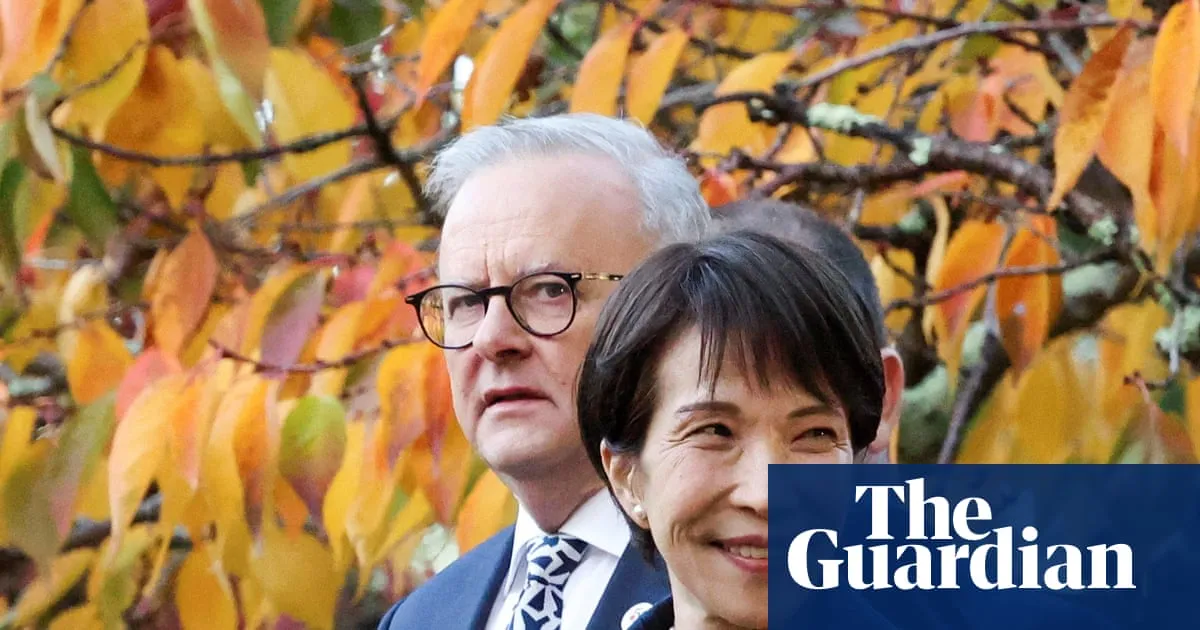
Anthony Albanese with Japanese prime minister, Sanae Takaichi, on Monday. Australia supplies Japan with roughly 40% of its LNG, making the east Asian nation hostile to any market intervention that it considers a threat to the stability of those supplies. Photograph: Hollie Adams/Reuters View image in fullscreen Anthony Albanese with Japanese prime minister, Sanae Takaichi, on Monday. Australia supplies Japan with roughly 40% of its LNG, making the east Asian nation hostile to any market intervention that it considers a threat to the stability of those supplies. Photograph: Hollie Adams/Reuters Analysis Albanese won’t bring in a gas export tax next week – but he’ll struggle to hold off pressure forever Dan Jervis-Bardy The PM is clearly not prepared to risk backlash from Asian energy trading partners during a fuel crisis – but his government will face domestic challenges if it doesn’t move eventually Get our breaking news email, free app or daily news podcast Two separate events on Monday – one in rain-soaked Canberra, the other in sunny Gladstone – neatly explain why the federal government won’t pursue a new gas export tax in next week’s budget and why it might have no choice but to do so in the future. In the nation’s capital, Anthony Albanese hosted his Japanese counterpart, Sanae Takaichi, for annual leaders’ talks that coincided with the 50th anniversary of the signing of a landmark treaty between the two nations. The prime ministers made high-level commitments on economic security, energy trade, defence and cyber, elevating a friendship that Albanese said had “never been closer”. Had local journalists had the chance to put questions to Takaichi – which they didn’t – she would have almost certainly been asked about the prospect of a new tax on Australian liquified natural gas (LNG) exports. Takaichi might not have responded, at least not explicitly. But the Australian government – from Albanese down – would be in no doubt such a measure would face political and corporate resistance in Tokyo. Australia supplies Japan with roughly 40% of its LNG, making the east Asian nation hostile to any market intervention that it considers a threat to the stability of those supplies. Gas exporters, including Inpex, whose parent company is partly owned by the Japanese government, have framed the prospect of a 25% export levy as one such risk that could undermine Australia’s standing as a reliable seller. Whether that claim has any weight whatsoever is questionable to say the least. But it has proven influential for Albanese, who is clearly not prepared to risk a potential backlash from Tokyo and other Asian energy trading partners at the same time Australia is leaning on them for shipments of petrol and diesel during the international oil crisis. 2:43 'Just do it and stop the crap': Ken Henry's blunt response to question of gas tax – video “These agreements are to the benefit of both of our people. For Australians, it will mean we are less vulnerable to global shocks like we are seeing right now because of conflict in the Middle East,” Albanese said of the agreements struck on Monday. Circumstances have helped the gas companies win the argument this time. But the Albanese government will face risks of its own if it doesn’t move eventually. Labour Day marches are typically the domain of Labor MPs and their trade union allies, a chance to celebrate their success in progressing the rights of working people. At Monday’s event in the Queensland resources town of Gladstone, a different kind of politician was front and centre: David Pocock. The independent senator for the ACT, one of the faces of the campaign for a 25% export tax, was invited to speak at the rally by the Labor-aligned Australian Manufacturing Workers’ Union (AMWU). “I really believe that we’re at a crossroads as a country,” Pocock told the event, which was also attended by the Gladstone-based Greens senator Penny Allman-Payne. “We’re seeing record profits at the same time that so many Australians are starting to question and say, ‘hang on, I’m in a household where we’ve got two incomes and we’re still struggling to pay the rent. We’re still struggling to pay the mortgage and get ahead. Why is it not working for us?’” Albanese might be able to dismiss Pocock and others campaigning for a gas tax as “populists”. But can he reasonably attach the same label to the AMWU, or their peak body, the Australian Council of Trade Unions (ACTU)? Albanese might have ruled out a gas export tax for now but the internal pressure will continue, particularly in the lead-up to Labor’s national conference in Adelaide in July. “The union movement’s long-standing position is that multinationals should pay their fair share of tax, and that includes the biggest gas companies,” the ACTU president, Michele O’Neil, told Guardian Australia. “Our current tax system disproportionately benefits professional landlords and multinational companies at the expense of working people, and that needs to change.” Explore more on these topics Australian politics Gas (Business) Fossil fuels Australian budget 2026 Japan David Pocock Gas (Environment) analysis Share Reuse this content
SRCThe Guardian - World News
LANGEN
LEANCenter-Left
WORDS847
ENT8
MON · 2026-05-04 · 15:00 GMTBRIEF NSR-2026-0504-73644
NSR-2026-0504-73644Analysis·EN·Political Strategy
Albanese won’t bring in a gas export tax next week – but he’ll struggle to hold off pressure forever
Australian Prime Minister Anthony Albanese will not introduce a gas export tax in the upcoming budget, primarily due to concerns about alienating key energy trading partners like Japan. Japan, which relies on Australia for approximately 40% of its LNG supply, views market interventions as a threat to the stability of these crucial energy imports.
Dan Jervis-BardyThe Guardian - World NewsFiled 2026-05-04 · 15:00 GMTLean · Center-LeftRead · 4 min
The Guardian - World NewsFIG 01
Reading time
4min
Word count
847words
Sources cited
2cited
Entities identified
8entities
Quality score
100%
§ 01
Briefing Summary
AI-generatedNEWSAR · AI
Australian Prime Minister Anthony Albanese will not introduce a gas export tax in the upcoming budget, primarily due to concerns about alienating key energy trading partners like Japan. Japan, which relies on Australia for approximately 40% of its LNG supply, views market interventions as a threat to the stability of these crucial energy imports. Australian gas exporters, some with Japanese government ties, have also warned that such a tax could jeopardize Australia's reputation as a reliable supplier. While Albanese is deferring the tax for now to avoid immediate backlash, the article suggests domestic pressures may eventually force his government to reconsider this stance.
Confidence 0.90Sources 2Claims 5Entities 8
§ 02
Article analysis
Model · rule-basedFraming
Political Strategy
Diplomatic
Tone
Measured
AI-assessed
CalmNeutralAlarmist
Factuality
0.40 / 1.00
Mixed
LowHigh
Sources cited
2
Limited
FewMany
§ 03
Key claims
5 extracted01
Australia supplies Japan with roughly 40% of its LNG.
factual
Confidence
1.00
02
Albanese is not prepared to risk a potential backlash from Tokyo and other Asian energy trading partners.
factual
Confidence
0.90
03
Gas exporters have framed the prospect of a 25% export levy as a risk that could undermine Australia’s standing as a reliable seller.
factualGas exporters
Confidence
0.90
04
The federal government won’t pursue a new gas export tax in next week’s budget.
factual
Confidence
0.90
05
Japan is hostile to any market intervention that it considers a threat to the stability of its LNG supplies.
factual
Confidence
0.80
§ 04
Full report
4 min read · 847 words§ 05
Entities
8 identifiedKey playerOppositionContextPositiveNeutralNegative
Organizations1
§ 06
Keywords & salience
8 termsgas export tax
1.00
lng exports
0.90
energy trade
0.80
anthony albanese
0.70
japan
0.70
economic security
0.60
market intervention
0.50
fuel crisis
0.40
§ 07
Topic connections
Interactive graph Network visualization showing 51 related topics
View Full Graph Person Organization Location Event|Click node to navigate|Edge numbers = shared articles