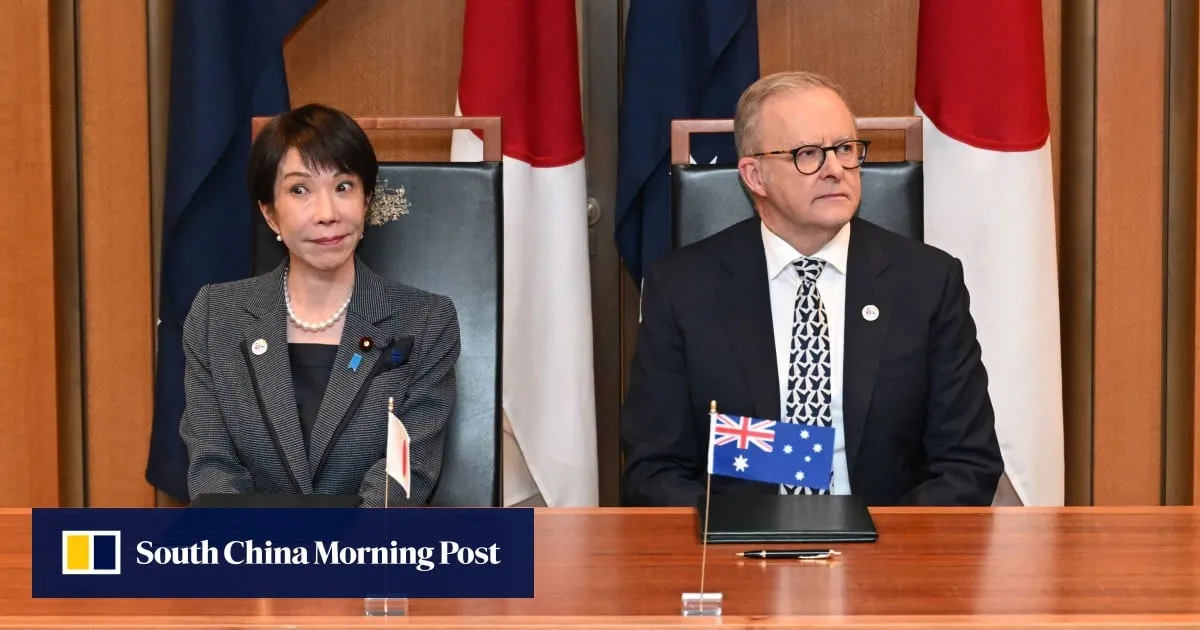
Japan’s prime minister touched down in Australia on Sunday with a set of shared anxieties – about Trump, China and the fragility of supply chains that the two insular nations have long relied upon – to which she sought some small relief.By the time she departed, Sanae Takaichi and Australian Prime Minister Anthony Albanese had signed an economic security pact, unlocked nearly US$1 billion in critical minerals funding and laid the groundwork for what observers describe as the most comprehensive defence arrangement the two have ever forged.The centrepiece of her three-day visit was the Australia-Japan-joint-declaration-on-economic-security-cooperation" class="entity-link entity-event" data-entity-id="122851" data-entity-type="event">Australia-Japan Joint Declaration on Economic Security Cooperation, which commits both governments to coordinating responses to economic coercion: a provision analysts say is aimed squarely at Beijing and Washington alike.Japan’s Prime Minister Sanae Takaichi and Australia’s Prime Minister Anthony Albanese exchange documents during a signing ceremony for their Joint Declaration on Economic Security Cooperation on Monday. Photo: AFPUnder the agreement, Canberra has committed up to A$1.3 billion (US$935.8 million) in support for critical minerals projects with Japanese involvement, potentially supplying resources including nickel, graphite and rare earths to Tokyo.
SRCSouth China Morning Post
LANGEN
LEANCenter-Right
WORDS182
ENT10
WED · 2026-05-06 · 04:25 GMTBRIEF NSR-2026-0506-74045
NSR-2026-0506-74045News Report·EN·National Security
Anxious Australia and jittery Japan deepen ‘quasi-alliance’ for an uneasy age
Japan's Prime Minister Sanae Takaichi visited Australia, resulting in a strengthened "quasi-alliance" between the two nations. During her three-day trip, Takaichi and Australian Prime Minister Anthony Albanese signed an economic security pact and secured nearly US$1 billion in funding for critical minerals.
Maria SiowSouth China Morning PostFiled 2026-05-06 · 04:25 GMTLean · Center-RightRead · 1 min
South China Morning PostFIG 01
Reading time
1min
Word count
182words
Sources cited
1cited
Entities identified
10entities
Quality score
100%
§ 01
Briefing Summary
AI-generatedNEWSAR · AI
Japan's Prime Minister Sanae Takaichi visited Australia, resulting in a strengthened "quasi-alliance" between the two nations. During her three-day trip, Takaichi and Australian Prime Minister Anthony Albanese signed an economic security pact and secured nearly US$1 billion in funding for critical minerals. The core of their agreement is the Australia-Japan Joint Declaration on Economic Security Cooperation, designed to coordinate responses to economic coercion, with analysts suggesting it targets both Beijing and Washington. Australia committed up to A$1.3 billion to support critical minerals projects involving Japan, aiming to secure vital resources like nickel, graphite, and rare earths. This deepened cooperation reflects shared anxieties regarding global uncertainties and supply chain vulnerabilities.
Confidence 0.90Sources 1Claims 5Entities 10
§ 02
Article analysis
Model · rule-basedFraming
National Security
Diplomatic
Tone
Measured
AI-assessed
CalmNeutralAlarmist
Factuality
0.80 / 1.00
Factual
LowHigh
Sources cited
1
Limited
FewMany
§ 03
Key claims
5 extracted01
Canberra committed up to A$1.3 billion (US$935.8 million) in support for critical minerals projects with Japanese involvement.
factual
Confidence
1.00
02
The Australia-Japan Joint Declaration on Economic Security Cooperation commits both governments to coordinating responses to economic coercion.
factual
Confidence
1.00
03
Japan and Australia signed an economic security pact and unlocked nearly US$1 billion in critical minerals funding.
factual
Confidence
1.00
04
The two nations share anxieties about Trump, China and the fragility of supply chains.
factual
Confidence
0.90
05
Analysts say the economic coercion provision is aimed squarely at Beijing and Washington alike.
quoteanalysts
Confidence
0.80
§ 04
Full report
1 min read · 182 words§ 05
Entities
10 identifiedKey playerOppositionContextPositiveNeutralNegative
People3
Locations6
§ 06
Keywords & salience
9 termseconomic security pact
1.00
critical minerals
0.90
quasi-alliance
0.80
economic coercion
0.80
supply chains
0.70
defence arrangement
0.60
australia-japan
0.50
china
0.40
trump
0.40
§ 07
Topic connections
Interactive graph Network visualization showing 51 related topics
View Full Graph Person Organization Location Event|Click node to navigate|Edge numbers = shared articles