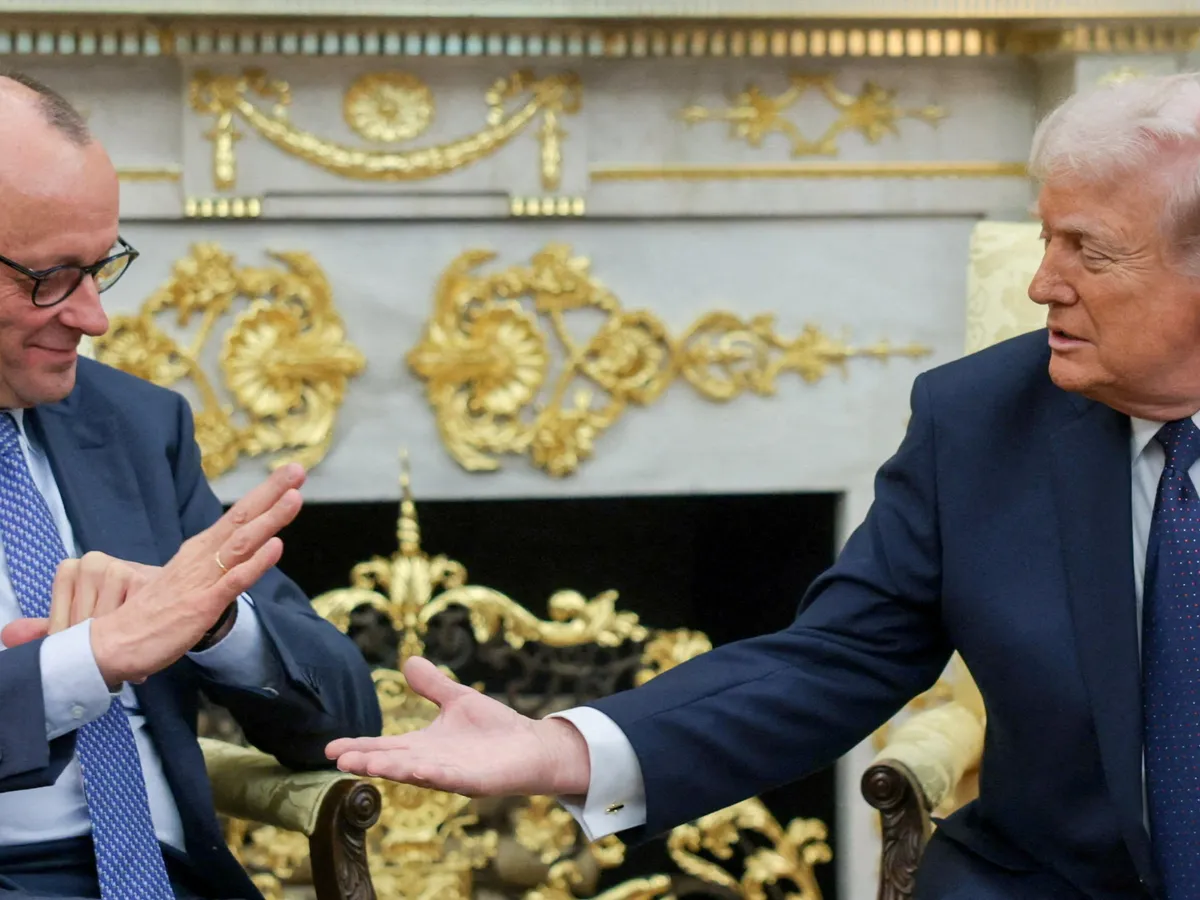
German official says US-Europe relationship is being tested as opposition MP says Berlin is ‘not neutral’US President Donald Trump and German Chancellor Friedrich Merz reach to shake hands as they meet in the Oval Office at the White House in Washington, DC on March 3, 2026 [File: Jonathan Ernst/Reuters]Published On 6 May 2026Berlin, Germany – A diplomatic rift between US President Donald Trump and German Chancellor Friedrich Merz over the war on Iran has escalated into a broader debate about Europe’s transatlantic ties – while Berlin pushes to become the continent’s leading military power.Merz sparked controversy last week when he said Washington had been “humiliated” by its failure to reach a deal with Tehran and accused Trump of having “no strategy.”Recommended Stories list of 4 itemslist 1 of 4NATO assessing details of US troop withdrawal from Germanylist 2 of 4US to cut troops in Germany as Iran war spat deepenslist 3 of 4Germany’s Merz downplays rift with Washington despite US troop drawdownlist 4 of 4NATO chief says Europeans have ‘gotten the message’ from Trump on defenceend of listThe remarks triggered a heated discussion that has intensified since Trump announced the redeployment of 5,000 US troops from German soil.According to media reports, the withdrawal will include a Stryker Brigade currently stationed in Vilseck, Bavaria – a redeployment that had first been mentioned by Trump in 2020.The announcement comes as Germany dispatched a minesweeper and a replenishment vessel to the Mediterranean on Monday, bound for the Strait of Hormuz. While Berlin has said the vessels would only take part in operations to clear the narrow shipping lane after hostilities ended, the United States has relied heavily on bases and military infrastructure across Germany throughout its campaign in Iran.Merz – a former senior adviser at BlackRock who has long been seen as closely aligned with US interests – said the troop withdrawal came as no surprise. The defence ministry described the move as “foreseeable”.Republican politicians Roger Wicker and Mike Rogers, chairs of the Senate and House Armed Services Committees, expressed “grave concern” over the withdrawal.The move would return troop numbers roughly to levels last seen before Russia’s full-scale invasion of Ukraine in 2022, meaning the operational impact may be limited. More consequential, analysts say, could be a separate decision to cancel plans to station long-range weapons systems in Germany.On Monday, the German defence ministry said there had been no “definitive cancellation” by the US of a plan to deploy a battalion with long-range Tomahawk cruise missiles and SM-6 missiles to Germany.A spokesperson of the Chancellor’s Office said on the matter, “It is important to implement the development of our own systems in Europe and Germany.”The US had planned episodic deployments of long-range fires capabilities in Germany from 2026. Due to their long range, these missiles can strike targets deep inside Russia.Germany is vital to US operations in Middle EastWith some 36,000 troops currently stationed on its soil, Germany is home to one of the largest US deployments abroad.During the Cold War, Germany served as NATO’s front line against Soviet expansion. Until today, its bases are considered essential to US operations across the Middle East, clustered in the country’s south and southwest.The most prominent is Ramstein – the US’s largest installation in Europe, which serves as a military hub for drone operations, from where transmission of data and video signals via satellite and fibre optics enables pilots in the US to carry out strikes. It also functions as a global transit hub for troops and military equipment, situated close to the Landstuhl Regional Medical Center, where wounded US personnel were treated during the Iran war.Stuttgart hosts the US European Command and US Africa Command headquarters, as well as those of US Marine Forces Europe and Africa.According to media reports, facilities close to Stuttgart have also been used to transmit coded communications to Iran, believed to be intended for intelligence operatives on the ground. Additionally, about 20 US nuclear weapons are stationed in Germany – a presence some critics want removed, while others consider it a cornerstone of NATO deterrence.Lea Reisner, a Left Party politician and member of the parliamentary foreign affairs committee, has been among the most vocal critics of Germany’s role in the conflict.“The German government claims that Germany is not a party to this war and at the same time, dispatched a minesweeper toward the Strait of Hormuz,” she told Al Jazeera. “A state that provides military infrastructure and logistical support cannot credibly describe itself as neutral. That is not neutrality. It is dishonesty.”Jurgen Hardt, a lawmaker with Merz’s CDU party and the foreign policy spokesperson of the CDU/CSU parliamentarian group, told Al Jazeera that a “combat mission” in the Strait of Hormuz is “out of the question for Germany”.“Any military engagement by the [army] in the Strait of Hormuz would require an international mandate and an agreement among the parties to the conflict. Under these conditions, it might be possible for Germany to contribute to the protection of free shipping in this strait, which is vital for global trade. At present, however, it is too early to speculate about deployment scenarios. The necessary conditions are not yet in place,” he said.He added that the transatlantic partnership is currently undergoing “a stress test” but said US President Trump has ultimately “always stood by NATO”.While other European countries have moved to restrict their involvement in the US attacks – Spain limited the use of its airbases, and Switzerland closed its airspace – Germany has taken no such step.Reisner said Germany faced a clear choice. “It can condemn the war as a clear violation of international law, restrict the use of its territory for offensive operations, and join Europe in demanding an immediate ceasefire,” she said. “Or it can continue pretending this is none of its business while German infrastructure plays a role in killing people.”Real rupture or rhetorical manoeuvre?According to Dominik Tolksdorf, associate fellow for US and Transatlantic Relations at the German Council on Foreign Relations (DGAP), the decision is “not so surprising” given Washington’s realignment of its security and defence policy, announced in its National Defense Strategy of January 2026, “which also has implications for NATO”.“More serious is the failure to station the Tomahawks in Germany, since Europe does not yet produce cruise missiles with comparable range,” he added.The announcements come at a time when European nations are accelerating rearmament and pushing for greater military independence.Berlin has announced its intention to field the strongest conventional army on the continent by 2039.Defence spending has risen from 47 billion euros ($55bn) – approximately 1.3 percent of GDP – in 2021 to 108 billion euros ($127bn) today, an increase of about 130 percent. Trump’s threats to withdraw from NATO and his erratic handling of the Ukraine war have accelerated the development.A pattern of tensionVerbal clashes between Europe and the Trump administration are not new.In February 2025, Vice President JD Vance sparked a furore at the Munich Security Conference when he slammed Europe over issues relating to free speech and migration.In Europe’s largest economy, Chancellor Merz is facing mounting pressure.High energy costs in the aftermath of the closure of the Strait of Hormuz are weighing heavily on voters, and his approval ratings have fallen sharply.German industry has already been in a prolonged downturn since Russia’s invasion of Ukraine severed access to cheap gas, accelerated by the sabotage of the Nord Stream pipelines in 2022. And Germany’s car sector – one of the most important sectors of its economy – has fallen behind in the global transition to electric vehicles.
SRCAl Jazeera
LANGEN
LEANCenter
WORDS1 253
ENT12
WED · 2026-05-06 · 08:35 GMTBRIEF NSR-2026-0506-74108
NSR-2026-0506-74108News Report·EN·Diplomatic
‘A stress test’: US-Germany rift widens as Iran war drags on
A diplomatic rift between the US and Germany has widened over the ongoing war in Iran, testing transatlantic ties. German Chancellor Friedrich Merz criticized President Trump's strategy in Iran and stated Washington had been "humiliated." This followed Trump's announcement to redeploy 5,000 US troops from Germany, a move described as "foreseeable" by Berlin.
Karim NatourAl JazeeraFiled 2026-05-06 · 08:35 GMTLean · CenterRead · 6 min
Al JazeeraFIG 01
Reading time
6min
Word count
1 253words
Sources cited
5cited
Entities identified
12entities
Quality score
100%
§ 01
Briefing Summary
AI-generatedNEWSAR · AI
A diplomatic rift between the US and Germany has widened over the ongoing war in Iran, testing transatlantic ties. German Chancellor Friedrich Merz criticized President Trump's strategy in Iran and stated Washington had been "humiliated." This followed Trump's announcement to redeploy 5,000 US troops from Germany, a move described as "foreseeable" by Berlin. While Germany dispatched naval vessels to the Mediterranean, the US has relied on German bases for its Iran campaign. Analysts suggest the troop withdrawal, returning numbers to pre-2022 levels, may have limited operational impact, but a potential cancellation of long-range weapons systems in Germany could be more significant.
Confidence 0.90Sources 5Claims 5Entities 12
§ 02
Article analysis
Model · rule-basedFraming
Diplomatic
Conflict
Tone
Mixed Tone
AI-assessed
CalmNeutralAlarmist
Factuality
0.70 / 1.00
Factual
LowHigh
Sources cited
5
Well sourced
FewMany
§ 03
Key claims
5 extracted01
Republican politicians Roger Wicker and Mike Rogers expressed 'grave concern' over the US troop withdrawal from Germany.
quoteRoger Wicker and Mike Rogers
Confidence
1.00
02
Germany dispatched a minesweeper and a replenishment vessel to the Mediterranean, bound for the Strait of Hormuz.
factualnull
Confidence
1.00
03
US President Donald Trump announced the redeployment of 5,000 US troops from German soil.
factualDonald Trump
Confidence
1.00
04
German Chancellor Friedrich Merz stated that Washington had been 'humiliated' by its failure to reach a deal with Tehran and accused Trump of having 'no strategy.'
quoteFriedrich Merz
Confidence
1.00
05
The US had planned episodic deployments of long-range fires capabilities in Germany from 2026.
factualnull
Confidence
0.90
§ 04
Full report
6 min read · 1 253 words§ 05
Entities
12 identifiedKey playerOppositionContextPositiveNeutralNegative
People4
Organizations2
§ 06
Keywords & salience
10 termswar on iran
1.00
us-germany rift
1.00
transatlantic ties
0.90
us troop withdrawal
0.80
military power
0.80
friedrich merz
0.70
donald trump
0.70
strait of hormuz
0.60
russia's invasion of ukraine
0.50
long-range weapons systems
0.40
§ 07
Topic connections
Interactive graph Network visualization showing 51 related topics
View Full Graph Person Organization Location Event|Click node to navigate|Edge numbers = shared articles