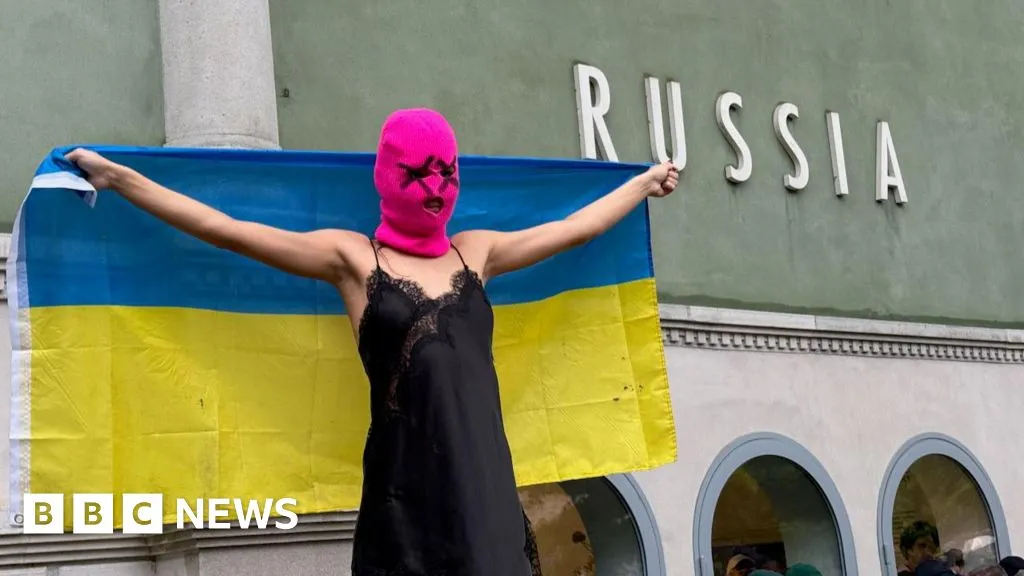
As the fuss has grown, the event's president has resisted requests for interviews. A right-wing former journalist, Pietrangelo Buttafuoco, has spoken admiringly in the past of Vladimir Putin.Today, he broke his near silence on the Biennale to accuse critics of creating a "laboratory of intolerance" and condemn what he styled as censorship and exclusion in calls for Russia and Israel to be banned."If the Biennale began to select not works but affiliations, not visions but passports, it would cease to be what it has always been: the place where the world meets," Buttafuoco announced, then left the press conference before anyone could ask questions.His argument ignores the point made by posters pasted all over Venice this week. They advertise imaginary events at an "Invisible Biennale" featuring Ukrainian artists and authors like Volodymyr Vakulenko, who was shot when Russian troops occupied his village.The posters are stamped: "Cancelled. Because the author was killed by Russia."Posters have been placed all over Venice advertising imaginary events featuring Ukrainian artists and authors who have been killed in the warThe canal-side gardens of the Biennale are home to dozens of stylish national pavilions that operate as showcases for their owners. For all countries, but especially for autocracies like Russia, the bi-annual exhibition is a prime chance to exert some soft power.In 2022, the curators at the Russian pavilion pulled out in protest at the invasion of Ukraine. Two years later, the building was loaned to Bolivia. But this time a Russian team has filled the space with an upside-down tree and experimental sound performances.
SRCBBC News - World
LANGEN
LEANCenter
WORDS258
ENT9
WED · 2026-05-06 · 21:29 GMTBRIEF NSR-2026-0506-74264
NSR-2026-0506-74264News Report·EN·Conflict
'Enjoy the show. Ignore the war': Venice Biennale faces backlash after including Russia
The Venice Biennale is facing criticism for including Russia in its exhibition, despite the ongoing war in Ukraine. Biennale President Pietrangelo Buttafuoco has defended the decision, accusing critics of intolerance and censorship, and stating the event should not select based on nationality.
BBC News - WorldFiled 2026-05-06 · 21:29 GMTLean · CenterRead · 2 min
BBC News - WorldFIG 01
Reading time
2min
Word count
258words
Sources cited
1cited
Entities identified
9entities
Quality score
100%
§ 01
Briefing Summary
AI-generatedNEWSAR · AI
The Venice Biennale is facing criticism for including Russia in its exhibition, despite the ongoing war in Ukraine. Biennale President Pietrangelo Buttafuoco has defended the decision, accusing critics of intolerance and censorship, and stating the event should not select based on nationality. This stance contrasts with "Invisible Biennale" posters appearing in Venice, highlighting Ukrainian artists killed by Russian forces. The Russian pavilion, absent in 2022, is now showcasing experimental art, a move seen as an attempt at soft power by an autocratic state. The inclusion of Russia has sparked debate about the role of art in international conflict and the potential for cultural institutions to be used for political purposes.
Confidence 0.90Sources 1Claims 4Entities 9
§ 02
Article analysis
Model · rule-basedFraming
Conflict
Diplomatic
Tone
Mixed Tone
AI-assessed
CalmNeutralAlarmist
Factuality
0.60 / 1.00
Mixed
LowHigh
Sources cited
1
Limited
FewMany
§ 03
Key claims
4 extracted01
This year, a Russian team has filled the national pavilion space with an upside-down tree and experimental sound performances.
factualarticle
Confidence
1.00
02
In 2022, the curators at the Russian pavilion pulled out of the Biennale in protest at the invasion of Ukraine.
factualarticle
Confidence
1.00
03
Posters advertising an "Invisible Biennale" with Ukrainian artists, including Volodymyr Vakulenko who was killed by Russian troops, have been pasted around Venice.
factualarticle
Confidence
1.00
04
Venice Biennale president Pietrangelo Buttafuoco accused critics of creating a "laboratory of intolerance" and condemned calls for Russia and Israel to be banned.
quotePietrangelo Buttafuoco
Confidence
1.00
§ 04
Full report
2 min read · 258 words§ 05
Entities
9 identifiedKey playerOppositionContextPositiveNeutralNegative
People3
Locations5
§ 06
Keywords & salience
8 termsvenice biennale
1.00
russia
0.90
ukraine
0.80
war
0.70
backlash
0.60
censorship
0.50
soft power
0.40
pietrangelo buttafuoco
0.40
§ 07
Topic connections
Interactive graph Network visualization showing 6 related topics
View Full Graph Person Organization Location Event|Click node to navigate|Edge numbers = shared articles