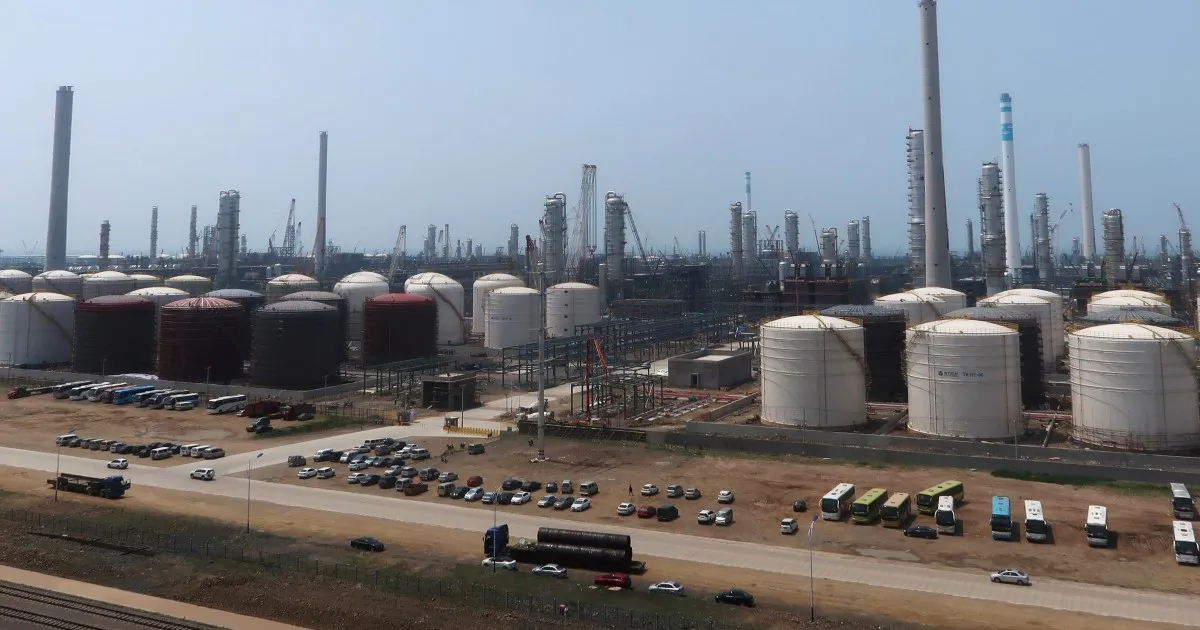
EXPLAINERBeijing’s order blocking US sanctions on five oil refineries marks first invocation of 2021 law.Hengli Petrochemical's refinery on Changxing island in Dalian, Liaoning province, China, on July 16, 2018 [Chen Aizhu/Reuters]Published On 7 May 2026China has ordered its citizens and companies not to comply with United States sanctions against five Chinese refineries accused of handling Iranian oil, deploying a law intended to counteract “extra-territorial” punitive measures for the first time.China’s Ministry of Commerce issued the “prohibition order” after the US Department of the Treasury last month announced sanctions targeting one of China’s biggest independently run “teapot” refineries.Recommended Stories list of 4 itemslist 1 of 4US pauses plan to guide ships through the Strait of Hormuzlist 2 of 4Romania’s pro-EU government ousted after no-confidence votelist 3 of 4China calls for end to Iran war and Hormuz to reopen during Araghchi visitlist 4 of 4US president Trump restarts Pope feud ahead of Rubio visit to Vaticanend of listThe move marks a significant escalation in Beijing’s efforts to counter what it views as the unjustified “long-arm jurisdiction” of US laws and regulations.Here is what we know about China’s order and its anti-sanctions regime:What does China’s order say?In its announcement on Saturday, China’s Ministry of Commerce stipulated that the US sanctions on Dalian-refinery" class="entity-link entity-organization" data-entity-id="120563" data-entity-type="organization">Hengli Petrochemical (Dalian) Refinery and four other refineries previously targeted by Washington “shall not be recognised, enforced or complied with”.The ministry said the sanctions “improperly” restricted normal trade and business activities in violation of international law, and it issued its order to safeguard China’s “national sovereignty, security, and development interests”, as well as the “lawful rights and interests of Chinese citizens”.“The Chinese government has consistently opposed unilateral sanctions that lack authorisation from the United Nations and a basis in international law,” the ministry said in a statement.The US Treasury Department imposed the latest sanctions after accusing Hengli of generating hundreds of millions of dollars in revenue for Iran’s military via crude oil purchases, calling the refinery “one of Tehran’s most valued customers”.China is Iran’s largest trade partner and by far the biggest buyer of Iranian oil.Chinese buyers received more than 80 percent of Iran’s oil shipments in 2025, according to market intelligence firm Kpler.A Chinese flag flutters at the Chinese Ministry of Commerce building in Beijing, China, on June 4, 2025 [Florence Lo/Reuters]How does China’s anti-sanctions law work?Under the law, Chinese citizens and organisations restricted from engaging in business activities by foreign legislation are required to report their circumstances to the Ministry of Commerce within 30 days.Those who fail to report their situation to the authorities face potential penalties, including warnings and fines.After determining within a 30-day review period that a business or individual has been subject to an “unjustified extra-territorial application”, the ministry can issue an order barring the party from complying with the legislation.Businesses that suffer losses due to parties’ compliance with foreign sanctions can initiate court proceedings against them for compensation, and in some cases may receive “necessary support” from the government.Beijing introduced the law in 2021 after years of tensions with US President Donald Trump’s first administration over sanctions targeting Chinese firms and technology, casting the measure as a counter to “rising unilateralism”.Naimeh Masumy, a PhD candidate at Maastricht University who has studied China’s anti-sanctions measures, said the law marked the introduction of a codified system for prosecuting its longstanding grievances against the US sanctions regime.“Before this, China mostly relied on ad hoc diplomatic protests and informal pressures,” Masumy told Al Jazeera.“By formalising this resistance into statute law, China is sending a clear signal: it views US sanctions as a systemic, long-term challenge that requires a structural legal response, rather than just reacting case-by-case.”How significant is China’s latest move?The order is noteworthy as this is the first time that Beijing has invoked its anti-sanctions measures, formally known as the “Rules on Counteracting Unjustified Extra-territorial Application of Foreign Legislation and Other Measures”.“The move signals that Beijing is taking a more assertive approach to countering sanctions,” Dominic Chiu, a China analyst at political risk adviser Eurasia Group, told Al Jazeera.“They are demonstrating a lower threshold for deploying their legal and regulatory toolkit to counter US sanctions,” Chiu said, adding that Beijing has been expanding its range of retaliatory instruments since the first Trump administration.What does this mean for companies navigating tensions between the US and China?It potentially puts them in a difficult position.Companies risk facing the wrath of Washington or Beijing, depending on which measures they comply with.Maastricht University’s Masumy said firms are likely to approach the competing pressures based on their respective levels of exposure to the US and Chinese markets.“For most companies with any significant exposure to US markets, transactions in US dollars, or relationships with American banks, the decision is relatively clear,” she said.“The consequences from the US are usually far more immediate and devastating than anything Beijing might impose.”But the calculation “shifts considerably” for companies heavily focused on China and Chinese state-owned enterprises, Masumy said.“For these entities, complying with the blocking statute becomes a more realistic expectation – and the risk of US punishment becomes the cost of doing business within China’s regulatory framework,” she said.Eurasia Group’s Chiu said he does not expect the order to have an immediate material impact as its power largely rests on whether Beijing decides to impose penalties and the affected refineries choose to sue.But China’s stance means that firms may increasingly face “binary choices between complying with US sanctions and risking Chinese countermeasures, or vice versa”, Chiu said.The US Department of the Treasury building in Washington, DC, the United States, on December 7, 2024 [Jose Luis Magana/AP]Could China’s anti-sanctions toolkit be seen as a model for other countries?Chinese state media has been eager to paint Beijing’s efforts as instructive to other countries seeking to counter US pressure.In an unsigned commentary, the state-run Global Times hailed the anti-sanctions order as a “practical example for the international community to resist unilateral bullying and oppose ‘long-arm jurisdiction'”.Masumy said the anti-sanctions law’s most significant long-term effect could be to inspire other powers such as Russia and the European Union.“A Chinese model – even an imperfect one – of codified counter-sanctions law gives these states a template and, perhaps more importantly, a degree of political legitimacy for doing the same,” she said.Chiu, however, expressed doubt that China’s model would be of much use to countries already in Washington’s crosshairs.“Most adversaries such as Iran or Russia are already cut off from the US financial system,” Chiu said.“This makes it less compelling for entities operating within their countries to comply with US sanctions,” he said.“If Russian or Iranian firms have already been severed from the dollar-clearing access, then a domestic blocking order telling them not to comply adds little practical value.”
SRCAl Jazeera
LANGEN
LEANCenter
WORDS1 114
ENT10
THU · 2026-05-07 · 09:50 GMTBRIEF NSR-2026-0507-74364
NSR-2026-0507-74364News Report·EN·Political Strategy
What is China’s anti-sanctions law and how does it work?
China has invoked its 2021 anti-sanctions law for the first time, ordering its citizens and companies not to comply with recent US sanctions against five Chinese oil refineries. The Ministry of Commerce issued a "prohibition order" after the US Treasury sanctioned Hengli Petrochemical and four other refineries for allegedly handling Iranian oil.
John PowerAl JazeeraFiled 2026-05-07 · 09:50 GMTLean · CenterRead · 5 min
Al JazeeraFIG 01
Reading time
5min
Word count
1 114words
Sources cited
3cited
Entities identified
10entities
Quality score
100%
§ 01
Briefing Summary
AI-generatedNEWSAR · AI
China has invoked its 2021 anti-sanctions law for the first time, ordering its citizens and companies not to comply with recent US sanctions against five Chinese oil refineries. The Ministry of Commerce issued a "prohibition order" after the US Treasury sanctioned Hengli Petrochemical and four other refineries for allegedly handling Iranian oil. Beijing stated the US sanctions violate international law and infringe upon China's national interests. This action signifies China's opposition to what it perceives as the US's "long-arm jurisdiction" and its efforts to protect its trade relationships, particularly with Iran, its largest trade partner and a major oil buyer.
Confidence 0.90Sources 3Claims 5Entities 10
§ 02
Article analysis
Model · rule-basedFraming
Political Strategy
Legal & Judicial
Tone
Measured
AI-assessed
CalmNeutralAlarmist
Factuality
0.70 / 1.00
Factual
LowHigh
Sources cited
3
Well sourced
FewMany
§ 03
Key claims
5 extracted01
The Chinese government has consistently opposed unilateral sanctions that lack authorisation from the United Nations and a basis in international law.
quoteChina's Ministry of Commerce
Confidence
1.00
02
China’s anti-sanctions law requires Chinese citizens and organisations restricted by foreign legislation to report their circumstances to the Ministry of Commerce.
factual
Confidence
1.00
03
The US Treasury Department imposed sanctions accusing Hengli Petrochemical of generating hundreds of millions of dollars in revenue for Iran’s military via crude oil purchases.
factualUS Treasury Department
Confidence
1.00
04
China has ordered its citizens and companies not to comply with United States sanctions against five Chinese refineries accused of handling Iranian oil.
factualChina's Ministry of Commerce
Confidence
1.00
05
Chinese buyers received more than 80 percent of Iran’s oil shipments in 2025.
statisticKpler
Confidence
0.90
§ 04
Full report
5 min read · 1 114 words§ 05
Entities
10 identifiedKey playerOppositionContextPositiveNeutralNegative
Organizations4
§ 06
Keywords & salience
10 termsanti-sanctions law
1.00
us sanctions
0.90
china
0.90
extraterritorial measures
0.80
refineries
0.70
iranian oil
0.60
national sovereignty
0.50
international law
0.50
ministry of commerce
0.40
us treasury department
0.40
§ 07
Topic connections
Interactive graph Network visualization showing 51 related topics
View Full Graph Person Organization Location Event|Click node to navigate|Edge numbers = shared articles