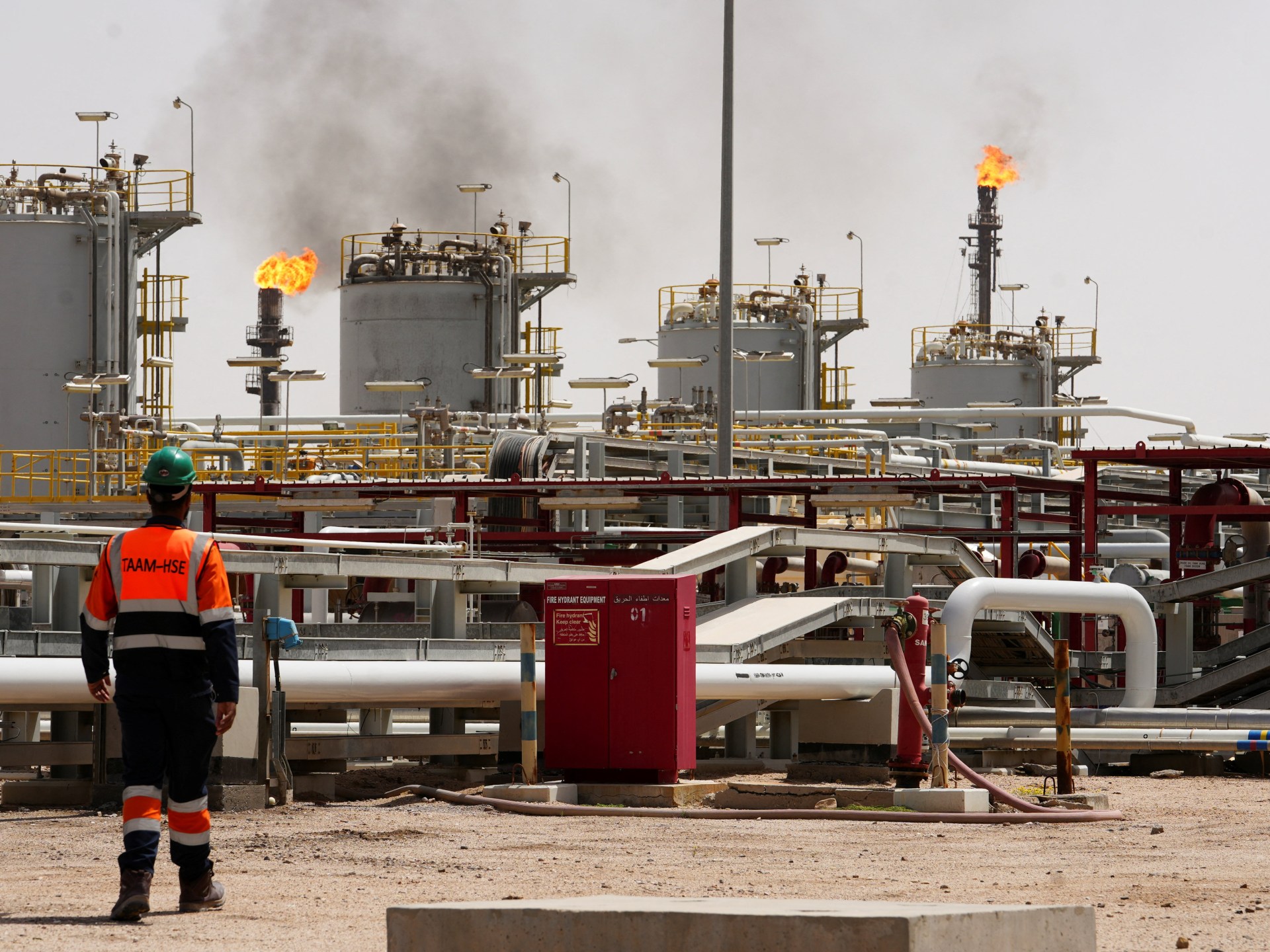
EXPLAINERThe US accuses Ali Maarij al-Bahadly of helping Iran avoid sanctions and export its oil through Iraq.The US accuses Iraqi oil officials of helping Iran avoid sanctions through corrupt methods [Mohammed Aty/Reuters]Published On 7 May 2026The US Treasury has sanctioned Iraq’s Deputy Oil Minister, Ali Maarij al-Bahadly, and leaders of pro-Iran militias, accusing them of helping Iran to sell oil in violation of US sanctions.“Like a rogue gang, the Iranian regime is pillaging resources that rightfully belong to the Iraqi people,” said US Treasury Secretary Scott Bessent. “Treasury will not stand idly by as Iran’s military exploits Iraqi oil to fund terrorism against the United States and our partners.”Recommended Stories list of 3 itemslist 1 of 3US pushing Israeli de-escalation ahead of new talks: Lebanese officiallist 2 of 3Iran’s President Pezeshkian seeks to quash divided leadership narrativelist 3 of 3Photos: War on Iran leaves Jordan’s Petra nearly empty of touristsend of listNeither Iraq nor Iran has responded.Thursday’s sanctions also come as the US and Iran battle over control of the Strait of Hormuz, the vital conduit for oil exports from the Gulf region.Iraq has come under pressure from the US in recent months over accusations that it is too close to neighbouring Iran. President Donald Trump warned earlier this year that Washington would stop support for Iraq – if pro-Iran Nouri al-Maliki became Iraq’s prime minister. He later dropped out of the running.Let’s take a closer look.Who has the US sanctioned?Al-Bahadly is the most prominent figure to be sanctioned by the US on Thursday. He has overseen Iraqi oil governance for years, first as head of the Iraqi parliament’s oil and gas committee. The US Treasury says he later held roles in the oil ministry, including head of the licensing and contracts office, acting minister and deputy leader of the ministry, which has been his current position since 2024.Also sanctioned were Mustafa Hashim Lazim al-Behadili, described as a “leader and economic official” for the Iran-backed Asa’ib Ahl al-Haq movement, as well as Ahmed Khudair Maksus Maksus and Mohammed Issa Kadhim al-Shuwaili, both referred to as senior officials within the pro-Iran Kata’ib Sayyid al-Shuhada.The US Treasury alleged that al-Behadili “controlled oil smuggling financing” and dealt directly with Iran and the Islamic Revolutionary Guard Corps’ Quds Force, with whom he negotiated contracts to ship oil from Iran. Maksus and al-Shuwaili were accused of being involved in illicit weapons purchases.None has commented on the allegations.Does Iran use Iraq to avoid sanctions?That is the US Treasury’s argument. In its designation, the Treasury says that al-Bahadly was “instrumental in facilitating the diversion of Iraqi oil products” to benefit an Iran-affiliated oil smuggler and Asa’ib Ahl al-Haq. The smuggler, according to Washington, labelled Iranian oil as Iraqi to enable Tehran to avoid sanctions.The US also says that corrupt practices in the Iraqi government allowed for the smuggling operation to continue, placing al-Bahadly at the heart of the operation.Iraq’s Oil Minister, Hayan Abdel-Ghani, said last March that Iranian oil tankers had used forged Iraqi documents while attempting to avoid US sanctions.Experts speaking to the Reuters news agency in December 2024 said that Iran is believed to generate at least $1bn a year from an oil smuggling network that diverts Iranian fuel from Iraqi asphalt plants, and then blends it with Iraqi oil before exporting it as purely Iraqi. Reuters also said that Iran obtains hard currency from Iraq through its exports to the country, thereby avoiding US sanctions on its banking system.What are the US sanctions on Iran’s oil?The Trump administration describes its sanctions on Iran as part of a “maximum pressure” campaign to bend the Iranian government to its will.Trump imposed oil sanctions on Iran in 2018 during his first presidential term, after he withdrew from the nuclear deal with Tehran. The sanctions prevented Iran from freely selling its oil on global markets, although the US allowed some countries to make limited purchases.While the Biden administration largely kept the sanctions in place, Trump further increased them in his second term, particularly in the run-up to the US-Israeli war on Iran.Oil is a major resource for Iran, which is one of the world’s largest producers, accounting for about 80 percent of Iranian exports. Oil revenues account for approximately a quarter of the state budget.What are the ties between Iraq and Iran?Iraq and Iran are close allies, particularly under the pro-Iranian Coordination Framework bloc that governs Baghdad. The framework represents Iraq’s Shia population, sharing religious ties with Iran’s leadership.Many of Iraq’s current leaders have lived in Iran, particularly before 2003 and the overthrow of Iraq’s former leader, Saddam Hussein in the US-led invasion. That allowed Iran to expand its power in Iraq through the funding of pro-Iran Shia militia groups, many with political wings now.Those pro-Iran groups have integrated themselves into key sectors of the economy, including oil, allowing Iran to utilise their control to create a shadow economy that can also fund pro-Iranian groups across the wider Middle East region.But Iraq has a tough balancing act. While its ties to Iran are rooted in geography and ideology, Iraqi leaders are also careful not to upset the US, which provides vital military and economic support. Trump has already leveraged that to ensure that al-Maliki did not return as Iraqi prime minister, and has backed the new Iraqi Prime Minister-designate, Ali al-Zaidi.
SRCAl Jazeera
LANGEN
LEANCenter
WORDS883
ENT12
THU · 2026-05-07 · 17:36 GMTBRIEF NSR-2026-0507-74469
NSR-2026-0507-74469News Report·EN·Diplomatic
Why has the US sanctioned Iraq’s deputy oil minister for helping Iran?
The US Treasury has sanctioned Iraq's Deputy Oil Minister, Ali Maarij al-Bahadly, and leaders of pro-Iran militias, accusing them of facilitating Iran's oil exports in violation of US sanctions. The US alleges that al-Bahadly, who has held various senior positions in Iraq's oil sector, helped Iran circumvent sanctions through corrupt methods.
Abubakr Al-ShamahiAl JazeeraFiled 2026-05-07 · 17:36 GMTLean · CenterRead · 4 min
Al JazeeraFIG 01
Reading time
4min
Word count
883words
Sources cited
2cited
Entities identified
12entities
Quality score
100%
§ 01
Briefing Summary
AI-generatedNEWSAR · AI
The US Treasury has sanctioned Iraq's Deputy Oil Minister, Ali Maarij al-Bahadly, and leaders of pro-Iran militias, accusing them of facilitating Iran's oil exports in violation of US sanctions. The US alleges that al-Bahadly, who has held various senior positions in Iraq's oil sector, helped Iran circumvent sanctions through corrupt methods. Also sanctioned were leaders of the Asa’ib Ahl al-Haq and Kata’ib Sayyid al-Shuhada movements, accused of controlling oil smuggling and negotiating directly with Iran's Islamic Revolutionary Guard Corps. These sanctions were announced on May 7, 2026, amidst ongoing tensions between the US and Iran over the Strait of Hormuz and US pressure on Iraq regarding its ties with Iran. Neither Iraq nor Iran has yet responded to the accusations.
Confidence 0.90Sources 2Claims 5Entities 12
§ 02
Article analysis
Model · rule-basedFraming
Diplomatic
Political Strategy
Tone
Mixed Tone
AI-assessed
CalmNeutralAlarmist
Factuality
0.80 / 1.00
Factual
LowHigh
Sources cited
2
Limited
FewMany
§ 03
Key claims
5 extracted01
The US Treasury alleged that al-Behadili controlled oil smuggling financing and dealt directly with Iran and the Islamic Revolutionary Guard Corps’ Quds Force.
factualUS Treasury
Confidence
1.00
02
Treasury will not stand idly by as Iran’s military exploits Iraqi oil to fund terrorism against the United States and our partners.
quoteUS Treasury Secretary Scott Bessent
Confidence
1.00
03
The Iranian regime is pillaging resources that rightfully belong to the Iraqi people.
quoteUS Treasury Secretary Scott Bessent
Confidence
1.00
04
US accuses al-Bahadly of helping Iran avoid sanctions and export its oil through Iraq.
factualUS Treasury
Confidence
1.00
05
The US Treasury has sanctioned Iraq’s Deputy Oil Minister, Ali Maarij al-Bahadly, and leaders of pro-Iran militias.
factualUS Treasury
Confidence
1.00
§ 04
Full report
4 min read · 883 words§ 05
Entities
12 identifiedKey playerOppositionContext
I
Iraq location · Context
100
I
Iran location · Opposition
100
AM
Ali Maarij al-Bahadly person · Opposition
100
US
United States location · Key Player
100
MH
Mustafa Hashim Lazim al-Behadili person · Opposition
80
AA
Asa'ib Ahl al-Haq organization · Opposition
70
MI
Mohammed Issa Kadhim al-Shuwaili person · Opposition
70
AK
Ahmed Khudair Maksus Maksus person · Opposition
70
KS
Kata'ib Sayyid al-Shuhada organization · Opposition
70
IR
Islamic Revolutionary Guard Corps’ Quds Force organization · Opposition
60
SO
Strait of Hormuz location · Context
50
SB
Scott Bessent person · Key Player
50
§ 06
Keywords & salience
8 termsus sanctions
1.00
iran oil exports
0.90
iraq oil governance
0.80
pro-iran militias
0.70
strait of hormuz
0.60
us treasury
0.50
islamic revolutionary guard corps
0.50
oil smuggling
0.40
§ 07
Topic connections
Interactive graph Network visualization showing 51 related topics
View Full Graph Person Organization Location Event|Click node to navigate|Edge numbers = shared articles