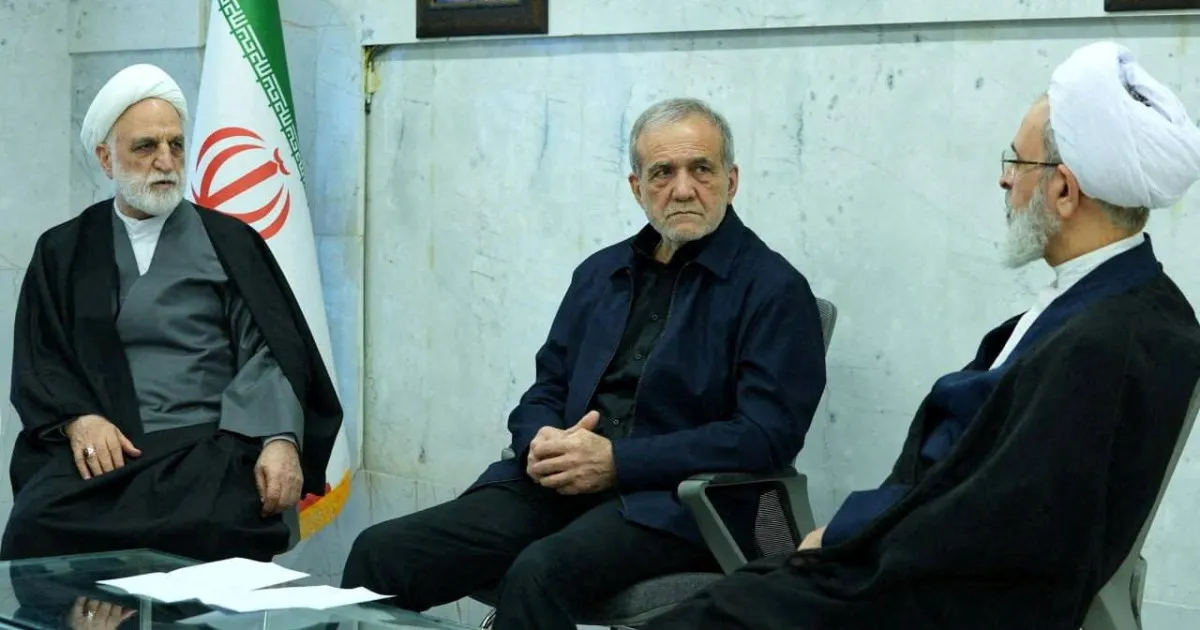
Tehran emphasises solidarity among top officials as Washington pressures Iran during ongoing Strait of Hormuz disputes.Iranian President Masoud Pezeshkian (centre) meets officials on March 1, 2026. [IRIB/WANA (West Asia News Agency)/handout via Reuters]Published On 7 May 2026Tehran, Iran – A meeting between two of Iran’s leaders may seem routine, but President Masoud Pezeshkian’s announcement that he had a positive discussion with Supreme Leader Mojtaba Khamenei, is an attempt to push back against efforts from the United States to portray the Islamic Republic’s leadership as divided.Pezeshkian’s announcement on Thursday appears to mark the first time the president has been able to get an audience with Khamenei since the latter’s selection two months ago for Iran’s most powerful position.Recommended Stories list of 3 itemslist 1 of 3Photos: War on Iran leaves Jordan’s Petra nearly empty of touristslist 2 of 3Somali pirates abandon hijacked UAE dhow due to dwindling supplieslist 3 of 3Why is the US seeking UN help to open Hormuz after undermining it?end of listHe did not specify when the two-and-a-half-hour meeting was, but said Khamenei facilitated an atmosphere of “trust, calm, solidarity, and direct, unmediated dialogue”, according to state media.Since the killing of Ayatollah Ali Khamenei and other leaders at the start of the war on February 28, US President Donald Trump and others have pushed the notion that military, security and political authorities in Tehran are divided.“The time has come for Iran to make the sensible choice,” US Secretary of State Marco Rubio told reporters at the White House on Monday after Washington offered a new proposal to reach an understanding with Iran. “It’s not easy for them to do that, because they have a fracture in their own leadership system. Apart from that, the top people in that government are, to say the least, insane in the brain”.Iran International, an anti-Islamic Republic London-based news network, this week cited unnamed sources as saying Pezeshkian was angered by military operations ordered by Ahmad Vahidi, Ali Abdollahi and other commanders of the Islamic Revolutionary Guard Corps (IRGC), and had considered resigning before demanding direct access to the supreme leader, who is recovering from injuries sustained in the attack that killed his father.But the president’s chief of staff and his deputy for communications gave separate interviews to the state-linked ISNA news agency, saying Pezeshkian and IRGC commanders make decisions in joint meetings, and that claims of resignations and rifts are “fake news”.IRGC at the topThe IRGC and the security apparatus linked to it have entrenched their central role in Iran’s strategic decision-making, particularly concerning the Strait of Hormuz, experts told Al Jazeera.“I think the military and security camp around Mojtaba Khamenei currently has enormous influence, arguably more than at any point in years because the war elevated the importance of coercive power, deterrence, and wartime cohesion,” said Sina Toossi, a senior non-resident fellow at the Washington-based Center for International Policy.The analyst said the Supreme National Security Council formally remains a top institution, but in practice, decision-making likely flows through smaller connections linked to the office of the supreme leader, senior IRGC figures, and trusted officials, such as security chief Mohammad Bagher Zolghadr.“At this stage, it is difficult to imagine any meaningful arrangement on the strait proceeding without their blessing,” Toossi said. “Hormuz is increasingly viewed not simply as an economic chokepoint but as one of Iran’s core strategic deterrents, especially after the war demonstrated that Iran could still threaten shipping and energy flows, despite weeks of intense US and Israeli bombardment”.Saeed Leylaz, a pro-establishment political and economic analyst based in Tehran, said he believes that while opinions may vary among some figures within the Islamic Republic’s leadership, they have all rallied around the flag of the new supreme leader.Leylaz said Iranian authorities agree on the necessity to maintain control over Hormuz, as long as the US naval blockade of Iran’s ports remains, ramping up the pressure on Iranian households.“But the Americans do not want to give any concessions. They started the naval blockade immediately after the ceasefire. Then they said we want to open the strait and then backed away,” he told Al Jazeera.“All of this signals to the Islamic Republic that if it gives up control of the strait without a strong geopolitical agreement, it would not be able to return and therefore it will lose.”‘Surrender’Iranian authorities have continued to engage in diplomatic messaging with Washington through intermediaries while expressing distrust towards the other side.Pezeshkian and others have stressed that they cannot agree to a deal that amounts to capitulation, despite threats of mass bombardment of Iran’s energy infrastructure.Foreign Minister Abbas Araghchi travelled to China this week, and has also remained in close contact with Russia.“Our Chinese friends believe that Iran after the war is different from Iran before the war,” the diplomat said after his meetings, adding that Iran’s “international position has improved, and it has proven its capabilities and power”.But Trump and Israeli Prime Minister Benjamin Netanyahu continue to make some of the same demands made before the start of the war, including a full halt to uranium enrichment on Iranian soil, as well as extraction of its buried highly-enriched uranium.Leylaz, the Tehran-based analyst, said Iran may make temporary compromises on its nuclear programme, but will not fully give up enrichment.He said that while the blockade is hurting Iran, it is also negatively impacting regional US allies like Bahrain, the United Arab Emirates, Qatar and Kuwait. He argued that they have a lower pain threshold than Iran, which has been subject to years of sanctions from the US and United Nations.Washington-based Toossi said a more securitised Iranian state in the future may be less invested in broad rapprochement with the US and more focused on deterrence, strategic self-sufficiency and deepening ties with non-Western powers.“At the same time, the system still appears interested in avoiding full-scale war if it can secure recognition of its core interests and avoid economic strangulation. So, I think the most likely path is prolonged managed confrontation, mixed with intermittent diplomacy rather than either full normalisation or immediate all-out war,” he said.
SRCAl Jazeera
LANGEN
LEANCenter
WORDS1 006
ENT12
THU · 2026-05-07 · 15:58 GMTBRIEF NSR-2026-0507-74476
NSR-2026-0507-74476News Report·EN·Political Strategy
Iran’s President Pezeshkian seeks to quash divided leadership narrative
Iranian President Masoud Pezeshkian has publicly emphasized solidarity within the country's leadership following a meeting with Supreme Leader Mojtaba Khamenei. This announcement comes amidst US efforts to portray Iran's leadership as divided, particularly during ongoing disputes in the Strait of Hormuz.
Maziar MotamediAl JazeeraFiled 2026-05-07 · 15:58 GMTLean · CenterRead · 5 min
Al JazeeraFIG 01
Reading time
5min
Word count
1 006words
Sources cited
5cited
Entities identified
12entities
Quality score
100%
§ 01
Briefing Summary
AI-generatedNEWSAR · AI
Iranian President Masoud Pezeshkian has publicly emphasized solidarity within the country's leadership following a meeting with Supreme Leader Mojtaba Khamenei. This announcement comes amidst US efforts to portray Iran's leadership as divided, particularly during ongoing disputes in the Strait of Hormuz. Pezeshkian stated the meeting fostered trust and dialogue, countering US claims of internal fractures. The US, referencing the recent deaths of top Iranian officials, has suggested Iran's leadership is "insane" and fractured. Reports from an anti-Islamic Republic news network suggested presidential anger over military operations and a desire for direct access to the Supreme Leader, though Iranian officials have denied these claims, asserting unity between the president and the IRGC.
Confidence 0.90Sources 5Claims 5Entities 12
§ 02
Article analysis
Model · rule-basedFraming
Political Strategy
Conflict
Tone
Mixed Tone
AI-assessed
CalmNeutralAlarmist
Factuality
0.60 / 1.00
Mixed
LowHigh
Sources cited
5
Well sourced
FewMany
§ 03
Key claims
5 extracted01
US Secretary of State Marco Rubio stated that Iran's leadership system is fractured and top people are 'insane in the brain'.
quoteUS Secretary of State Marco Rubio
Confidence
0.90
02
Iranian President Masoud Pezeshkian announced a positive discussion with Supreme Leader Mojtaba Khamenei.
quotePresident Masoud Pezeshkian
Confidence
0.90
03
The president’s chief of staff and deputy for communications stated that claims of resignations and rifts are 'fake news'.
quotePresident's chief of staff and deputy for communications
Confidence
0.80
04
US President Donald Trump and others have pushed the notion that military, security, and political authorities in Tehran are divided.
factualArticle
Confidence
0.80
05
Iran International cited unnamed sources claiming Pezeshkian was angered by IRGC military operations and considered resigning.
factualIran International (unnamed sources)
Confidence
0.70
§ 04
Full report
5 min read · 1 006 words§ 05
Entities
12 identifiedKey playerOppositionContextPositiveNeutralNegative
People7
Organizations1
Locations3
§ 06
Keywords & salience
10 termsdivided leadership narrative
1.00
strait of hormuz disputes
0.90
iran's leadership
0.80
supreme leader mojtaba khamenei
0.70
president masoud pezeshkian
0.70
us pressure
0.60
war on iran
0.50
islamic revolutionary guard corps
0.50
solidarity
0.40
direct dialogue
0.40
§ 07
Topic connections
Interactive graph Network visualization showing 51 related topics
View Full Graph Person Organization Location Event|Click node to navigate|Edge numbers = shared articles