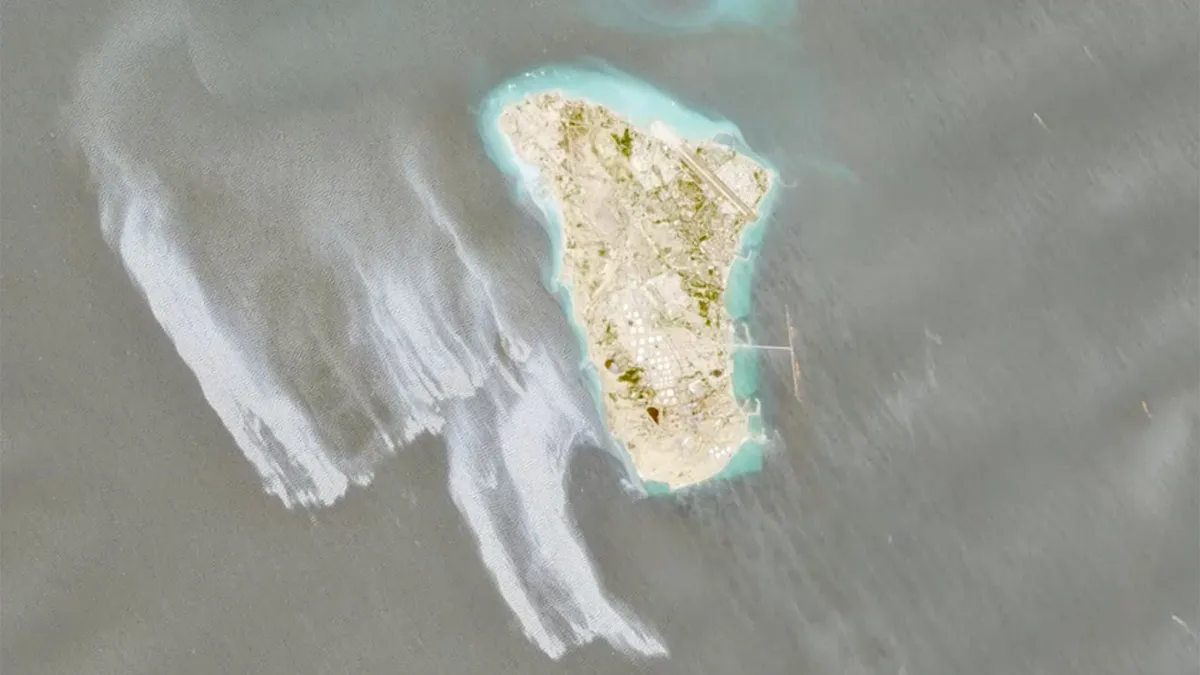
close Video US and Iran trade fire in Strait of Hormuz as tensions escalate with ongoing blockade Bill Hemmer and Dana Perino lead coverage on escalating U.S.-Iran tensions in the Strait of Hormuz, with new U.S. airstrikes against tankers trying to breach Iran's blockade. President Trump dismissed previous Iranian attacks as a "love tap" while Secretary of State Marco Rubio affirmed strong U.S. retaliation for threats against Americans. Michael Allen, former NSC senior director, highlighted the U.S. economic stranglehold, noting over 70 tankers were blocked. NEWYou can now listen to Fox News articles! Hören Sie sich diesen Artikel an 5 Min Satellite imagery revealed a massive suspected oil slick spreading near Kharg Island, Iran’s main oil export terminal, in what experts say could be evidence that Tehran’s oil infrastructure is buckling under mounting U.S. pressure. The slick, seen in Copernicus Sentinel satellite images between Wednesday and Friday, covered roughly 45 square kilometers west of the island, according to analysts cited by Reuters. The incident is emerging as a potential sign that Trump’s maritime pressure campaign is achieving one of its central objectives: overwhelming Iran’s export system to the point where Tehran can no longer move or store crude fast enough to sustain normal production. US ECONOMIC CHOKEHOLD ON Iran REACHES PEAK LEVERAGE AS COLLAPSE RISKS EMERGE The suspected spill near Iran’s main oil hub is raising concerns that mounting U.S. pressure is overwhelming Tehran’s ability to store or export crude, potentially forcing risky workarounds with environmental consequences in the Gulf. The slick, seen in Copernicus Sentinel satellite images between Wednesday and Friday, covered roughly 45 square kilometers west of the island, according to analysts cited by Reuters. (Reuters) "At this stage I see two plausible explanations, and they’re not mutually exclusive," Miad Maleki, an Iran sanctions and energy expert at the Foundation for Defense of Democracies, told Fox News Digital. "One is operational: they simply didn’t ramp down extraction fast enough relative to their true onshore capacity and over-counted on empty tankers slipping through the blockade," he said. "Now they’ve effectively over-delivered crude into the export system, with more oil at or near the terminals than they can actually load, and the ‘solution’ is to push some of that excess into the water." Maleki said another possible explanation is mechanical failure tied to Iran’s use of aging tankers as floating storage or sanctions-busting carriers. TRUMP CLAIMS Iran 'STARVING FOR CASH,' 'COLLAPSING FINANCIALLY' AFTER EXTENDING CEASEFIRE A suspected oil spill covering dozens of square kilometers of sea near Iran's main oil hub of Kharg Island has been seen on satellite imagery this week. (European Union/Copernicus Sentinel-2 via Reuters) "They’ve dragged older, marginal tonnage into service as floating storage or sanctions-busting carriers, and some of those retired or poorly maintained hulls are now leaking," he said. "Either way, the common denominator is the same — storage and evacuation capacity are out of sync with upstream output, and the Gulf is paying the price for that mismatch." The incident comes as the Trump administration continues pressing its "Economic Fury" campaign against Iran, combining sanctions enforcement with a growing U.S. naval presence around the Strait of Hormuz aimed at restricting Iran’s oil exports. Before the conflict, Iran exported roughly 1.5 million barrels of oil per day, much of it to China. Analysts say the blockade and the threat of sanctions on shipping companies and financial institutions have made it increasingly difficult for Tehran to move crude out of Kharg Island. Reuters reported the slick appeared as a "grey and white" plume west of the 8-kilometer-long island. Leon Moreland, a researcher at the Conflict and Environment Observatory, told Reuters the slick was "visually consistent with oil," while Louis Goddard, co-founder of consultancy Data Desk, said it could be the largest spill since the start of the U.S.-Israel war against Iran roughly 70 days ago. Kharg Island handles roughly 90% of Iran’s oil exports and has become a critical choke point in the Trump administration’s effort to cut off the regime’s main source of revenue during the ongoing war. Energy analysts say Iran is now facing a dangerous dilemma. If Iran cannot export oil or find additional storage capacity, it may be forced either to shut down wells, risking long-term damage to oil fields, or dispose of excess crude in ways that could trigger environmental fallout across the Gulf. US STRIKE ON KEY Iran OIL HUB WOULD FIT TRUMP'S 'ENERGY DOMINANCE DOCTRINE,' SAYS EXPERT A cargo ship sails in the Persian Gulf toward the Strait of Hormuz on April 22, 2026. (AP Photo) "They’ve already reduced extraction. In a true blockade scenario, the constraint isn’t production at the wellhead, it’s the inability to load tankers at export terminals," Maleki said. "Once onshore storage nears capacity, output has to be cut to match remaining headroom or wells get shut in," he added. "In Iran’s case, that’s roughly 13 days." The environmental implications are also raising alarm across the Gulf. Windward, a maritime risk intelligence firm, estimated the slick was moving southeast at roughly 2 kilometers per hour and warned it could reach Qatar’s exclusive economic zone within days and potentially drift toward the United Arab Emirates within two weeks. The Gulf’s desalination infrastructure, relied upon by millions across the region, remains especially vulnerable to major oil contamination events. The spill also is unfolding amid heightened military tensions in the Gulf. The war has trapped hundreds of vessels in the region and caused one of the largest disruptions to global crude and liquefied natural gas supplies in recent years. An oil tanker is seen near the terminal at Kharg Island, Iran, as U.S. officials and analysts consider whether seizing the island could significantly impact Iran's oil exports. (Ali Mohammadi/Bloomberg via Getty Images) Iranian authorities have not publicly commented on the suspected spill or its possible causes. Fox News Digital reached out to the Iran mission to the U.N. for comment. Efrat Lachter is a foreign correspondent for Fox News Digital covering international affairs and the United Nations. Follow her on X @efratlachter. Stories can be sent to efrat.lachter@fox.com. Fox News' Antisemitism Exposed" newsletter brings you stories on the rising anti-Jewish prejudice across the U.S. and the world." By entering your email and clicking the Subscribe button, you agree to the Fox News and Terms of Use, and agree to receive content and promotional communications from Fox News. You understand that you can opt-out at any time. You've successfully subscribed to this newsletter!
SRCFox News - World
LANGEN
LEANCenter-Right
WORDS1 074
ENT12
FRI · 2026-05-08 · 19:42 GMTBRIEF NSR-2026-0508-74776
NSR-2026-0508-74776News Report·EN·Economic Impact
Trump blockade squeezing Iran so hard regime may be dumping oil into Gulf, experts say
Satellite imagery shows a large suspected oil slick near Kharg Island, Iran's primary oil export terminal, raising concerns that Iran's oil infrastructure is struggling under U.S. sanctions.
Fox News - WorldFiled 2026-05-08 · 19:42 GMTLean · Center-RightRead · 5 min
Fox News - WorldFIG 01
Reading time
5min
Word count
1 074words
Sources cited
3cited
Entities identified
12entities
Quality score
100%
§ 01
Briefing Summary
AI-generatedNEWSAR · AI
Satellite imagery shows a large suspected oil slick near Kharg Island, Iran's primary oil export terminal, raising concerns that Iran's oil infrastructure is struggling under U.S. sanctions. Experts suggest this could indicate Iran is unable to export or store crude oil quickly enough due to the U.S. blockade, potentially leading to the dumping of excess oil into the Gulf. This situation, observed between Wednesday and Friday, covers approximately 45 square kilometers. Analysts propose two possible explanations: either Iran overproduced oil relative to its export capacity and is now unable to manage the surplus, or mechanical failure is a contributing factor. The U.S. has implemented economic pressure, reportedly blocking over 70 tankers.
Confidence 0.90Sources 3Claims 5Entities 12
§ 02
Article analysis
Model · rule-basedFraming
Economic Impact
Environmental
Tone
Mixed Tone
AI-assessed
CalmNeutralAlarmist
Factuality
0.70 / 1.00
Factual
LowHigh
Sources cited
3
Well sourced
FewMany
§ 03
Key claims
5 extracted01
Trump claims Iran is 'starving for cash' and 'collapsing financially'.
quoteTrump
Confidence
0.90
02
Two plausible explanations for the spill are operational over-delivery of crude or mechanical failure of aging tankers used for storage.
quoteMiad Maleki, Iran sanctions and energy expert
Confidence
0.90
03
Satellite imagery revealed a massive suspected oil slick spreading near Kharg Island, Iran’s main oil export terminal.
factualCopernicus Sentinel satellite images
Confidence
0.90
04
The U.S. economic stranglehold has blocked over 70 tankers.
statisticMichael Allen, former NSC senior director
Confidence
0.80
05
Experts suggest the oil slick could be evidence that Tehran’s oil infrastructure is buckling under mounting U.S. pressure.
predictionexperts
Confidence
0.70
§ 04
Full report
5 min read · 1 074 words§ 05
Entities
12 identifiedKey playerOppositionContextPositiveNeutralNegative
People4
Organizations4
§ 06
Keywords & salience
10 termsiran oil exports
1.00
us economic blockade
1.00
oil slick
0.90
strait of hormuz
0.80
us pressure
0.80
export system
0.70
tanker blockade
0.60
kharg island
0.50
trump administration
0.40
environmental consequences
0.40
§ 07
Topic connections
Interactive graph Network visualization showing 51 related topics
View Full Graph Person Organization Location Event|Click node to navigate|Edge numbers = shared articles